

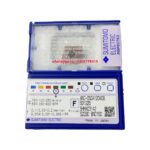
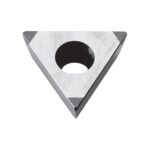
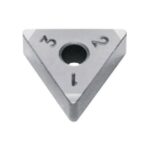
Why Hardened Steel Turning Demands a Different Approach
Turning steel in the 45–65 HRC range is one of the most demanding operations in metalcutting. Unlike soft steel machining, where material flows cleanly across the rake face, hardened steel generates intense cutting forces, high localized temperatures, and rapid abrasive wear on the insert edge. A single wrong parameter decision — cutting speed too high, feed too heavy, or poor workholding rigidity — can destroy an edge in seconds, producing a scrapped part and an expensive tool replacement.
The goal of this guide is to give you a repeatable starting point: grade selection, geometry, cutting parameters, rigidity setup, and coolant strategy, all backed by practical shop-floor data. We will also compare how leading tool suppliers (Sandvik, Iscar, Walter, Kyocera, and Mitsubishi) approach the same problem so you can translate the principles to the catalogue you already use.
Material Classification: Not All “Hardened Steel” Is the Same
Before selecting an insert, classify the workpiece by hardness and microstructure. The ISO H group covers hardened materials above 45 HRC, but the right tooling changes dramatically between 45 HRC and 65 HRC.
| Hardness Range | Typical Materials | Primary Insert Type | Recommended Vc Range |
|---|---|---|---|
| 45–52 HRC | 4140 HT, 4340 HT, low-alloy steel | Coated carbide / CBN | 80–180 m/min |
| 52–58 HRC | Tool steel H13, D2, A2 hardened | CBN / mixed-ceramic | 120–250 m/min |
| 58–65 HRC | Bearing steel 100Cr6, case-hardened 20MnCr5 | PCBN / CBN tipped | 150–300 m/min |
Bear in mind that the same nominal HRC can behave differently depending on prior heat treatment. A fully martensitic structure cuts more cleanly but wears tools faster than a tempered structure with residual austenite.
Insert Grade Selection: CBN, Ceramic, or Carbide?
1. Polycrystalline Cubic Boron Nitride (PCBN / CBN)
CBN is the first choice for continuous and lightly interrupted cuts above 50 HRC. Its hardness (second only to diamond) and thermal stability above 1000 °C keep the edge sharp even at the high surface speeds hardened steel requires.
- Low CBN content (40–65%) with ceramic binder: best for finishing and continuous cuts, excellent surface finish, lower impact resistance.
- High CBN content (85–95%) with metallic binder: higher toughness for interrupted cuts, but slightly shorter life in pure finishing.
- WBN / whisker-reinforced grades: niche solution for heavy interrupted cuts and scale.
For most automotive and die-and-mould work, a 50–65% CBN content grade with a 0.1–0.2 mm hone or T-land will deliver the best balance of life and finish.
2. Ceramic Inserts (Alumina-Based and SiAlON)
Ceramic inserts run at higher speeds than CBN but are more notch-sensitive and less forgiving of interruption. They are economical for roughing hardened steel where the part geometry is simple and the cut is continuous.
- Al2O3 + TiC (black ceramic): good for steel up to 62 HRC at Vc 200–400 m/min.
- SiAlON: better thermal shock resistance, preferred for interrupted cuts and high-temperature alloys.
- Whisker-reinforced (Al2O3 + SiCw): highest toughness among ceramics, good for scale and interrupted cuts.
3. Coated Carbide (When to Use It)
Modern (Ti,Al)N / AlCrN-coated micrograin carbide grades can handle 45–55 HRC at moderate speeds, especially where CBN cost is hard to justify. Use them for roughing and semi-finishing, then switch to CBN for finishing passes.
Key rule: Never run carbide at CBN speeds. Carbide above 50 HRC should stay below 120 m/min in continuous cuts.
Cutting Parameters Reference Table
The table below gives starting values for continuous longitudinal turning of hardened steel. Always reduce Vc by 20–30% for interrupted cuts and by 15% for long overhangs.
| Insert Type | HRC | Vc (m/min) | f (mm/rev) | ap (mm) | Coolant |
|---|---|---|---|---|---|
| CBN 60% (finishing) | 58–65 | 150–250 | 0.05–0.12 | 0.05–0.25 | Dry or MQL |
| CBN 85% (interrupted) | 50–62 | 120–180 | 0.10–0.20 | 0.20–0.80 | Dry |
| Alumina ceramic | 50–62 | 200–400 | 0.10–0.25 | 0.50–2.00 | Dry (no flood) |
| SiAlON ceramic | 45–58 | 250–500 | 0.10–0.30 | 0.50–2.50 | Dry |
| Coated carbide (P20/P25) | 45–52 | 60–120 | 0.12–0.25 | 0.50–2.00 | Flood or MQL |
Depth-of-cut note: For finishing with CBN, keep ap below 0.3 mm. Running CBN at heavier ap than recommended causes thermal cracks at the depth-of-cut line and catastrophic edge failure.
Tool Geometry and Edge Preparation
Edge preparation is the single most underrated variable in hardened steel turning. A sharp honed edge will micro-chatter and wear instantly; an over-honed edge increases cutting force and part distortion.
- Hone size: 0.02–0.05 mm for finishing CBN, 0.05–0.12 mm for roughing/interrupted.
- T-land (chamfer): 15°–25° × 0.1–0.2 mm for high-impact ceramic and CBN grades.
- Insert nose radius: use the smallest nose radius that satisfies surface finish. A large rε concentrates force and raises deflection; 0.4–0.8 mm is typical for finishing.
- Rake angle: negative basic holders (−5° to −6°) with CBN provide better edge support. Positive geometries are reserved for low-power, small-diameter setups.
Rigidity: The Hidden Enabler of Hard Steel Turning
Hardened steel multiplies every micron of deflection into visible chatter and poor finish. Treat rigidity as a cutting parameter in its own right.
- Tool overhang: keep boring bar overhang ≤ 4× diameter for steel, ≤ 3× for CBN. Use damped bars above that ratio.
- Center height: set the insert exactly on center. Even 0.05 mm below center doubles effective rake and causes rubbing on CBN.
- Workholding: use a three-point jaw chuck or collet; avoid jaw deflection from over-tightening. For shafts, use a live center and steady rest.
- Spindle bearing condition: end play above 0.005 mm will telegraph into the surface finish. Check before blaming the insert.
Coolant Strategy: Dry Is Usually Better
For CBN and ceramic turning of hardened steel, dry cutting is almost always recommended. Flood coolant introduces thermal shock as the 1000+ °C edge suddenly contacts cold fluid, causing micro-cracks and early failure. Exceptions:
- Carbide roughing below 50 HRC: flood coolant or high-pressure coolant (70 bar) helps evacuate chips and control workpiece temperature.
- CBN finishing on thin-walled parts: minimal-quantity lubrication (MQL) can stabilize temperature and improve Ra by 20–30%.
- Threading and grooving in hard steel: MQL reduces built-up edge on the small engaged edge.
Competitor Grade Comparison
The same hardened-steel turning problem is solved differently by each manufacturer. This table maps common application scenarios to representative grades; it is not exhaustive, but it gives a cross-brand reference point.
| Supplier | CBN Finishing (58–65 HRC) | CBN Interrupted (50–62 HRC) | Ceramic (50–62 HRC) |
|---|---|---|---|
| Sandvik | CB7015, CB7025 | CB7035 | CC650, CC670 |
| Iscar | IB55, IB10H | IB20H, IBN90 | IC20N, IW7 |
| Walter | WBH20, WBH10 | WBK20, WBK30 | WKK20, WSM30 |
| Kyocera | KBN05M, KBN25M | KBN10M, KBN330 | PV720, A65 |
| Mitsubishi | MB825, MB835 | MB730, F620 | MC5015, NX3035 |
These grades overlap more than marketing materials suggest. If you are getting good results with one manufacturer’s finishing grade, switching brands will rarely improve tool life by more than 10–15% — edge preparation and rigidity account for far more of the result than the grade name on the box.
Common Problems and Fixes
Chatter and Poor Surface Finish
- Reduce feed by 30% or increase Vc by 20% — shifting the frequency often breaks the chatter loop.
- Switch to a smaller nose radius to reduce radial force.
- Check tool overhang and add a damped bar if overhang exceeds 4×D.
Rapid Crater Wear (Carbide)
- Reduce Vc by 20–30 m/min; crater wear is temperature-driven.
- Switch to a thicker Al2O3 top coat or a CBN grade if HRC exceeds 52.
Edge Chipping on CBN
- Increase hone or T-land size.
- Switch to a higher CBN-content (tougher) grade.
- Verify center height and eliminate entry/exit shock from interrupted geometry.
Thermal Cracks at the Depth-of-Cut Line
- Switch from flood coolant to dry or MQL.
- Reduce Vc slightly; the edge is exceeding its thermal stability window.
A Worked Example: Finishing a 62 HRC Shaft
Consider a 50 mm diameter shaft of 100Cr6 bearing steel hardened to 62 HRC, requiring a final Ra of 0.4 µm over a 150 mm turned length.
- Insert: CBN 60% finishing grade (e.g. Sandvik CB7015 equivalent), CNGA120408 with 0.03 mm hone.
- Holder: PCLNR −6° basic holder, rigid tool post, overhang 25 mm.
- Parameters: Vc = 200 m/min (n ≈ 1270 rpm), f = 0.08 mm/rev, ap = 0.15 mm.
- Coolant: dry.
- Expected result: Ra 0.3–0.5 µm, tool life 15–25 parts per corner, consistent within ±0.005 mm diameter.
The same job with a carbide grade would run at Vc 90 m/min, f 0.12 mm/rev, ap 0.4 mm, producing Ra 0.8–1.2 µm and requiring two passes. The CBN solution saves cycle time and improves finish, justifying the higher insert cost.
Conclusion
Hardened steel turning rewards methodical setup over brute force. Match the insert type to the HRC range — CBN for finishing above 50 HRC, ceramic for high-speed continuous roughing, carbide for softer hard steel — and protect the edge with the right hone, rigidity, and dry cutting. The grade you choose matters, but edge preparation and machine rigidity will always matter more. Start from the parameter table, tune feed and speed against your measured tool life, and you will turn 60+ HRC steel predictably, part after part.
Shop Related Products at HOOGUU

