
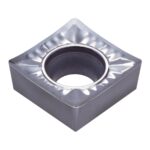

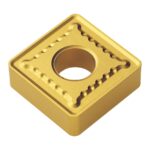
Thread turning looks deceptively simple on paper: the feed is fixed by the pitch, the profile is standardized at 60 degrees, and the cycle needs only a handful of passes. On austenitic stainless steel, however, threading is one of the most punishing lathe operations in the shop. Work hardening, poor heat conduction and stringy, abrasive chips attack the cutting edge from three directions at once. This guide covers how to set up thread turning for 304, 316, duplex and precipitation-hardening stainless steels, with a practical comparison of the two threading specialists — Vargus (Vardex) and Carmex — plus recommended cutting data, infeed strategy and a troubleshooting checklist.
Why Stainless Steel Is Hard on Threading Tools
Thread turning concentrates the entire chip load into a narrow V-groove, and stainless steels magnify every weakness of that geometry:
- Work hardening. Austenitic grades such as 304 and 316 harden rapidly in the deformation zone. Each threading pass plastically deforms the flank surfaces, so every subsequent pass cuts harder material. A dull edge rubs instead of shearing and can harden the surface enough to chip the next insert.
- Low thermal conductivity. At roughly 15 W/m·K, austenitic stainless conducts heat about a third as well as carbon steel. In a threading pass the tool is engaged for a very short arc and re-enters repeatedly, so heat stays concentrated at the nose and on both flanks.
- Built-up edge (BUE). At low cutting speeds, chromium and nickel smear onto the rake face and tear out of the thread flanks. Because thread feed is fixed by the pitch, you cannot reduce feed to fight BUE — you have to manage speed, edge preparation and coolant instead.
- Chip control. Stainless chips are tough, stringy and hot. In a V-groove they pack quickly, and a jammed chip on the return stroke frequently breaks the nose radius of the insert.
The table below summarizes the stainless grades you are most likely to thread and why they behave differently.
| Material | ISO Group | Hardness (HB) | Thermal Cond. (W/m·K) | Machinability (B1112 = 100) | Threading Difficulty |
|---|---|---|---|---|---|
| 303 | M | 170–200 | 16 | ~78 | Moderate |
| 304 / 304L | M | 160–190 | 16 | ~45–55 | High |
| 316 / 316L | M | 160–190 | 15 | ~45 | High |
| 410 / 416 | P/M | 180–240 | 24 | ~55–70 | Moderate |
| 2205 duplex | M | 260–290 | 19 | ~30–40 | Very high |
| 17-4PH (H900) | P | 330–400 | 17 | ~30 | Very high |
Free-machining 303 threads almost like alloy steel thanks to its manganese sulfide inclusions. 304 and 316 are the everyday problem children. Duplex 2205 and aged 17-4PH combine high strength with abrasiveness; they demand rigid setups, strong edges and substantially reduced speeds.
Insert Selection: Vargus vs Carmex
Vargus and Carmex are the two Israeli specialists that dominate dedicated thread-turning tooling, and both are stocked by industrial distributors worldwide. Their philosophies differ in ways that matter depending on your part mix.
Full-Profile vs V-Profile (Partial-Profile) Inserts
- Full-profile inserts carry the complete thread form — both flanks plus the root radius — in a single profile. They finish the whole thread contour simultaneously, produce the correct root radius automatically, and deliver the best surface finish in the fewest passes. The trade-off: you need one insert profile per pitch, so inventory grows with part variety.
- V-profile (partial-profile) inserts carry only a 60-degree V. One insert can cut several adjacent pitches and both left- and right-hand threads, which makes them ideal for maintenance, repair and low-volume work. The root form is generated over multiple passes, so finish and root-radius accuracy depend directly on your pass strategy.
Both manufacturers cover the full matrix of metric ISO, UN, Whitworth, NPT and API profiles. Vargus has traditionally been the reference in Swiss-type and small-part threading, where short overhangs, small insert sizes and tight root radii dominate the tooling decision. Carmex has built its reputation on productive systems for general turning centers, and its GRIP TT multi-tooth family is the most recognizable expression of that approach.
Multi-Tooth Threading: The Carmex GRIP TT Approach
Multi-tooth inserts stack several thread profiles along the insert edge. The front teeth rough the thread while the last tooth — a full-profile finisher — completes both flanks and the root in a single pass. Because the chip load is shared across more teeth, the number of infeed passes can drop by roughly 30–50 percent, and cycle time falls accordingly. The requirements are a machine with consistent pitch synchronization, a rigid setup, and enough workpiece length to accommodate the longer cutting zone. On short parts, near shoulders or inside small bores, single-tooth inserts remain the right choice.
Grades and Coatings for Stainless
For stainless threading, both manufacturers recommend fine-grain or sub-micron carbide substrates with PVD coatings from the TiAlN / AlTiN family, typically 2–3 μm thick. PVD-coated edges stay sharper than CVD-coated ones, and sharpness is critical in threading: a light hone of roughly 0.02–0.03 mm is the maximum you want before the edge starts rubbing and feeding work hardening back into the surface. Polished rake faces help shed the smearing that triggers built-up edge. Reserve heavier-honed, tougher grades for duplex and PH materials, where edge strength matters more than sharpness.
Head-to-Head Comparison
| Criterion | Vargus (Vardex) | Carmex |
|---|---|---|
| Core strength | Thread turning and grooving; Swiss-type and small parts | Threading, grooving, taps and solid carbide thread mills |
| Profile coverage | Full-profile and V-profile, all standard forms | Full-profile and V-profile, all standard forms |
| Multi-tooth system | Limited multi-tooth options | GRIP TT — passes cut by ~30–50% |
| Thread milling | Solid and indexable ranges | Strong solid-carbide and small-diameter ranges |
| Best fit | Short parts, tight root radii, Swiss lathes | Production threading on turning centers, deeper threads |
In practice, many shops stock both: Vargus inserts for the small-diameter, tight-tolerance threads coming off Swiss machines, and Carmex GRIP TT for coarse-pitch production threads on flanges, fittings and valve bodies.
Cutting Parameters for Thread Turning Stainless Steel
In thread turning, feed is not a free variable — it equals the pitch. Speed and pass strategy are what you tune. The table below gives recommended cutting speeds for PVD-coated carbide thread turning inserts in external threading.
| Material | Vc (m/min) | Coolant | Notes |
|---|---|---|---|
| 303 | 120–160 | Flood | Best machinability; watch for chatter on thin walls |
| 304 / 304L | 90–130 | Flood, high pressure preferred | Below ~80 m/min expect BUE and torn flanks |
| 316 / 316L | 80–120 | Flood, high pressure preferred | Stickier chips; keep passes shallow |
| 410 / 416 | 110–150 | Flood | Reduce 20–30% in hardened condition |
| 2205 duplex | 60–95 | High-pressure flood | Strong edge required; expect notch wear |
| 17-4PH (H900) | 60–90 | Flood | Rigid setup mandatory |
Spindle speed follows directly from diameter. For an M16×2.0 external thread at Vc = 110 m/min: n = 110,000 / (π × 16) ≈ 2,190 rpm.
Infeed Strategy: Radial vs Modified Flank
- Radial infeed (straight in, perpendicular to the axis) loads both cutting edges equally. It is the simplest method and works fine on fine pitches up to about 1.5 mm, especially with generous coolant.
- Modified flank infeed at ~29 degrees angles the tool path so one flank carries most of the cut while the opposite flank is burnished rather than cut. Chip formation is freer, heat generation drops, and tool life on austenitic grades improves noticeably. Use it for pitches of 1.5 mm and coarser.
- Decreasing pass depths keep the chip cross-section roughly constant as the contact length grows with each successive pass — this is why the tables below step down progressively.
- Spring passes (1–2 extra passes without radial advance) correct deflection and improve size and finish, especially on 316 and duplex.
Pass Depth Tables — Metric Threads (External, mm)
Total external thread depth ≈ 0.6134 × P. The values below are proven starting points; reduce individual pass depths by 20–30% for duplex and 17-4PH.
| Pitch | Total Depth | Pass Depths (mm) | ||||||
|---|---|---|---|---|---|---|---|---|
| 1.0 | 0.61 | 0.20 | 0.15 | 0.11 | 0.08 | 0.04 | 0.03 | — |
| 1.25 | 0.77 | 0.24 | 0.18 | 0.13 | 0.09 | 0.07 | 0.06 | — |
| 1.5 | 0.92 | 0.28 | 0.21 | 0.15 | 0.11 | 0.08 | 0.06 | 0.03 |
| 2.0 | 1.23 | 0.36 | 0.27 | 0.20 | 0.14 | 0.10 | 0.07 | 0.05 |
Pass Depth Tables — UN Threads (External, mm)
Total external thread depth for 60-degree UN forms ≈ 0.6134 × P.
| TPI | Pitch (mm) | Total Depth | Pass Depths (mm) | ||||||||
|---|---|---|---|---|---|---|---|---|---|---|---|
| 20 | 1.27 | 0.78 | 0.24 | 0.18 | 0.13 | 0.10 | 0.08 | 0.05 | — | — | — |
| 16 | 1.59 | 0.97 | 0.29 | 0.22 | 0.16 | 0.12 | 0.09 | 0.06 | 0.03 | — | — |
| 13 | 1.95 | 1.20 | 0.34 | 0.26 | 0.19 | 0.14 | 0.11 | 0.08 | 0.05 | 0.03 | — |
| 11 | 2.31 | 1.42 | 0.38 | 0.29 | 0.22 | 0.16 | 0.12 | 0.09 | 0.07 | 0.05 | 0.04 |
| 8 | 3.18 | 1.95 | 0.50 | 0.38 | 0.29 | 0.22 | 0.16 | 0.12 | 0.09 | 0.07 | 0.06 |
For internal threads, the total cutting depth is shallower — approximately 0.5413 × P for metric 60-degree forms — and the same decreasing strategy applies. Carbide edges are more fragile in small internal bores; many shops run sharp PVD inserts at 15–20% lower speeds on internal stainless threading below M10, and switch to thread milling whenever the bore allows it.
Coolant, Chips and Process Discipline
Coolant is not optional on stainless threading. High-pressure flood at 10–20 bar, aimed directly into the groove, breaks chips, flushes the V-form and stabilizes edge temperature. Keep three rules in mind:
- Never interrupt coolant. On/off emulsion causes thermal cycling cracks in the insert edge. If the machine cannot sustain steady flow, run slightly dry at reduced speed rather than intermittently wet.
- Use the retract. Most CNC controls offer chip-retract threading cycles (for example G76 on Fanuc-class controls). A small pull-out between passes lets coolant clear the groove and prevents chip packing on coarse pitches.
- Consider thread milling for problem parts. Solid carbide thread mills — Carmex offers one of the strongest small-diameter ranges — eliminate chip jamming entirely, cut threads flush to a shoulder, and one single-profile tool can cover every pitch in its class. Cycle time is longer, but on tough austenitic and duplex grades the process is far more forgiving.
Troubleshooting Stainless Thread Turning
| Symptom | Likely Cause | Corrective Action |
|---|---|---|
| Built-up edge, torn flanks | Vc too low, dull edge, weak coolant | Raise Vc 15–25%, index to fresh edge, ensure continuous flood |
| Nose chipping | Excessive radial depth, radial infeed on coarse pitch | Switch to 29-degree flank infeed, reduce pass depth 20–30% |
| Chatter, wavy flanks | Overhang too long, weak clamping, worn edge | Minimize overhang, verify holder torque, add spring pass |
| Thread oversize | Deflection and spring between passes | Add 1–2 spring passes, compensate X on final passes |
| Burrs on crest and flanks | Final pass too light, edge rubbing | Keep final pass at 0.03–0.05 mm with a sharp edge |
| Rapid flank wear | Vc too high for grade or material | Drop Vc 20–30%, use tougher grade for duplex and PH |
Key Takeaways
- Choose full-profile inserts for production threads and V-profile inserts for mixed or low-volume work; use Carmex GRIP TT multi-tooth inserts to cut cycle time on coarse-pitch production threads, and Vargus Vardex where Swiss-type precision and root-radius accuracy dominate.
- Run PVD TiAlN/AlTiN fine-grain grades with a light 0.02–0.03 mm hone; avoid CVD and heavy honing on austenitic stainless.
- Keep Vc in the 90–130 m/min band for 304/316 and 60–95 m/min for duplex and 17-4PH, with continuous high-pressure flood coolant.
- Use 29-degree modified flank infeed on pitches of 1.5 mm and coarser, decreasing pass depths per the tables above, and finish with 1–2 spring passes.
- When chips, shoulders or bore size fight you, thread milling is the robust alternative — slower, but far more forgiving on stainless.
Shop Related Products at HOOGUU