

Titanium Grade 2 vs Grade 5 (Ti-6Al-4V): Korloy Insert and Parameter Differences
Titanium machining demands respect for the metal’s unique thermal and chemical properties. However, treating all titanium grades identically is a common and costly mistake. Grade 2 (commercially pure) and Grade 5 (Ti-6Al-4V) present distinctly different machining challenges that require different parameter strategies despite sharing the same base element. Understanding these differences allows you to optimize Korloy insert selection and cutting parameters for each alloy.
Material Characteristics Comparison
Titanium Grade 2: Commercially Pure
Grade 2 is the workhorse of the commercially pure titanium grades. With a tensile strength of 345-485 MPa and no alloying additions beyond trace elements, it is significantly softer than alloyed grades. Its primary applications include chemical processing equipment, marine hardware, heat exchangers, and medical implants where biocompatibility without high strength is needed.
The machining challenge with Grade 2 is its gummy nature. Low hardness combined with high ductility creates continuous, stringy chips that weld to the cutting edge. Built-up edge (BUE) is the dominant failure mode, not wear. The material behaves more like soft stainless steel than what most machinists expect from titanium.
Titanium Grade 5: Ti-6Al-4V
Grade 5 accounts for over 50% of all titanium used globally. With 6% aluminum and 4% vanadium, it achieves tensile strengths of 900-1170 MPa while maintaining reasonable ductility. Aerospace structural components, turbine blades, landing gear, and high-performance medical implants are primary applications.
Grade 5 combines every difficult machining characteristic: low thermal conductivity (7.2 W/mK versus 50+ for steel), high chemical reactivity with tool materials at elevated temperatures, strong work-hardening tendency, and segmented chip formation that creates cyclic loading on the cutting edge. This is genuinely difficult material that demands precise parameter control.
Korloy Grade Selection
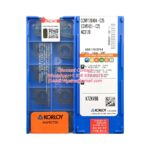
For both Grade 2 and Grade 5, Korloy PC9530 serves as the primary recommended grade. This PVD-coated carbide provides the sharp cutting edge geometry essential for titanium (preventing the work-hardened layer that forms under dull edges) combined with sufficient wear resistance for productive tool life.
The critical distinction is that for Grade 5 in demanding applications, uncoated carbide or thin PVD coating can outperform thicker coatings. The reason is edge acuity: titanium’s low thermal conductivity concentrates all heat at the tool-chip interface, and thicker coatings create a rounded edge microgeometry that increases heat generation rather than reducing it. PC9530’s thin PVD layer represents the optimal compromise, maintaining sharp edge geometry while adding surface hardness.
Parameter Recommendations
| Alloy | Condition | Korloy Grade | Speed (m/min) | Feed (mm/rev) | DOC (mm) | Coolant |
|---|---|---|---|---|---|---|
| Grade 2 | Annealed | PC9530 | 80-120 | 0.15-0.30 | 0.5-3.0 | Flood recommended |
| Grade 2 | Stress-relieved | PC9530 | 70-100 | 0.12-0.25 | 0.5-2.5 | Flood recommended |
| Grade 5 | Annealed | PC9530 | 50-80 | 0.10-0.20 | 0.5-2.5 | TSC 50 bar+ mandatory |
| Grade 5 | Solution treated + aged | PC9530 | 40-65 | 0.08-0.18 | 0.5-2.0 | TSC 70 bar+ mandatory |
| Grade 5 | Finishing | PC9530 (uncoated alt.) | 60-80 | 0.05-0.12 | 0.1-0.5 | TSC 50 bar+ |
Chipbreaker and Geometry Selection
MM Chipbreaker with Positive Rake
The Korloy MM chipbreaker in positive rake geometry is the recommended choice for both titanium grades. Positive rake reduces cutting forces by 15-25% compared to negative geometry, which directly translates to lower cutting temperatures — the critical factor in titanium tool life. The MM profile provides controlled chip breaking without aggressive chip curling that can cause chip re-cutting issues.
Insert Shape Selection
Round inserts (RCMT): For maximum edge strength and tool life in roughing operations, round inserts distribute cutting forces over a larger radius, reducing the peak stress concentration at any single point. RCMT style inserts in PC9530 are particularly effective for Grade 5 roughing where mechanical loading is severe. The variable depth-of-cut engagement inherent in round insert geometry also helps prevent notch wear.
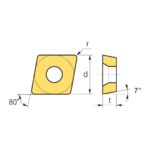
WNMG-MM positive geometry: The Korloy WNMG with MM chipbreaker in positive geometry represents the most versatile option for general titanium turning. The 80-degree included angle provides good strength while the positive rake reduces forces. This is the recommended starting point for shops machining both Grade 2 and Grade 5 without dedicated setups for each.
Why CVD Coating Fails on Titanium
A common mistake is applying CVD-coated inserts (designed for steel) to titanium operations. The failure mechanism is straightforward but not always obvious until it is too late.
CVD coatings are deposited at 900-1050 degrees Celsius, creating coating layers 8-20 micrometers thick. This thickness rounds the cutting edge radius to approximately 30-50 micrometers. On steel, this edge rounding is acceptable because high cutting speeds generate enough heat to soften the workpiece locally. On titanium, the low thermal conductivity means heat cannot dissipate into the workpiece, so a rounded edge creates a dead zone where material is compressed rather than sheared.
This compression creates extreme local temperatures (exceeding 1000 degrees Celsius at the edge), causes rapid diffusion wear as titanium chemically attacks the alumina and TiCN coating layers, and generates an aggressive work-hardened surface layer that accelerates wear further. The result is tool life 50-70% shorter than a properly selected PVD or uncoated grade.
PVD coatings (2-5 micrometers thick, deposited at 400-600 degrees Celsius) maintain the sharp edge geometry that titanium demands. This is why Korloy PC9530 with its thin PVD coating is the correct choice rather than the thicker CVD grades designed for steel applications.
Coolant Strategy: The Decisive Factor
For Grade 2, standard flood coolant at normal pressure (10-20 bar) provides adequate chip evacuation and temperature control. BUE prevention is the primary coolant function here, flushing away material that would otherwise weld to the cutting edge.
For Grade 5, through-spindle coolant (TSC) at minimum 50 bar pressure is not optional — it is mandatory for productive tool life. High-pressure coolant at 50-100 bar delivers three critical functions simultaneously: it penetrates the tool-chip interface to reduce friction and temperature, it breaks chips into manageable segments (critical for the segmented chip formation of Grade 5), and it provides the hydraulic force to clear chips from the cutting zone before re-cutting occurs.
Shops without high-pressure coolant capability should expect 30-50% reduction in achievable cutting speeds on Grade 5. This directly impacts cost-per-part and often makes the investment in high-pressure coolant systems economically justified within months of titanium production work.
Grade 2 Specific Challenge: Built-Up Edge Prevention
The primary strategy against BUE on Grade 2 is maintaining adequate cutting speed. Below approximately 60 m/min, the cutting temperature is insufficient to prevent adhesion between the titanium chip and the insert rake face. Counterintuitively, increasing speed on Grade 2 often improves surface finish and extends tool life by eliminating the BUE cycle that tears surface material and creates edge chipping through adhesive wear.
If BUE persists despite adequate speed, verify that the cutting edge is genuinely sharp. Even slight edge wear creates a flat that promotes adhesion. Index to a fresh edge earlier than wear criteria alone would suggest. The cost of one additional indexing per shift is trivial compared to the scrap generated by BUE-related surface finish defects.
Shop Related Products at HOOGUU