
Wind Turbine Component Machining: Gearbox Housings, Main Shafts, and Bearing Rings — A Korloy Application Guide
The global wind energy sector continues to expand at double-digit annual rates, and behind every megawatt of installed capacity lies a stack of very large, very demanding metal parts. Gearbox housings in nodular cast iron, main shafts in 42CrMo4 forged steel, and yaw-bearing rings up to four metres in diameter all require CNC machining cycles measured in hours, not minutes. Tool selection, stability strategy, and grade pairing directly determine whether a job is profitable or a loss leader. In this guide we walk through the material challenges, recommended cutting parameters, and Korloy tooling solutions that Korean and Asian job shops are adopting for wind-sector work.
Material Challenges in Wind Components
Gearbox Housings: Nodular Cast Iron GGG-50 / GGG-60
Wind-turbine gearbox housings are typically sand-cast in nodular (ductile) iron with pearlitic matrices. While not as abrasive as grey cast iron, nodular iron produces irregular chip shapes and places high mechanical loads on insert edges. Interrupted cuts are common because of casting risers, parting lines, and internal ribbing. The goal is to remove stock quickly while maintaining dimensional tolerance on bearing bores that must align perfectly with planetary gear trains.
Main Shafts: 42CrMo4 and 34CrNiMo6 Forged Steel
Main shafts transmit rotor torque to the gearbox or direct-drive generator. They are open-die forged, leaving a tough, variable skin layer that can reach 3–5 mm in thickness before machining. Under the skin, 42CrMo4 offers tensile strengths of 900–1,100 MPa and moderate work-hardening tendency. The challenge is twofold: roughing through the scale without chipping, and then semi-finishing at speeds high enough to keep cycle times reasonable without triggering built-up edge.
Bearing Rings: 42CrMo4 Induction-Hardened or 100Cr6
Slewing bearings for yaw and pitch systems use large rings (outer diameters frequently exceed 2,500 mm) that are either through-hardened or induction-hardened to 55–60 HRC on the raceway surfaces. Machining is typically done before hardening, but some repair and remanufacturing shops must turn or mill already-hardened surfaces. This demands CBN or ceramic grades capable of sustained cuts at low depth but high cutting speed.
Roughing Strategy and Parameter Windows
For wind-component roughing, rigidity is more important than speed. Machine tool spindle power is rarely the bottleneck; the limiting factor is the ability to hold tolerances as cutting forces excite low-frequency modes in long overhangs or thin-walled cast sections.
| Operation | Material | Cutting Speed (Vc) | Feed (fn) | Depth of Cut (ap) |
|---|---|---|---|---|
| Face milling (rough) | GGG-50 | 180–220 m/min | 0.25–0.35 mm/tooth | 4–8 mm |
| Face milling (rough) | 42CrMo4 | 140–180 m/min | 0.20–0.30 mm/tooth | 3–6 mm |
| OD turning (rough) | 42CrMo4 | 120–160 m/min | 0.30–0.45 mm/rev | 3–5 mm |
| Boring (semi-finish) | GGG-50 | 200–250 m/min | 0.15–0.25 mm/rev | 0.5–2 mm |
| OD turning (hardened) | 55–60 HRC | 80–120 m/min | 0.10–0.18 mm/rev | 0.2–0.5 mm |
When roughing nodular iron, keep coolant concentration above 8 % and use through-tool supply if available. For 42CrMo4, emulsion at 6–8 % is standard; high-pressure coolant (70 bar) significantly improves chip breaking in deep bores.
Korloy Tooling Recommendations by Operation
Face Milling Large Cast-Iron Surfaces
For gearbox-housing face milling, Korloy’s MAF series face mills using double-sided octagonal inserts deliver high metal-removal rates with low cutting forces. The eight cutting edges per insert reduce cost per edge, which matters when a single housing may require 40–60 minutes of milling time. Pair the MAF body with Korloy PC5300 CVD-coated grades for nodular iron; the thick alumina layer provides thermal stability at the elevated speeds needed to keep productivity acceptable. If the casting skin is particularly abrasive or contains sand inclusions, step up to PC8110 for additional crater-wear resistance.
Turning Main Shafts and Bearing Rings
For rough turning 42CrMo4 main shafts, a Korloy CNMG or WNMG negative-insert holder with PC2510 PVD-coated grade offers an excellent balance of toughness and heat resistance. The PC2510 substrate is optimised for medium-to-high speed steel turning and resists the combination of scale impact and continuous heat that characterises shaft machining. Use a HS or HM chipbreaker for heavy roughing to ensure safe chip evacuation; if the machine has limited coolant pressure, the HMP breaker improves chip control without narrowing the parameter window.
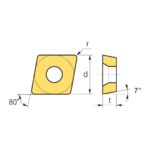
For semi-finishing bearing-ring bores where roundness below 0.01 mm is required, switch to a Korloy DNMG or CCMT positive-insert geometry at lighter depths. A PC9530 grade with MM chipbreaker produces predictable chips and surface finishes in the Ra 1.6–3.2 range, usually sufficient before grinding or induction hardening.
Grooving and Parting Seal Lands
Main shafts and bearing housings contain multiple seal grooves, retaining-ring grooves, and chamfers. Korloy’s MGMN and TDC grooving inserts cover widths from 2 mm to 6 mm with corner radii down to 0.2 mm. In 42CrMo4, run MGMN inserts with PC2510 coating at 100–140 m/min with feed rates of 0.08–0.15 mm/rev. For interrupted grooves crossing bolt holes or oil passages, reduce speed by 15 % and select the toughest grade available to avoid corner chipping.
Hardened-Ring Finish Turning
When turning pre-hardened bearing rings at 55–60 HRC, conventional carbide fails within minutes. Korloy’s CBN grades, such as those in the KB series, are formulated for hardened-steel finishing. A light depth of cut (0.1–0.3 mm) and moderate feed (0.08–0.15 mm/rev) at 100–150 m/min produces surfaces ready for final grinding. The key is to avoid dwell marks at entry and exit; use constant surface speed control and plan tool paths so that CBN edges do not rub during retract moves.
Fixture and Stability Considerations
Wind components are heavy, but their mass does not automatically guarantee stability. Long main shafts (2–4 m) can sag between centres, and thin-walled gearbox housings distort under clamping pressure. Consider the following shop-floor practices:
- Counter-supports: Use travelling steadies or hydraulic follower rests on main shafts to raise the first natural frequency above the spindle speed range.
- Soft jaws or mandrels: For bearing-ring OD turning, custom soft jaws that match the as-cast diameter distribute clamping force and reduce ovality.
- Adaptive machining: Where cast surfaces vary by ±2 mm in stock allowance, probe cycles before roughing allow dynamic tool-path offsets rather than conservative constant depths.
Cost-per-Part Perspective
Because wind components are low-volume (often ten to fifty pieces per year), tooling cost per part is dominated by insert price and edge life, not the initial holder investment. A Korloy double-sided octagonal insert with eight edges can reduce cost per edge by 30–40 % compared with single-sided competitors, even when the list price is similar. In our field data from Korean job shops machining GGG-50 gearbox faces, switching from a four-edge square insert to the Korloy MAF octagonal system dropped cost per housing from roughly USD 12 to USD 7.50 in insert consumption alone.
Conclusion
Wind turbine machining is a sector where size, material variability, and tolerance requirements collide. Success depends on matching the right grade and geometry to each phase of the process: roughing through forged scale, semi-finishing bores to grinding stock, and finish turning hardened raceways where necessary. Korloy’s broad portfolio — from MAF face mills and PC-series turning grades to MGMN grooving inserts and CBN finishing solutions — provides Korean and Asian manufacturers with a coherent tool set that keeps these large parts profitable. If you are quoting your first gearbox housing or scaling up bearing-ring production, HOOGUU’s application team can cross-reference your current tool list against Korloy equivalents and recommend parameter windows based on your machine spindle power and coolant capacity.
Shop Related Products at HOOGUU