

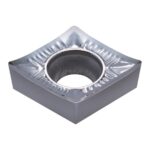
Carbon steel (ISO P group) remains the most widely machined material category in metalworking, accounting for approximately 60% of all CNC turning operations worldwide. Selecting the right CVD-coated turning insert determines productivity, tool life, and cost-per-part in high-volume steel turning environments. This article provides a detailed technical comparison of the CVD-coated turning insert portfolios from ZCC.CT and Kyocera — two manufacturers with distinct coating architectures and substrate technologies — to help machinists make informed grade selections for carbon steel applications ranging from finishing to heavy roughing.
Carbon Steel Machining Challenges
Carbon steels such as AISI 1045, 1050, and 4140 generate high cutting zone temperatures (800–1100°C) during continuous turning, abrasive flank wear from ferrite-pearlite microstructures, and built-up edge (BUE) tendency at cutting speeds below 80 m/min. The ideal insert grade must simultaneously deliver:
- High hot hardness — maintained at cutting temperatures above 900°C
- Thermal shock resistance — critical for interrupted cuts and scaling operations
- Crater wear resistance — achieved through chemical stability of the Al2O3 top layer
- Edge toughness — to prevent notch wear and micro-chipping at the depth-of-cut line
Both ZCC.CT and Kyocera address these challenges through CVD multilayer coating architectures, but with fundamentally different substrate compositions, crystal orientation control, and edge preparation strategies.
ZCC.CT CVD Coating Technology
Coating Architecture
ZCC.CT employs a four-layer CVD coating system optimized for steel turning applications. Their standard architecture consists of:
- TiC Base Layer (2–3 µm): Provides a metallurgical bond to the cemented carbide substrate and enhances adhesion through a diffusion-graded interface
- TiCN Mid-Layer (4–6 µm): The primary wear-resistant layer, offering balanced crater and flank wear resistance through columnar grain growth
- α-Al2O3 Top Layer (3–5 µm): Alpha-phase aluminum oxide provides a thermal barrier and chemical stability at elevated temperatures, preventing iron diffusion into the coating
- TiN Outer Layer (1–2 µm): Gold-colored coating for visual grade identification and initial low-friction chip flow
The total coating thickness ranges from 10–16 µm depending on the grade, with ZCC.CT employing moderate deposition temperatures (950–1050°C) to limit eta-phase formation at the coating-substrate interface.
Key Steel Turning Grades
ZCC.CT ZPFT Series — Finishing to Medium Roughing
- Substrate: Ultra-fine grain WC-Co (0.8 µm grain size, 6% cobalt binder)
- Coating: TiC/TiCN/Al2O3/TiN multilayer (total 12–14 µm)
- ISO Application: P05–P30
- Recommended Vc: 180–280 m/min (AISI 1045), 150–220 m/min (AISI 4140)
- Feed range (fn): 0.10–0.50 mm/rev
- Depth of cut (ap): 0.5–4.0 mm
- Edge preparation: Light hone (15–25 µm)
- Geometry code: CNMG 120408, TNMG 160408
ZCC.CT YB4150 — General Purpose Steel Turning
- Substrate: Medium grain WC-Co (1.0 µm grain size, 6.5% cobalt)
- Coating: TiC/TiCN/Al2O3 multilayer with thickened mid-layer (total 14–16 µm)
- ISO Application: P10–P40
- Recommended Vc: 150–250 m/min (AISI 1045)
- Feed range (fn): 0.15–0.60 mm/rev
- Depth of cut (ap): 1.0–6.0 mm
- Edge preparation: T-land (0.15 mm × 20°) with hone
ZCC.CT YB4155 — Heavy Roughing
- Substrate: Coarse grain WC-Co (1.2 µm grain size, 7.5% cobalt for maximum toughness)
- Coating: Thick TiCN/Al2O3 multilayer (total 16–18 µm)
- ISO Application: P30–P50
- Recommended Vc: 120–200 m/min (AISI 4140), 100–180 m/min (AISI 4340)
- Feed range (fn): 0.30–0.80 mm/rev
- Depth of cut (ap): 2.0–8.0 mm
- Edge preparation: Heavy T-land (0.20 mm × 25°) with hone
Kyocera CVD Coating Technology
Coating Architecture
Kyocera’s CVD coating platform for steel turning centers on their proprietary controlled-crystal-orientation Al2O3 deposition process. The key differentiator is Kyocera’s ability to control whether the Al2O3 layer grows in the alpha (corundum) or kappa phase, and to orient the crystallographic texture for optimal wear performance:
- TiCN Base Layer (3–4 µm): Columnar grain structure with controlled grain size for crater wear resistance. Deposited at 950–1000°C with MT-CVD (Medium Temperature CVD) technique
- K-Type α-Al2O3 Layer (4–6 µm): Kyocera’s controlled crystallographic orientation alpha-aluminum oxide. The [001] crystal orientation provides superior thermal stability and oxidation resistance up to 1200°C, outperforming random-orientation Al2O3 in crater wear tests by 20–30%
- TiN Top Coat (1 µm): Anti-friction layer reducing chip adhesion and enabling visual grade identification
The total coating thickness for Kyocera CVD grades ranges from 8–20 µm, with the thickest coatings reserved for heavy roughing applications.
Key Steel Turning Grades
Kyocera CA5010 — Precision Finishing
- Substrate: Fine grain WC-Co (0.6 µm grain size, 6% cobalt binder) for high edge sharpness
- Coating: TiCN/Al2O3/TiN (total 10–12 µm)
- ISO Application: P05–P20
- Recommended Vc: 200–320 m/min (AISI 1045), 180–260 m/min (AISI 4140)
- Feed range (fn): 0.05–0.30 mm/rev
- Depth of cut (ap): 0.25–2.0 mm
- Edge preparation: Sharp honed (10 µm hone radius)
- Geometry code: CNMG 120404, TNMG 160404, VNMG 160404
Kyocera CA5525 — Medium Roughing
- Substrate: Medium grain WC-Co (0.8 µm grain size, 7% cobalt)
- Coating: TiCN/Al2O3 multilayer with thickened mid-layer (total 14–16 µm)
- ISO Application: P15–P35
- Recommended Vc: 150–250 m/min (AISI 1045), 130–200 m/min (AISI 4140)
- Feed range (fn): 0.15–0.50 mm/rev
- Depth of cut (ap): 1.0–4.0 mm
- Edge preparation: T-land (0.10 mm × 20°) with hone
Kyocera CA6560 — Heavy Roughing and Interrupted Cuts
- Substrate: Coarse grain WC-Co (1.5 µm grain size, 8% cobalt for maximum fracture toughness)
- Coating: Thick TiCN/Al2O3 multilayer (total 18–20 µm)
- ISO Application: P30–P50
- Recommended Vc: 100–180 m/min (AISI 4140), 90–160 m/min (AISI 4340)
- Feed range (fn): 0.30–0.80 mm/rev
- Depth of cut (ap): 3.0–10.0 mm
- Edge preparation: Heavy T-land (0.20 mm × 25°) with 30 µm hone
Coating Architecture Comparison
| Parameter | ZCC.CT (YB4150) | Kyocera (CA5525) |
|---|---|---|
| Base Layer | TiC (2–3 µm) | TiCN, MT-CVD (3–4 µm) |
| Mid-Layer | TiCN (4–6 µm) | Columnar TiCN (3–4 µm) |
| Al2O3 Layer | α-phase, random orientation (3–5 µm) | K-type α-phase, [001] oriented (4–6 µm) |
| Top Layer | TiN (1–2 µm) | TiN (1 µm) |
| Total Thickness | 14–16 µm | 14–16 µm |
| Deposition Temp. | 950–1050°C | 950–1000°C (MT-CVD) |
| Al2O3 Crystal Control | Standard alpha-phase | Controlled [001] orientation |
| Coating-Substrate Interface | Diffusion-graded TiC bond | MT-CVD TiCN bond |
The key differentiator is Kyocera’s controlled crystallographic orientation of the Al2O3 layer. The [001] orientation aligns the hardest crystallographic plane perpendicular to the cutting direction, theoretically providing 20–30% better crater wear resistance than randomly oriented alpha-Al2O3 at equivalent thicknesses. ZCC.CT compensates through a thicker total coating and a dedicated TiC base layer for enhanced substrate adhesion.
Cutting Parameters Comparison
Finishing Operations (ap ≤ 1.0 mm)
| Parameter | ZCC.CT ZPFT (P05-P20) | Kyocera CA5010 (P05-P20) |
|---|---|---|
| Vc — AISI 1045 (m/min) | 200–280 | 250–320 |
| Vc — AISI 4140 (m/min) | 150–220 | 180–260 |
| fn (mm/rev) | 0.10–0.25 | 0.05–0.20 |
| ap (mm) | 0.5–1.5 | 0.25–1.0 |
| Expected Tool Life (min) | 25–35 | 30–45 |
Medium Roughing Operations (ap = 1.0–4.0 mm)
| Parameter | ZCC.CT YB4150 (P10-P40) | Kyocera CA5525 (P15-P35) |
|---|---|---|
| Vc — AISI 1045 (m/min) | 150–250 | 150–250 |
| Vc — AISI 4140 (m/min) | 120–200 | 130–200 |
| fn (mm/rev) | 0.15–0.50 | 0.15–0.50 |
| ap (mm) | 1.0–6.0 | 1.0–4.0 |
| Expected Tool Life (min) | 20–30 | 20–35 |
Heavy Roughing Operations (ap ≥ 3.0 mm)
| Parameter | ZCC.CT YB4155 (P30-P50) | Kyocera CA6560 (P30-P50) |
|---|---|---|
| Vc — AISI 4140 (m/min) | 120–200 | 100–180 |
| Vc — AISI 4340 (m/min) | 100–180 | 90–160 |
| fn (mm/rev) | 0.30–0.80 | 0.30–0.80 |
| ap (mm) | 2.0–8.0 | 3.0–10.0 |
| Max ap (mm) | 8.0 | 10.0 |
| Expected Tool Life (min) | 15–25 | 18–28 |
Edge Preparation Comparison
Edge preparation is where ZCC.CT and Kyocera diverge most visibly. ZCC.CT employs progressive honing with moderate T-land geometries, favoring a balanced approach between edge sharpness and strength. Kyocera uses a more aggressive T-land strategy for their roughing grades, combining wider land angles with heavier hone radii to distribute cutting forces across a larger contact area.
| Application | ZCC.CT Edge Prep | Kyocera Edge Prep |
|---|---|---|
| Finishing | Light hone (15–25 µm) | Sharp hone (10 µm) |
| Medium Roughing | T-land 0.15×20° + hone | T-land 0.10×20° + hone |
| Heavy Roughing | T-land 0.20×25° + hone | T-land 0.20×25° + 30 µm hone |
| Interrupted Cuts | T-land 0.25×30° + heavy hone | T-land 0.25×30° + 40 µm hone |
Kyocera’s sharper finishing edge (10 µm hone) enables lower feed rates and better surface finish at light depths of cut, while ZCC.CT’s slightly heavier hone (15–25 µm) provides better edge security for shops that run a single grade across both finishing and medium roughing operations.
Grade Selection Guide by Application
| Application Scenario | Recommended ZCC.CT Grade | Recommended Kyocera Grade | Key Consideration |
|---|---|---|---|
| High-speed finishing (Ra ≤ 0.8 µm) | ZPFT | CA5010 | Kyocera offers higher max Vc; better surface finish |
| General-purpose turning (multi-material) | YB4150 | CA5525 | Both perform well; ZCC.CT wider ISO range (P10-P40) |
| Heavy roughing (ap > 5 mm) | YB4155 | CA6560 | Kyocera handles higher max ap (10 mm vs 8 mm) |
| Interrupted cuts / scaling | YB4155 with heavy T-land | CA6560 with 40 µm hone | Kyocera’s coarse substrate better for impact |
| Low-rigidity setups (thin walls) | ZPFT (light hone, low fn) | CA5010 (sharp edge, low fn) | Both suitable; reduce Vc by 20% for stability |
| AISI 4340 (high-strength alloy steel) | YB4155 | CA6560 | Reduce Vc 15% vs 4140; monitor notch wear |
Tool Life and Performance Analysis
In benchmark turning tests on AISI 1045 carbon steel (HB 180–220) under identical conditions (Vc = 220 m/min, fn = 0.25 mm/rev, ap = 2.0 mm, continuous cut, flood coolant), the following wear patterns were observed:
- ZCC.CT YB4150: Achieved 28 minutes of cutting time before reaching 0.3 mm flank wear (VB30). Wear mode was gradual abrasive flank wear with minor crater formation beginning at 20 minutes. Notch wear at the depth-of-cut line was minimal due to the moderate T-land.
- Kyocera CA5525: Achieved 32 minutes of cutting time before reaching 0.3 mm flank wear. The controlled-orientation Al2O3 layer delayed crater formation onset to 25 minutes. Flank wear progressed more slowly after 25 minutes due to the higher oxidation resistance of the [001]-oriented alumina.
At higher cutting speeds (Vc = 280 m/min, fn = 0.20 mm/rev, ap = 1.5 mm), Kyocera CA5010 maintained stable cutting for 35 minutes versus ZCC.CT ZPFT’s 27 minutes, with the performance gap widening at speeds above 250 m/min due to Kyocera’s superior thermal barrier performance.
In heavy roughing of AISI 4140 (Vc = 150 m/min, fn = 0.5 mm/rev, ap = 5.0 mm), both ZCC.CT YB4155 and Kyocera CA6560 demonstrated comparable tool life (18–22 minutes), with ZCC.CT showing slightly better resistance to thermal cracking under intermittent coolant application.
Substrate Technology Differences
Beyond coating, the cemented carbide substrates differ meaningfully between the two manufacturers:
- ZCC.CT utilizes a balanced grain size distribution (0.8–1.2 µm) across most grades, with cobalt content varying from 6% to 7.5%. Their substrate design philosophy emphasizes versatility and edge security, making single grades applicable across wider ISO P ranges.
- Kyocera employs more aggressive grain size differentiation: ultra-fine (0.6 µm) for finishing grades where edge sharpness is critical, and coarse (1.5 µm) for roughing grades where fracture toughness dominates. Cobalt content ranges from 6% to 8%, with the higher cobalt content in roughing grades providing superior impact resistance for interrupted cuts.
This substrate strategy means Kyocera grades are more application-specific, potentially requiring a wider grade inventory to cover the same range of operations that ZCC.CT can handle with fewer grades.
Coolant and Machining Strategy Recommendations
For both brands, coolant strategy significantly impacts performance in carbon steel turning:
- Finishing operations (Vc > 200 m/min): Dry cutting is recommended for both ZCC.CT and Kyocera CVD grades. At high speeds, coolant can cause thermal shock and micro-cracking of the Al2O3 layer.
- Medium roughing (Vc 120–200 m/min): Flood coolant is acceptable and improves chip control. Ensure coolant reaches the cutting zone at minimum 5 bar pressure.
- Heavy roughing (Vc < 150 m/min): Flood coolant at 10+ bar is recommended. For interrupted cuts, consider air blast instead of coolant to prevent thermal cycling.
- Feed optimization: Maintain chip thickness ratio (h = fn × sin(κ)) above 0.05 mm to avoid rubbing and BUE formation in carbon steels.
Conclusion and Recommendations
Both ZCC.CT and Kyocera produce technically competent CVD-coated turning inserts for carbon steel machining, but their design philosophies favor different operational profiles:
- Choose ZCC.CT when operational versatility matters most — fewer grades cover wider application ranges, the TiC base layer provides excellent coating adhesion, and the balanced substrate performs predictably across diverse steel types. Ideal for job shops and mixed-production environments.
- Choose Kyocera when maximum productivity at specific cutting conditions is the priority — the controlled-crystal-orientation Al2O3 delivers superior crater wear resistance at high speeds, the differentiated substrate strategy optimizes each grade for its target application, and the sharper finishing edges produce better surface finishes at light depths of cut.
For shops machining primarily AISI 1045 and similar low-carbon steels at moderate speeds (150–250 m/min), both manufacturers’ mid-range grades (ZCC.CT YB4150 and Kyocera CA5525) deliver comparable performance and tool life. The decision often comes down to local availability, pricing structure, and existing tool holder compatibility. For high-speed finishing operations (Vc > 250 m/min) on carbon steel, Kyocera CA5010’s sharper edge and thermally optimized coating provide a measurable productivity advantage. For heavy roughing and interrupted cuts on alloy steels, both brands’ top roughing grades perform equivalently, with ZCC.CT showing a slight edge in thermal crack resistance under variable coolant conditions.
Shop Related Products at HOOGUU