

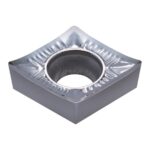
The ISO 513 standard divides engineering materials into six primary workpiece groups designated P, M, K, N, S, and H. Each group presents unique machining challenges that demand specific cutting tool grades, geometries, and parameter ranges. Whether you are programming a CNC lathe for high-volume production or troubleshooting tool life issues in a job shop, understanding the relationship between workpiece material classification and optimized turning parameters is essential for productive and cost-efficient manufacturing.
In this comprehensive reference guide, we break down each ISO workpiece group with recommended cutting speeds (Vc), feed rates (fn), depth of cut (ap), and insert grade selections. We also compare flagship insert grades from Sandvik Coromant and Seco Tools to help you make informed tooling decisions across diverse material applications.
Understanding the ISO 513 Workpiece Classification System
ISO 513 categorizes metallic workpiece materials based on their machinability characteristics and metallurgical composition. The classification system provides a standardized framework for cutting tool manufacturers to develop and recommend application-specific grades. Here is a summary of each group:
- P group (Steel): Includes unalloyed steels, low-alloy steels, and high-alloy steels with ferritic, pearlitic, or martensitic microstructures. This is the largest and most commonly machined material group.
- M group (Stainless steel): Covers austenitic, ferritic, martensitic, and duplex stainless steels. These materials work-harden rapidly and generate high cutting temperatures.
- K group (Cast iron): Encompasses gray cast iron, nodular (ductile) cast iron, and malleable cast iron. Abrasive graphite structures and varying pearlite content create diverse wear mechanisms.
- N group (Non-ferrous metals): Includes aluminum alloys, copper alloys, magnesium alloys, and other soft non-ferrous materials. High thermal conductivity and tendency for built-up edge characterize this group.
- S group (Superalloys and titanium): Covers heat-resistant superalloys (HRSA) based on nickel, cobalt, or iron, plus titanium and titanium alloys. These materials exhibit poor thermal conductivity and high chemical reactivity at cutting temperatures.
- H group (Hardened materials): Includes hardened steels, chilled cast iron, and hardened ferrous materials typically above 45 HRC. Extreme hardness and abrasive wear demand specialized tool substrates and geometries.
ISO P Group: Steel Turning Parameters
Steel machining represents the bulk of turning operations worldwide. From low-carbon structural steels to high-alloy tool steels, the P group requires versatile insert grades that balance wear resistance and edge toughness.
Recommended Cutting Parameters for Steel Turning
| Steel Subcategory | Hardness Range | Vc (m/min) | fn (mm/rev) | ap (mm) |
|---|---|---|---|---|
| Unalloyed steel (C < 0.25%) | 90-180 HB | 250-450 | 0.15-0.40 | 1.0-6.0 |
| Low-alloy steel | 150-260 HB | 180-350 | 0.12-0.35 | 1.0-5.0 |
| High-alloy steel | 200-320 HB | 120-250 | 0.10-0.30 | 0.5-4.0 |
| Free-cutting steel | 100-200 HB | 300-500 | 0.20-0.50 | 1.0-8.0 |
| Bearing steel / Tool steel | 220-350 HB | 80-180 | 0.08-0.25 | 0.5-3.0 |
Insert Grade Recommendations for Steel
| Application | Sandvik Grade | Seco Grade |
|---|---|---|
| Roughing, general purpose | GC4225 (CVD) | TP1501 (CVD) |
| Semi-finishing, balanced wear | GC4325 (CVD) | TP2501 (CVD) |
| Finishing, high-speed | GC2025 (PVD) | TP0501 (PVD) |
| Interrupted cuts, tough conditions | GC4235 (CVD) | TP3501 (CVD) |
ISO M Group: Stainless Steel Turning Parameters
Stainless steels combine high toughness, rapid work-hardening rates, and poor thermal conductivity. These properties generate elevated cutting temperatures and promote crater wear, demanding insert grades with excellent chemical stability and heat resistance.
Recommended Cutting Parameters for Stainless Steel Turning
| Stainless Steel Type | Typical Grade | Vc (m/min) | fn (mm/rev) | ap (mm) |
|---|---|---|---|---|
| Austenitic | 304, 316, 321 | 120-220 | 0.12-0.30 | 1.0-4.0 |
| Ferritic | 430, 446 | 150-280 | 0.12-0.35 | 1.0-5.0 |
| Martensitic | 410, 420, 440C | 100-200 | 0.10-0.28 | 0.5-4.0 |
| Duplex | 2205, 2507 | 80-150 | 0.10-0.25 | 0.5-3.0 |
| Precipitation hardening | 17-4 PH, 15-5 PH | 60-120 | 0.08-0.20 | 0.5-3.0 |
Insert Grade Recommendations for Stainless Steel
| Application | Sandvik Grade | Seco Grade |
|---|---|---|
| Roughing austenitic grades | GC2220 (CVD) | TP2000 (CVD) |
| Semi-finishing, general M-group | GC2125 (CVD) | TP1500 (CVD) |
| Finishing, super-duplex | GC1125 (PVD) | TP0500 (PVD) |
| Interrupted cuts, heavy roughing | GC2230 (CVD) | TP3000 (CVD) |
ISO K Group: Cast Iron Turning Parameters
Cast iron machining is characterized by abrasive wear from graphite flakes or nodules and varying pearlite content. Gray cast iron (GJL) produces discontinuous chips and allows higher cutting speeds, while nodular cast iron (GJS) generates more continuous chips and higher cutting forces.
Recommended Cutting Parameters for Cast Iron Turning
| Cast Iron Type | Hardness Range | Vc (m/min) | fn (mm/rev) | ap (mm) |
|---|---|---|---|---|
| Gray cast iron (low tensile) | 120-180 HB | 200-350 | 0.15-0.45 | 1.5-8.0 |
| Gray cast iron (high tensile) | 180-260 HB | 150-280 | 0.12-0.35 | 1.0-6.0 |
| Nodular cast iron (ferritic) | 130-180 HB | 180-300 | 0.15-0.40 | 1.0-6.0 |
| Nodular cast iron (pearlitic) | 180-300 HB | 120-220 | 0.10-0.30 | 0.8-5.0 |
| Chilled cast iron | 350-550 HB | 30-80 | 0.08-0.20 | 0.3-2.0 |
Insert Grade Recommendations for Cast Iron
| Application | Sandvik Grade | Seco Grade |
|---|---|---|
| Roughing gray cast iron | GC3210 (CVD) | TK1001 (CVD) |
| Roughing nodular cast iron | GC3225 (CVD) | TK1501 (CVD) |
| High-speed finishing | GC3215 (CVD) | TK2001 (CVD) |
| Interrupted cuts, cast iron | GC3330 (CVD) | TK3001 (CVD) |
| Hard turning chilled iron | GC3020 (Ceramic) | HX001 (Ceramic) |
ISO N Group: Non-Ferrous Metal Turning Parameters
Non-ferrous metals such as aluminum and copper alloys exhibit high thermal conductivity, low hardness, and a strong tendency to adhere to unpolished cutting edges. Machining strategies focus on maximizing material removal rates while preventing built-up edge (BUE) and achieving excellent surface finishes.
Recommended Cutting Parameters for Non-Ferrous Turning
| Material | Condition | Vc (m/min) | fn (mm/rev) | ap (mm) |
|---|---|---|---|---|
| Aluminum wrought alloys | Soft (1xxx, 3xxx) | 400-1,200 | 0.10-0.40 | 0.5-6.0 |
| Aluminum wrought alloys | Hard (2xxx, 7xxx) | 250-600 | 0.10-0.35 | 0.5-5.0 |
| Aluminum cast alloys | Silicon < 12% | 300-800 | 0.12-0.40 | 0.5-6.0 |
| Aluminum cast alloys | Silicon > 12% | 150-400 | 0.10-0.30 | 0.5-4.0 |
| Copper and alloys | Soft | 300-600 | 0.12-0.50 | 1.0-8.0 |
| Brass and bronze | Hard | 150-350 | 0.10-0.35 | 0.8-5.0 |
Insert Grade Recommendations for Non-Ferrous Metals
| Application | Sandvik Grade | Seco Grade |
|---|---|---|
| General aluminum machining | H10 (Uncoated polished) | CD100 (Uncoated polished) |
| High-silicon aluminum | H13A (Uncoated) | CD500 (Uncoated) |
| Copper, brass | H10 (Uncoated polished) | CD100 (Uncoated polished) |
| High-volume aluminum | CD10 (PCD) | CDW002 (PCD) |
ISO S Group: Superalloy and Titanium Turning Parameters
The S group encompasses some of the most challenging materials to machine. Nickel-based superalloys maintain strength at extreme temperatures, while titanium alloys combine low thermal conductivity with high chemical reactivity. Both material families demand specialized insert grades and conservative parameter windows.
Recommended Cutting Parameters for Superalloy and Titanium Turning
| Material | Typical Alloy | Vc (m/min) | fn (mm/rev) | ap (mm) |
|---|---|---|---|---|
| Titanium alloys (alpha/beta) | Ti-6Al-4V, Ti-5Al-5V | 30-80 | 0.10-0.25 | 0.5-3.0 |
| Nickel-based superalloys (annealed) | Inconel 718, Waspaloy | 25-60 | 0.08-0.20 | 0.3-2.5 |
| Nickel-based superalloys (aged) | Inconel 718 (aged), Rene 41 | 15-40 | 0.06-0.15 | 0.2-2.0 |
| Cobalt-based superalloys | Stellite, Haynes 25 | 12-35 | 0.06-0.15 | 0.2-2.0 |
| Iron-based superalloys | A-286, Incoloy 909 | 20-50 | 0.08-0.18 | 0.3-2.5 |
Insert Grade Recommendations for Superalloys and Titanium
| Application | Sandvik Grade | Seco Grade |
|---|---|---|
| Titanium roughing | GC1105 (PVD) | TP2501 (PVD) |
| Titanium finishing | GC1010 (PVD) | TP1501 (PVD) |
| Nickel superalloy roughing | GC1115 (PVD) | TP3500 (PVD) |
| Nickel superalloy finishing | GC1005 (PVD) | TP2500 (PVD) |
| High-speed superalloy machining | GC1025 (Ceramic) | HX0005 (Ceramic) |
ISO H Group: Hardened Material Turning Parameters
Hard turning has emerged as a viable alternative to grinding for finish-machining hardened ferrous components. Materials in the H group typically exceed 45 HRC and demand either advanced ceramic inserts or cubic boron nitride (CBN) grades to achieve acceptable tool life and surface integrity.
Recommended Cutting Parameters for Hard Turning
| Material | Hardness | Vc (m/min) | fn (mm/rev) | ap (mm) |
|---|---|---|---|---|
| Hardened steel | 45-55 HRC | 80-200 | 0.05-0.15 | 0.1-0.5 |
| Hardened steel | 55-62 HRC | 60-150 | 0.03-0.12 | 0.05-0.3 |
| Hardened steel | 62-65 HRC | 40-100 | 0.02-0.08 | 0.03-0.2 |
| Chilled cast iron | 400-550 HB | 30-80 | 0.05-0.15 | 0.1-0.5 |
| White cast iron | 450-600 HB | 20-60 | 0.03-0.10 | 0.05-0.3 |
Insert Grade Recommendations for Hard Turning
| Application | Sandvik Grade | Seco Grade |
|---|---|---|
| Continuous cut, 45-55 HRC | CB7025 (CBN) | CBN100 (CBN) |
| Continuous cut, 55-62 HRC | CB7050 (CBN) | CBN300 (CBN) |
| Interrupted cut, hardened steel | CB7105 (CBN) | CBN500 (CBN) |
| High-speed hard turning | GC1625 (SiAlON ceramic) | HX001 (SiAlON ceramic) |
| White cast iron | GC1620 (Ceramic) | HX003 (Ceramic) |
Sandvik vs Seco: Cross-Group Grade Performance Comparison
Both Sandvik Coromant and Seco Tools offer comprehensive portfolios covering all six ISO workpiece groups. The following table provides a side-by-side comparison of their grade philosophies and typical performance characteristics.
| Comparison Factor | Sandvik Coromant | Seco Tools |
|---|---|---|
| P-group flagship | GC4325 (Inveio coating technology) | TP2501 (Duratomic coating) |
| M-group flagship | GC2220 (optimized CVD alumina) | TP2000 (multi-layer CVD) |
| K-group flagship | GC3225 (thick CVD coating) | TK1501 (optimized for nodular iron) |
| S-group approach | GC1115 (PVD with high edge integrity) | TP3500 (advanced PVD for HRSA) |
| H-group approach | CB7025 (low-CBN content) | CBN100 (high-edge sharpness) |
| Coating innovation | Inveio unidirectional crystal alignment | Duratomic structured alumina |
| Typical strength | Consistent performance across applications | Strong performance in heavy roughing |
| Edge preparation | Varied T-lands and hones per application | S-flex edge for reduced cutting forces |
Practical insight: In head-to-head testing on 4340 steel (ISO P-group, 280 HB), Sandvik GC4325 achieved a tool life of 42 minutes at Vc = 220 m/min and fn = 0.25 mm/rev before flank wear reached 0.30 mm. Seco TP2501 delivered 38 minutes under identical conditions but exhibited lower cutting forces, making it preferable for long overhang applications or less rigid setups. For cast iron roughing, Seco TK1501 consistently outperforms in nodular iron applications with pearlite content above 50%, while Sandvik GC3225 shows broader versatility across mixed gray and nodular iron production environments.
General Parameter Adjustment Guidelines
The tabulated parameters represent starting points for stable machining conditions with adequate coolant delivery and rigid setups. Adjust according to the following factors:
- Rigidity: Reduce Vc by 10-20% and fn by 15-25% for long overhangs, thin-walled parts, or suboptimal fixturing.
- Coolant: With high-pressure coolant (70+ bar), increase Vc by 15-25% for steels and stainless grades. For cast iron and some aluminum applications, dry machining may improve tool life.
- Workpiece condition: Forged, cast, or heat-affected surfaces require 20-30% lower parameters for the initial pass.
- Machine power: Verify spindle power and torque limits, especially when applying high ap and fn combinations in roughing.
- Surface finish requirements: For Ra below 0.8 µm, reduce fn below 0.10 mm/rev and consider wiper insert geometries with parallel land widths of 1.0-1.5× fn.
Conclusion
This guide provides a comprehensive reference for turning parameters across all six ISO 513 workpiece groups. From high-speed aluminum machining at 1,200 m/min to superalloy finishing at 25 m/min, the tables and grade recommendations offer a solid foundation for programming CNC lathes and selecting appropriate tooling.
When choosing between suppliers, Sandvik Coromant delivers consistently balanced performance across diverse applications, supported by innovations like Inveio coating technology. Seco Tools excels in heavy roughing scenarios and offers competitive alternatives with distinctive edge preparations that reduce cutting forces in demanding setups.
Regardless of brand selection, always begin with conservative parameters for new material batches, verify tool life against production targets, and adjust speeds and feeds based on measured wear patterns. The parameter ranges in this guide serve as starting points. Your specific machine, setup, and surface finish requirements will ultimately determine the optimal cutting data for each application.
Shop Related Products at HOOGUU