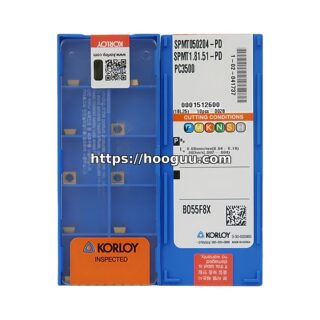

Face milling is the most common milling operation in machine shops working with ISO P steels, and it is also where insert grade selection has the most direct impact on productivity and tool life. Two of the most widely specified grades in this segment are Sandvik GC4240 and Kyocera PR1225. Both are CVD-coated carbide grades positioned by their manufacturers as first-choice recommendations for steel milling, yet they take noticeably different engineering routes in coating architecture, substrate design, and edge preparation.
This guide compares the two grades head to head: how each coating system is built, how the substrates behave under milling loads, which insert geometries they are typically paired with, and what cutting parameter windows (Vc, fz, ap, ae) are realistic for carbon steel, alloy steel, and tool steel workpieces.
Why Insert Grade Choice Matters in Steel Face Milling
Unlike turning, where the cutting edge is continuously engaged, face milling imposes a cyclic thermo-mechanical load on every edge. Each insert enters and exits the cut hundreds of times per minute, and the surface temperature at the cutting zone can fluctuate by several hundred degrees Celsius within a single revolution. This cycling is what makes steel milling grades so demanding to engineer: the coating must resist oxidation and crater wear at elevated temperature, while the substrate and edge preparation must absorb the mechanical shock of entry and exit.
A grade that performs brilliantly in continuous turning can fail by chipping or coating delamination within minutes in an interrupted milling cut. This is why both Sandvik Coromant and Kyocera maintain dedicated milling grades with tougher substrates and, in Kyocera’s case, coating technologies specifically developed to resist layer peeling under cyclic loads. Choosing between them is less about which grade is “better” and more about which one matches your stability conditions, coolant strategy, and the steel group you are cutting.
Sandvik GC4240: Coating Architecture and Intended Window
GC4240 has been Sandvik Coromant’s workhorse first-choice grade for steel milling for many years. It uses a medium-temperature CVD multilayer coating built around a thick MT-TiCN (medium-temperature titanium carbonitride) base layer, a dense aluminum oxide (Al2O3) layer for hot hardness and oxidation resistance, and a thin TiN top layer that gives the insert its characteristic golden color and makes flank wear easy to inspect visually.
The substrate behind the coating is a fine-grain carbide with a cobalt-enriched surface zone. This gradient design concentrates toughness exactly where the edge needs it, improving resistance to micro-chipping at entry and exit without sacrificing the hardness of the bulk material. In practice, GC4240 is characterized by:
- High speed capability in dry cutting. The thick alumina layer holds its integrity well at elevated cutting speeds, making GC4240 a strong performer in stable, continuous face milling where temperature, not impact, is the dominant wear mechanism.
- Good edge security in interrupted cuts. The gradient substrate tolerates entry shock better than older generation steel milling grades, which is why it remains the default recommendation for general steel milling across CoroMill face milling platforms such as CoroMill 245 and CoroMill 345.
- Predictable, gradual wear. GC4240 typically fails by progressive flank and oxidation wear rather than sudden chipping, which simplifies tool life monitoring in production.
The grade is aimed squarely at the middle of the ISO P range: unalloyed and low-alloy steels in the roughly 140–300 HB band, with reduced parameters for harder alloy and tool steels.
Kyocera PR1225: MEGACOAT Nano Technology
PR1225 is Kyocera’s flagship CVD steel milling grade within the MEGACOAT Nano family. The defining feature of this technology is a nano-scale grain structure in the aluminum oxide layer. By controlling alumina grain size during the CVD process, Kyocera achieves a coating with finer, more densely packed crystals than a conventional CVD alumina layer. The practical benefits claimed and observed are:
- Improved coating adhesion under cyclic loads. Nano-grain alumina is less prone to the micro-cracking that eventually causes conventional CVD coatings to peel away in milling. This directly addresses the dominant failure mode of CVD grades in interrupted cutting.
- A tough, ultra-fine grain substrate. PR1225 pairs the coating with a fine-grain carbide substrate tuned for chipping resistance, which is why Kyocera consistently positions it as the first recommendation for steel milling, including in unstable machining and low-frequency vibration conditions.
- Strong performance with coolant. Where many CVD grades are primarily dry-cutting grades, PR1225 is frequently specified for wet milling and emulsion-heavy environments, where the coating’s resistance to thermal cracking matters as much as its wear resistance.
In the ISO classification, PR1225 spans roughly P10–P40 in milling duty, with its sweet spot in general-purpose carbon and alloy steel milling where edge security is at a premium.
Head-to-Head: Coating and Substrate Comparison
The table below summarizes the technical differences between the two grades.
| Property | Sandvik GC4240 | Kyocera PR1225 |
|---|---|---|
| Coating process | Conventional CVD multilayer | MEGACOAT Nano CVD |
| Main layers | MT-TiCN + thick Al2O3 + TiN top layer | Nano-grain Al2O3 over TiCN-based layers |
| Substrate | Fine-grain carbide, cobalt-enriched surface zone | Ultra-fine grain, high-toughness carbide |
| Typical ISO window (milling) | P15–P40 | P10–P40 |
| Key strength | Hot hardness and oxidation resistance at high speed | Edge security and coating adhesion under cyclic load |
| Coolant behavior | Dry cutting preferred; suitable with coolant | Very tolerant of wet cutting and thermal cycling |
| Typical wear mode | Progressive flank wear and oxidation | Flank wear with high chipping resistance |
| Best fit | Stable, high-speed, predominantly dry milling | Unstable setups, interrupted cuts, coolant-heavy jobs |
One way to interpret the table: GC4240 pushes the temperature frontier, while PR1225 pushes the mechanical security frontier. On a rigid, well-clamped workpiece milled dry at high speed, GC4240 will typically allow the higher metal removal rate. As soon as conditions become marginal — long overhang, thin walls, interrupted surfaces, heavy coolant — PR1225’s nano coating and tough substrate tend to hold up better and deliver more predictable tool life.
Insert Geometry Pairing: The Other Half of the Equation
Grade selection alone never determines performance; the chip former and edge preparation do at least as much work. Both manufacturers structure their steel milling inserts along the same three-tier logic, so it is useful to think in terms of duty rather than brand-specific designations.
| Operation | Typical ap | Sandvik geometry family | Kyocera geometry approach |
|---|---|---|---|
| Light / finishing | < 2 mm | -PM light chip former | Sharp edge prep, low-force rake design |
| General purpose | 2–4 mm | -MM medium chip former | Standard honed edge, medium rake |
| Roughing / interrupted | > 4 mm | -RM/-PR tough chip former | Reinforced edge, heavy hone, robust nose |
On the platform side, GC4240 is most commonly seen on 45° face mills such as CoroMill 245 and CoroMill 345, as well as square-shoulder systems, while PR1225 is paired with Kyocera’s 45° face milling and square-shoulder platforms. In both cases, a 45° lead angle is the default for general steel face milling because it thins the chip and reduces edge loading, allowing a higher feed per tooth than a 90° lead angle at the same metal removal rate.
For finishing passes where surface texture is critical, both brands offer wiper-type insert variants that can double the achievable feed rate for a given surface roughness target (Ra), effectively letting one wiper insert smooth the cusp marks left by the neighboring standard inserts.
Cutting Parameter Reference for ISO P Steels
The tables below give typical starting windows synthesized from published manufacturer catalog data and shop-floor experience. Treat them as starting points: always verify against the current catalog for your exact insert geometry, and adjust based on wear mode observed on the machine.
Carbon steel, unalloyed (< 200 HB, ISO P1–P2)
| Parameter | Sandvik GC4240 | Kyocera PR1225 |
|---|---|---|
| Cutting speed Vc | 200–300 m/min | 150–260 m/min |
| Feed per tooth fz (12 mm insert) | 0.12–0.30 mm | 0.10–0.28 mm |
| Depth of cut ap (max) | 5–6 mm | 5–6 mm |
| Engagement ae | 60–75% of Dc | 60–75% of Dc |
Alloy steel, medium strength (200–280 HB, ISO P2–P3)
| Parameter | Sandvik GC4240 | Kyocera PR1225 |
|---|---|---|
| Cutting speed Vc | 150–230 m/min | 130–210 m/min |
| Feed per tooth fz (12 mm insert) | 0.10–0.25 mm | 0.10–0.22 mm |
| Depth of cut ap (max) | 3–5 mm | 3–5 mm |
| Engagement ae | 55–70% of Dc | 55–70% of Dc |
Tool steel and high-strength alloy steel (280–350 HB, ISO P3)
| Parameter | Sandvik GC4240 | Kyocera PR1225 |
|---|---|---|
| Cutting speed Vc | 110–170 m/min | 100–160 m/min |
| Feed per tooth fz (12 mm insert) | 0.08–0.18 mm | 0.08–0.16 mm |
| Depth of cut ap (max) | 2–3.5 mm | 2–3.5 mm |
| Engagement ae | 50–65% of Dc | 50–65% of Dc |
Adjustment rules:
- For interrupted cuts (slots, holes crossing the surface, forged skin), reduce Vc by approximately 20% and select the toughest chip former available.
- When ae falls below half the cutter diameter, chip thinning reduces the effective chip thickness. Increase fz by 20–30% to maintain productivity, but verify the machine has the spindle speed headroom.
- If flank wear accumulates rapidly with no chipping, increase Vc. If the edge chips or the coating flakes, reduce Vc and switch to a tougher geometry before touching the grade.
- For Martensitic stainless (ISO P5.2 territory), both grades can be used at the bottom of the tool steel parameter window, but dedicated PVD stainless grades from either brand will usually outperform them.
Application Scenarios: Which Grade Wins Where
Choose Sandvik GC4240 when:
- The setup is rigid, the workpiece clamping is solid, and the cut is predominantly continuous.
- You are cutting dry or with minimal coolant and want maximum cutting speed in carbon and low-alloy steel.
- Your tool life monitoring relies on gradual, predictable flank wear rather than sudden edge failure.
- You standardize on Sandvik CoroMill platforms and want a grade that is the documented default across the family.
Choose Kyocera PR1225 when:
- Machining conditions are unstable: long tool overhang, thin-walled parts, welded or cast surfaces with interruptions.
- The process runs wet with emulsion, where thermal cracking resistance and coating adhesion matter as much as hot hardness.
- You experience coating delamination or micro-chipping with conventional CVD grades on similar jobs.
- The mixed steel family you cut spans a wide hardness band and you need one grade to cover P10–P40 with acceptable security.
For a mixed-production job shop cutting a broad range of steels in varying stability conditions, both grades can coexist in the tool crib: GC4240 on the dedicated, high-volume face milling fixtures, and PR1225 on the jobs where setup conditions are less predictable.
Practical Tips for Steel Face Milling with CVD Grades
- Enter and exit the cut cleanly. Dwell at entry causes rubbing and thermal spikes; prefer a rolling entry by positioning the cutter so the exit angle is positive, protecting the edge on the way out.
- Respect the position tolerance of inserts. On both brands, run-out beyond a few hundredths of a millimeter overloads individual edges and is a common root cause of premature chipping that gets misattributed to the grade.
- Watch the flank, not just the color. The TiN top layer on GC4240 makes wear inspection easy; with PR1225, use edge microscopy if available, since a nano coating can look intact while flank wear is progressing underneath.
- Match coolant to the grade strategy. If the machine cannot run reliably dry, PR1225 is the more forgiving choice; forcing a dry-optimized CVD grade into flood coolant with intermittent contact invites thermal cracking.
- Index on schedule, not on failure. CVD steel milling grades are inexpensive relative to downtime. Establish an edge life from the first production run and index at 80% of observed failure life.
Conclusion
Sandvik GC4240 and Kyocera PR1225 represent two well-executed but philosophically different answers to the same problem. GC4240 leans on a proven CVD multilayer and a gradient substrate to deliver high-speed, high-temperature capability in stable steel milling. PR1225 counters with nano-grain alumina and an ultra-tough substrate engineered for edge security in unstable, wet, and interrupted conditions. The right choice depends less on specification sheets and more on your setup rigidity, coolant strategy, and how the grade’s wear mode aligns with your process control. Parameterize both honestly, measure wear on real parts, and let your own tool life data make the final call.
Shop Related Products at HOOGUU