


High-Feed Milling Strategy: Korloy HFM Insert Geometry, Cutter Selection, and Parameter Optimization
High-Feed Milling Strategy: Korloy HFM Insert Geometry, Cutter Selection, and Parameter Optimization
High-feed milling (HFM) has become one of the most productive strategies for roughing operations in modern CNC machining. By utilizing extremely low lead angles and shallow axial depths of cut, HFM dramatically increases table feed rates while keeping cutting forces directed axially into the spindle. This article explains the mechanics of high-feed milling and provides practical guidance on Korloy HFM tooling selection, grade matching, and parameter windows for common engineering materials.
How High-Feed Milling Works
Unlike conventional face milling, which typically operates at 45 or 90 degrees, high-feed cutters use insert geometries with lead angles between 10 and 17 degrees. This shallow approach angle effectively thins the chip, allowing the feed per tooth to be increased by a factor of three to five without proportional increases in cutting force. The result is a significantly higher metal removal rate (MRR) with lower radial load on the tool and machine.
The trade-off is a limitation in axial depth of cut. Most HFM operations run at 0.5 mm to 2.0 mm axial depth, making the strategy ideal for rapid material removal over large surfaces, pocket roughing, and cavity opening. Because the majority of the cutting force is directed into the spindle bearings rather than radially, HFM is particularly well-suited to long-overhang applications and machines with limited spindle power.
Korloy HFM Cutter and Insert Families
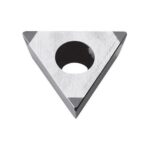
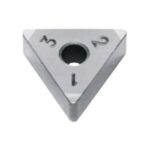
Korloy offers a comprehensive range of high-feed milling systems under the HFE and related modular families. The most common insert shapes are double-sided rectangular or trigon designs with precisely ground positive rake faces and reinforced cutting edges.
Cutter Body Selection
| Cutter Series | Diameter Range | Interface | Best Application |
|---|---|---|---|
| Korloy HFE | 16 – 160 mm | Shell mill / Arbor | Face roughing, pocket opening |
| Korloy HFE Mini | 10 – 32 mm | End mill shank | 3D cavity roughing, small features |
| Korloy HFM Modular | 25 – 100 mm | HSK / CAT / BT | 5-axis and long-overhang work |
For general-purpose roughing of mild steel and cast iron, the standard HFE shell mill in 50 or 63 mm diameter provides an excellent balance of stability and chip evacuation. For mold and die applications involving complex 3D cavities, the HFE Mini end-mill style with a 20 mm shank allows deep reach without excessive machine load.
Insert Geometry and Grade Pairing
Korloy HFM inserts are available with several edge preparations and chipbreaker styles. For roughing applications, a honed or T-land edge provides the necessary impact resistance. For lighter cuts in stainless steel or sticky materials, a sharper edge with polished flanks reduces built-up edge.
| Material Group | Recommended Grade | Coating | Typical Vc (m/min) |
|---|---|---|---|
| Low-alloy steel (P20, 1045) | PC5300 | PVD | 180 – 250 |
| Stainless steel 304/316 | PC9530 | PVD | 120 – 160 |
| Hardened steel 45–55 HRC | PC8110 | PVD | 80 – 120 |
| Grey / Ductile cast iron | PC3545 | CVD | 150 – 220 |
| Aluminum alloys | PCD tipped or uncoated polished | — | 400 – 800 |
The PC5300 grade is an excellent starting point for general steel machining. Its PVD coating offers high hot hardness and oxidation resistance, allowing elevated cutting speeds in stable setups. When transitioning to 304 or 316 stainless steel, PC9530 provides superior crater wear resistance and reduces the tendency for chip welding at the insert tip.
Parameter Optimization
Successful HFM programming depends on respecting the relationship between axial depth, radial width, and feed per tooth. Because the chip is thinned by the shallow lead angle, feed rates must be higher than conventional milling to maintain adequate chip thickness for heat dissipation.
As a general rule, set the axial depth of cut (ap) to no more than 5 percent of the cutter diameter for standard inserts, and up to 10 percent for dedicated long-edge HFM geometries. Radial engagement (ae) can range from 40 to 100 percent of the cutter diameter, making HFM highly efficient for straight-line passes and open pockets.
For a 50 mm HFE cutter running PC5300 in 4140 steel, a practical starting point is ap = 1.0 mm, fz = 1.2 mm/tooth, and Vc = 200 m/min. This yields a table feed of approximately 3,000 mm/min with four inserts and a spindle speed near 1,250 rpm. If vibration or noise occurs, reduce Vc by 15 percent before reducing feed, as HFM relies on adequate chip thickness for stability.
Programming and Toolpath Strategy
High-feed milling benefits from constant-tool-engagement toolpaths. Adaptive clearing and dynamic milling cycles maintain a stable radial load, preventing the insert from entering and exiting the workpiece repeatedly. In open regions, a simple zig-zag or parallel pass at 70 to 100 percent stepover is efficient. In corners, reduce feed by 30 to 40 percent to manage the transient increase in chip load.
Coolant strategy is material-dependent. For steel and cast iron, through-spindle coolant at 70 bar or higher effectively clears chips from the shallow cutting zone. For aluminum, air blast or MQL is often preferred to prevent thermal shock and chip recutting.
Real-World Application Example
A mold shop roughing a P20 cavity block previously used a 40 mm conventional shoulder mill at ap = 5 mm, ae = 20 mm, and fz = 0.15 mm/tooth. Cycle time for the roughing operation was 28 minutes. After switching to a 63 mm Korloy HFE cutter with PC5300 inserts, the shop ran ap = 1.2 mm, ae = 50 mm, and fz = 1.0 mm/tooth. Although the axial depth was reduced, the table feed increased by a factor of six, and the total roughing cycle dropped to 11 minutes while spindle load decreased by approximately 20 percent.
Conclusion
High-feed milling is not merely a faster version of face milling; it is a distinct process with its own parameter envelope and programming rules. Korloy HFE and HFM systems provide a robust platform for implementing this strategy across a wide material spectrum. By matching the correct insert grade to the workpiece and respecting the shallow-depth, high-feed relationship, shops can significantly reduce roughing cycle times while extending spindle and machine life.
For technical datasheets and cutting condition calculators specific to Korloy HFM tooling, contact HOOGUU or refer to the latest Korloy milling catalog.
Shop Related Products at HOOGUU