

Machining Zirconium and Zircaloy Alloys: Korloy Tool Selection for Nuclear, Chemical and Medical Applications
Zirconium and its alloys—most notably Zircaloy-2 and Zircaloy-4—occupy a unique position in advanced manufacturing. With a melting point of 1,855 °C, exceptional corrosion resistance in aqueous environments, and a very low thermal neutron absorption cross-section, these materials are indispensable for nuclear fuel cladding, chemical process equipment, and select medical implants. However, those same properties make zirconium notoriously difficult to machine. Gummy chip formation, strong chemical affinity with tool materials, and poor thermal conductivity place extraordinary demands on cutting tools, coolants, and process parameters. In this guide, we examine the metallurgical challenges of machining zirconium and present practical Korloy tooling solutions that deliver consistent surface integrity and predictable tool life.
Understanding Zirconium’s Machining Behavior
Pure zirconium exists in two allotropic forms: alpha (hexagonal close-packed, stable below 863 °C) and beta (body-centered cubic, stable above 863 °C). Zircaloy alloys retain the alpha structure at room temperature because tin, iron, chromium, and nickel stabilize the alpha phase while strengthening the matrix. From a machining perspective, this hexagonal structure produces segmented, stringy chips that tend to weld onto cutting edges—a phenomenon exacerbated by zirconium’s high chemical reactivity at elevated temperatures.
Unlike titanium, which shares some metallurgical similarities, zirconium has a lower thermal conductivity (approximately 23 W/m·K) and a strong tendency to form built-up edge (BUE) when machined dry. The material also work-hardens rapidly; a single aggressive pass can raise the hardness of the subsurface layer by 20–30 %, making subsequent finishing cuts even more demanding. Tool temperatures can spike quickly because heat does not dissipate through the chip or workpiece efficiently, concentrating instead at the tooltip.
Tool Material and Coating Strategy
For most zirconium turning and milling operations, uncoated fine-grain carbide remains the first choice. The reason is chemical: zirconium has a pronounced affinity for titanium, aluminum, and nitrogen at cutting temperatures, which means that TiAlN and TiN coatings can actually accelerate diffusion wear and edge buildup rather than retard it. Similarly, CBN and PCD are generally avoided in pure zirconium because the material’s softness and gumminess cause rapid edge loading and micro-chipping.
When coatings must be used—for example, in high-volume production where coolant delivery is limited—a thin PVD CrN or DLC coating can provide marginal improvement by reducing chemical reactivity. However, the dominant strategy is to rely on sharp, highly polished uncoated carbide edges with positive rake geometry and generous chipbreaker action.
Turning Zirconium and Zircaloy: Insert and Grade Selection
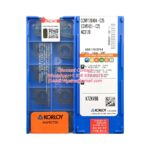
In turning operations, continuous cuts on tubular nuclear cladding or bar stock for chemical valves require inserts that combine edge sharpness with controlled chip flow. Korloy’s uncoated grade KC710 (fine-grain carbide, high toughness) performs well at moderate speeds, offering a balance between crater resistance and edge stability. For heavier roughing passes on cast or forged zirconium billets, KC730 provides additional substrate toughness to withstand intermittent cuts and surface scale.
Chipbreaker selection is equally important. Korloy’s HM and HS chipbreakers are optimized for medium to heavy feed rates in gummy materials; their open groove geometry prevents chip packing and reduces cutting pressure. For finishing operations where surface integrity is critical—such as the final pass on a Zircaloy-4 fuel tube—Korloy’s NM chipbreaker with a light hone edge produces low cutting forces and minimizes subsurface work hardening.
| Operation | Korloy Grade | Chipbreaker | Vc (m/min) | fn (mm/rev) | ap (mm) |
|---|---|---|---|---|---|
| Rough turning – pure Zr | KC730 | HM | 25–35 | 0.20–0.30 | 2.0–4.0 |
| Rough turning – Zircaloy | KC710 | HS | 30–45 | 0.15–0.25 | 1.5–3.0 |
| Finish turning – cladding tube | KC710 | NM | 40–60 | 0.08–0.15 | 0.3–0.8 |
| Grooving / part-off | KC710 | MGMN standard | 20–35 | 0.05–0.12 | Full radius |
Milling Zirconium: Cutter Selection and Parameters
Milling introduces thermal cycling that pure turning does not. Each insert entry and exit generates thermal shock, and because zirconium’s elastic modulus is relatively low (68 GPa, roughly one-third that of steel), workpiece deflection and chatter are common. Rigid setups, short overhangs, and cutters with high positive axial rake are essential.
For face milling and square-shoulder applications on zirconium process vessels and flanges, Korloy’s Mill-Rush indexable shoulder mills with APKT or ADKT inserts deliver excellent chip evacuation. Select uncoated APKT1604 inserts in KC710 grade, and run at light axial depths (ap = 2–4 mm) with high feed rates to keep the tool engaged and avoid dwell. In slotting and pocketing operations common to medical implant preforms, Korloy’s Heli-Mill high-feed cutters with positive-geometry inserts reduce radial forces and suppress chatter.
A critical milling parameter is the radial engagement. In peripheral milling, keep ae below 30 % of cutter diameter to ensure thinning chip loads and reduce heat accumulation. When using adaptive or trochoidal toolpaths—which are highly recommended for zirconium pockets—program a constant ae of 8–12 % and elevate feed per tooth (fz) to 0.12–0.18 mm with 2-flute indexable or solid-carbide tools.
Coolant, Lubrication and Fire Safety
Zirconium machining generates fine particles and turnings that are pyrophoric if allowed to dry and oxidize. A generous flood coolant is mandatory not only for temperature control but also for particle suppression. Water-soluble oil emulsions at 8–10 % concentration provide good lubricity and chip flushing. Never machine zirconium dry, and never allow chips to accumulate in machine sumps or on shop floors.
Because zirconium is chemically reactive with halogens, avoid chlorine-based cutting fluids and solvent degreasers. Some aerospace specifications prohibit sulfurized oils for nuclear-grade zirconium due to potential hydrogen embrittlement concerns; consult the applicable ASTM B353 or ASME specification before selecting lubricant additives. Through-tool coolant is beneficial in drilling and deep-pocket milling, provided filtration is maintained at 25 microns or finer to prevent nozzle blockage by gummy chip fragments.
Drilling and Reaming Considerations
Deep-hole drilling in zirconium—for instrumentation tubes, thermowell bores, or medical cannula preforms—requires careful drill geometry. Korloy’s KTD indexable drill series with WCMT or SPMT inserts can handle diameters from 14 mm upward. For smaller holes, Korloy solid carbide drills with wide flutes and high helix angles (35° or greater) improve chip evacuation. Peck drilling with a retract of 1–1.5× diameter is advisable at hole depths exceeding 3× diameter to clear gummy chips and reintroduce coolant.
Reaming should follow the same philosophy: sharp, uncoated carbide reamers with positive rake and ample margin relief. A reaming speed of 15–25 m/min and feed of 0.1–0.2 mm/rev typically yields H7 tolerance with surface roughness below Ra 0.8 µm, provided the pre-drill is accurately sized and concentric.
Surface Integrity and Post-Machining Handling
Zirconium components for nuclear service often require strict controls on surface finish, residual stress, and contamination. Machined surfaces should be inspected for smeared metal or embedded carbide particles from worn tools; these defects act as stress concentrators and can initiate localized corrosion. If surface discoloration (light grey to straw) appears, it generally indicates insufficient coolant or excessive speed. Dark blue or purple heat tint signals that the alpha-beta transition temperature has been approached locally, and the affected layer must be removed by skim machining or acceptable chemical cleaning.
After machining, store zirconium parts in clean, dry containers. Avoid contact with ferritic residues; iron contamination can initiate galvanic corrosion in reactor coolant environments. Many nuclear fabricators mandate post-machining pickling in a dilute hydrofluoric-nitric acid mixture to restore a passive surface, but this must be performed only by trained personnel with appropriate safety controls.
Conclusion
Zirconium and Zircaloy machining rewards a methodical approach: sharp uncoated carbide tools, generous coolant, controlled speeds, and disciplined chip management. Korloy’s KC710 and KC730 grades, combined with HM, HS, and NM chipbreaker geometries, provide a reliable platform for turning, grooving, and milling these demanding alloys. For fabricators serving nuclear, chemical, and medical markets, investing in the correct tooling strategy upfront eliminates the far costlier risks of scrapped components, fire incidents, or out-of-specification surface integrity. If your shop is transitioning into zirconium work, the HOOGUU technical team can assist with insert selection, parameter benchmarking, and coolant compatibility review tailored to your specific application.
Shop Related Products at HOOGUU