

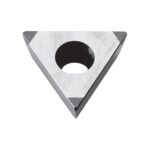
Insert grade selection is often reduced to a single question: which box is cheapest? In practice, the coating system on a turning insert decides whether an edge survives 12 minutes or 30 minutes in the cut, and it dictates the cutting data you can actually run. Korloy’s turning portfolio, built around NC-series CVD grades and PC-series PVD grades, is a clear example of how coating architecture, substrate toughness and edge preparation are balanced across different ISO material groups. This guide decodes that system, compares it with Sandvik Coromant and Iscar equivalents, and provides parameter tables you can take directly to the machine.
Why a 4-micron layer changes the economics of turning
During steel turning, roughly 70–80% of the heat generated in the shear zone is carried away by the chip, but the remaining fraction still reaches the rake face at temperatures between 700 °C and 1,000 °C. An uncoated carbide insert starts to diffuse into the chip at those temperatures: cobalt is depleted from the substrate, the rake face develops a crater, and the edge collapses long before the flank wear land reaches its 0.3 mm limit.
A coating works on two fronts. First, it acts as a chemical diffusion barrier between carbide and workpiece. Second, and often underestimated, it acts as a thermal barrier: an aluminium oxide (Al2O3) layer with a thermal conductivity of roughly 25–30 W/m·K, compared with about 80–100 W/m·K for carbide, forces more heat into the chip and away from the substrate. That is why a 12 µm CVD coating can double tool life in continuous steel turning, while a 3 µm PVD coating on the same substrate will fail by cratering at identical cutting data.
The counter-argument is edge sharpness. Thick CVD coatings round the cutting edge and add tensile residual stress, which promotes micro-cracking in interrupted cuts. PVD coatings are deposited at 450–550 °C instead of 900–1,000 °C, produce compressive residual stress, and can be applied at 2–4 µm on a sharp, honed edge. The result is a grade family split that is not about quality tiers but about failure-mode matching.
Decoding the Korloy turning grade system
Korloy uses a two-letter prefix to identify the coating process, followed by four digits that locate the grade within an application window. NC designates CVD-coated grades, PC designates PVD-coated grades. The digits are not a quality ranking: a higher number generally indicates a tougher substrate with a wider application range, not a better insert. Reading the code as “NC = alumina, thick, steel and cast iron” and “PC = TiAlN-family, thin, sharp, stainless and hardened” is a reliable first filter.
| Grade | Coating system | Thickness | Coating hardness | ISO range | Typical operation |
|---|---|---|---|---|---|
| NC9010 | CVD: MT-TiCN + Al2O3 + TiN top layer | 9–13 µm | 2,000–2,200 HV (Al2O3) | P05–P15 | High-speed finishing of carbon and alloy steel |
| NC9025 | CVD: MT-TiCN + thick Al2O3 + TiN | 12–16 µm | 2,000–2,200 HV | P15–P30 | General turning, mixed continuous and interrupted cuts |
| NC9035 | CVD: TiCN + Al2O3 on tough substrate | 14–18 µm | 1,900–2,100 HV | P30–P45 | Heavy roughing, forged and cast skin, interrupted cuts |
| PC5300 | PVD TiAlN, mono/multilayer | 2–4 µm | 3,000–3,200 HV | P20–P35, K20–K30 | General steel turning with sharp edge and light depth of cut |
| PC9030 | PVD TiAlN nano-multilayer | 3–5 µm | 3,200–3,400 HV | M20–M40 | Stainless, duplex and heat-resistant alloys, built-up edge control |
| PC8110 | PVD AlTiN (high-aluminium) | 2–4 µm | 3,300–3,500 HV | H10–H25 (45–62 HRC) | Hardened steel finishing and light roughing |
CVD grades: alumina as a thermal barrier
What the layer stack actually does
A typical NC-series stack begins with a medium-temperature TiCN (MT-TiCN) base layer, 4–8 µm thick, which provides hardness and adhesion on the substrate. Above it sits the functional layer: α- or κ-Al2O3, typically 3–6 µm, which delivers the oxidation resistance and diffusion barrier. A thin gold TiN top layer, around 0.5–1 µm, identifies the used corner and reduces friction during the first seconds of cut.
The performance difference between NC9010 and NC9025 is mostly substrate and layer thickness, not chemistry. NC9010 runs a harder, more wear-resistant substrate for finishing at 220–300 m/min in 1045 steel. NC9025 uses a tougher substrate with a thicker alumina layer for 180–260 m/min with interrupted cuts and 1.5–4 mm depth of cut. NC9035 adds substrate toughness again for cast or forged skins where the edge is hammered at every revolution.
Where CVD stops working
Thick CVD is the wrong tool for three situations: stainless steel with a strong tendency to built-up edge, hardened steel above 45 HRC, and small-depth finishing where the 0.05–0.08 mm edge rounding cannot fit inside the depth of cut. In those cases the coating’s wear resistance is irrelevant because the failure mode is chipping or adhesion, not cratering.
PVD grades: sharp edges, stainless steel and hardened steel
PC5300 is the general-purpose PVD grade: a TiAlN coating 2–4 µm thick on a fine-grain substrate, deposited at low temperature so the edge stays sharp after honing. It excels where the depth of cut is under 1.5 mm, where the operation is unstable, or where a thick CVD edge radius would rub rather than cut. In 4140 at 28–32 HRC, PC5300 typically runs 140–220 m/min with 0.2–0.3 mm/rev and gives 20–30% lower cutting force than NC9025 at the same feed, at the cost of faster crater wear at high speed.
PC9030 is the stainless workhorse. Its nano-multilayer TiAlN structure, with alternating layers of 20–50 nm, interrupts crack propagation and keeps the coating hard at the 600–700 °C that 304/316 generates at moderate speeds. Combined with a sharp edge and a polished rake face, it suppresses built-up edge, which is the dominant failure mode in austenitic stainless. Expect 120–180 m/min in 304 and 60–100 m/min in 2205 duplex.
PC8110 uses a high-aluminium AlTiN coating for hardened steel. At 45–62 HRC the workpiece is harder than the chip is ductile, so heat is concentrated in a very narrow zone and the coating must resist oxidation above 850 °C. PC8110 runs 70–110 m/min with 0.08–0.18 mm/rev and 0.2–1.0 mm depth of cut; it is a finishing grade, not a replacement for PCBN in continuous hard turning above 55 HRC.
Wear mechanism to grade decision map
Grade selection becomes predictable once the dominant wear mode is identified. The table below converts what you see on the used corner into a corrective action.
| Observed wear | Root cause | Grade / parameter response |
|---|---|---|
| Crater on rake face | Diffusion at high interface temperature | Move to CVD (NC9025/NC9010) or reduce Vc by 15–20% |
| Uniform flank wear | Abrasive scale, sand or cast skin | Use tougher substrate, increase f slightly, reduce Vc 10% |
| Notch at depth-of-cut line | Work-hardened surface layer, ap too small | Increase ap above the hardened layer, vary ap between passes |
| Built-up edge | Adhesion in stainless or low-carbon steel | PVD PC9030, sharper edge, raise Vc and f, check coolant |
| Plastic deformation | Rake-face temperature above substrate limit | Lower Vc, choose higher cobalt substrate, wider T-land |
| Thermal cracks | Cyclic heating and cooling with coolant | Tough grade, reduce coolant at interrupted entry, lower Vc |
| Chipping at entry | Impact load on a brittle edge | Increase hone/T-land, reduce feed at entry, use NC9035 |
Cutting parameter reference by ISO group
The values below are production starting points for a rigid setup (tool overhang under 3× diameter, 40+ kW spindle, flood coolant). Reduce Vc by 20–30% on small lathes or long overhangs, and always run a first-article check on tool life rather than surface finish alone.
| ISO | Workpiece | Grade | Vc (m/min) | f (mm/rev) | ap (mm) |
|---|---|---|---|---|---|
| P | 1045 carbon steel, 180 HB | NC9025 rough / NC9010 finish | 180–260 / 220–300 | 0.25–0.40 / 0.10–0.20 | 1.5–4.0 / 0.5–1.5 |
| P | 4140 alloy steel, 28–32 HRC | NC9025 / PC5300 | 150–220 | 0.20–0.35 | 1.0–3.0 |
| P | 42CrMo4 forged, with skin | NC9035 | 120–180 | 0.30–0.50 | 2.0–5.0 |
| M | 304 / 316 austenitic stainless | PC9030 | 120–180 finish / 100–150 rough | 0.15–0.30 | 0.8–2.5 |
| M | 2205 duplex stainless | PC9030 | 60–100 | 0.10–0.20 | 0.5–1.5 |
| K | Grey cast iron, 250 HB | NC9025 / PC5300 | 150–220 | 0.20–0.35 | 1.0–3.0 |
| H | Tool steel, 52 HRC | PC8110 | 70–110 | 0.08–0.18 | 0.2–1.0 |
| S | Inconel 718, aged | PVD S-grade (PC9030 as fallback) | 35–50 | 0.10–0.20 | 0.5–2.0 |
For milling with the same coating families, translate the feed into fz: a 45° face mill with 4 teeth running 0.15–0.25 mm/tooth at ae = 50–70% of cutter diameter and ap = 0.5–2.0 mm behaves similarly to the turning data above, provided the cutter body is stiff and the insert pocket repeatability is within 0.02 mm.
Korloy vs Sandvik vs Iscar: family-level cross-reference
Grade numbers are not interchangeable between brands. Substrate grain size, cobalt content, layer thickness and edge preparation all shift the application window by 10–20%. The table below maps the closest class rather than claiming an exact match; use it to shortlist, then validate with a tool-life test.
| Application class | Korloy | Sandvik Coromant | Iscar |
|---|---|---|---|
| Steel, CVD finishing | NC9010 | GC4315 | IC8250, finishing edge prep |
| Steel, CVD general purpose | NC9025 | GC4325 | IC8250 |
| Steel, CVD roughing | NC9035 | GC4335 | IC8350 |
| Steel, PVD sharp edge | PC5300 | GC1025 | IC907, light-cut geometry |
| Stainless, PVD | PC9030 | GC2035 stainless class | IC907 |
| Hardened steel, PVD | PC8110 | Dedicated hardened-steel line | Dedicated hardened-steel line |
Two practical differences matter more than grade naming. First, Sandvik’s Inveio technology orients the alumina crystals in the CVD layer along the cutting direction, which improves crater resistance by roughly 10–15% at equal thickness; Korloy compensates with a thicker functional alumina layer in the NC9025 class. Second, Iscar tends to pair its CVD grades with more aggressive chipbreakers and a wider T-land, which favours high-feed roughing but demands more spindle power than a Korloy PC5300 setup at the same metal removal rate.
Chipbreaker and edge preparation: the other half of the grade
A grade cannot be evaluated without its chipbreaker. The same NC9025 substrate is offered with a finishing geometry (small rake land, 5–8° rake angle, chipbreaker width around 1.0–1.5 mm) and a roughing geometry (wider chipbreaker, 0.15–0.25 mm T-land, negative rake). Running a roughing geometry at 0.8 mm depth of cut produces rubbing and notch wear, while running a finishing geometry at 4 mm depth of cut produces chipping. Match the chipbreaker to depth of cut and feed, not to the material alone.
Edge preparation follows the same logic. For stainless and heat-resistant alloys, use a sharp edge with a 0.01–0.02 mm hone to reduce cutting forces and built-up edge. For cast or forged skins and interrupted cuts, use a 0.03–0.05 mm hone plus a 0.10–0.20 mm T-land to survive impact. When PC9030 chips at entry, the solution is often a wider T-land rather than a tougher grade.
Worked examples
Example 1: 4140 shaft, Ø120 mm, roughing and finishing
Roughing with NC9025 at Vc 200 m/min, f 0.30 mm/rev, ap 3.0 mm gives 530 rpm and a metal removal rate of about 180 cm³/min. Finishing with NC9010 at Vc 260 m/min, f 0.12 mm/rev, ap 0.5 mm gives 690 rpm and 15.6 cm³/min. The grade split matters: using NC9010 for roughing would trade a 20–30% speed gain for a 40% drop in impact resistance, while using NC9025 for finishing would leave a 0.08 mm edge radius that rubs at 0.5 mm depth of cut.
Example 2: 304 stainless valve body, Ø80 mm, continuous cut
PC9030 at Vc 150 m/min, f 0.20 mm/rev, ap 1.5 mm gives 597 rpm and 45 cm³/min. If built-up edge appears, raise Vc to 170 m/min before changing grades, and verify that coolant is directed at the cutting zone rather than at the chip. If the insert still fails by chipping, move to a tougher stainless-grade substrate with the same PVD chemistry rather than to a CVD grade, which would accelerate adhesion.
Common mistakes that shorten tool life
- Using CVD in stainless steel. The alumina layer is chemically stable but the thick, rounded edge promotes built-up edge and smearing. PVD with a sharp edge is the correct starting point.
- Pushing PVD into high-speed continuous steel. Above 250 m/min in 1045, a 3 µm TiAlN coating crater-wears two to three times faster than a 12 µm CVD stack.
- Depth of cut below the hone radius. An ap of 0.3 mm with a 0.08 mm edge radius causes rubbing, work hardening and notch wear. Either increase ap or use a sharp finishing insert.
- Ignoring the entry condition. Interrupted cuts need toughness and edge preparation; a finishing grade will chip regardless of coating hardness.
- Changing grade before changing parameters. Ten to fifteen percent Vc reduction often recovers tool life without a grade change; the reverse order is expensive.
Selection checklist
- Identify the ISO group and hardness first; the grade family follows from the material, not from the insert shape.
- Define the dominant failure mode from a used corner: crater, flank, notch, built-up edge, chipping or deformation.
- Choose CVD for continuous steel and cast iron, PVD for stainless, hardened steel, small depths and unstable setups.
- Match chipbreaker and edge hone to depth of cut and entry condition before adjusting speed.
- Start at the lower third of the recommended Vc window, then increase in 10% steps while monitoring flank wear at fixed intervals.
- Validate any cross-brand substitution with a controlled tool-life trial at identical Vc, f and ap.
Conclusion
Korloy’s NC and PC grade families are best understood as two answers to two different failure modes, not as a ladder from economy to premium. CVD grades buy crater and flank wear resistance through a thick alumina barrier; PVD grades buy edge sharpness, toughness and adhesion control through a thin, compressively stressed TiAlN or AlTiN layer. Once the failure mode and the ISO group are known, the grade, chipbreaker and parameter window follow logically, and cross-brand comparisons become a matter of validating a class rather than collecting grade numbers. The parameter tables above are a starting point; a single controlled tool-life test on your own machine will tell you more than any catalogue rating.
Shop Related Products at HOOGUU