

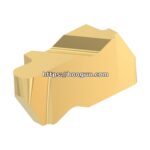

Introduction: Why Coating Technology Decides Insert Performance
In modern carbide turning, the coating is no longer a protective afterthought — it is the performance ceiling of the entire cutting edge. A well-designed substrate can only express its full toughness and deformation resistance when the coating on top of it delivers low friction, high hot hardness, and reliable edge retention. Japanese manufacturer Kyocera has built its indexable insert lineup around exactly this principle, and its flagship PVD platform, MEGACOAT NANO, sits at the center of that strategy.
This article explains how MEGACOAT NANO works at the microstructure level, walks through the main turning grades in the portfolio, provides practical cutting parameter starting points for steel and stainless steel, and compares the technology honestly with competing PVD systems from Sandvik, Tungaloy, and Iscar.
What Is MEGACOAT NANO?
MEGACOAT NANO is Kyocera’s second-generation nanocomposite PVD coating platform, developed as the successor to the original MEGACOAT system. While conventional PVD coatings deposit a relatively coarse columnar structure, MEGACOAT NANO is engineered as an alternating multilayer film built from individual layers in the nanometer range. Kyocera’s published technical literature describes layers with a periodicity of roughly 10 nm, meaning hundreds of alternating sub-layers are stacked within a total coating thickness of only 2–4 µm.
The Nano-Multilayer Structure
The coating chemistry is based on aluminum-rich nitride systems — AlTiN-type and AlCrN-type compounds with controlled additions of refractory metals and, in some grades, silicon. Two structural mechanisms give the platform its character:
- Crack deflection at layer interfaces. When a crack propagates through the coating, each nanolayer boundary forces it to change direction and lose energy. The result is a coating that behaves like a hard material in terms of wear resistance but like a much tougher material in terms of resistance to chipping and flaking.
- Refined grain structure. Because each layer is only a few nanometers thick, columnar grains never get the chance to grow coarse. The deposited film is fine-grained and dense, which produces a noticeably smoother as-coated surface than older PVD generations.
The smoother as-deposited surface has a direct consequence at the cutting edge: lower friction against the chip, less heat generated in the secondary shear zone, and reduced susceptibility to built-up edge — a critical property for stainless steel and low-carbon steels, where adhesion is the dominant wear mechanism.
Key Technical Properties
The table below summarizes the characteristic property ranges of the MEGACOAT NANO platform and their practical significance at the cutting edge.
| Property | Typical Range | Why It Matters in Cutting |
|---|---|---|
| Coating hardness | ~3,300–3,600 HV | High abrasive wear resistance against medium-carbon and alloyed steels |
| Maximum service temperature | ~1,000–1,100 °C | Hot hardness retention at high cutting speeds and in dry machining |
| Coating thickness | 2–4 µm | Preserves the sharp PVD cutting edge required for fine finishing |
| As-coated surface roughness | Low, fine-grained | Reduces friction and built-up edge in sticky materials |
| Oxidation resistance | High (high Al content) | Slows crater wear progression at elevated speeds |
| Residual stress state | Controlled compressive | Improves resistance to edge chipping in interrupted cuts |
These are platform-level characteristics; each individual grade combines the coating with a matched substrate (cobalt-enriched surface zones, fine-grain carbide) and edge preparation to target a specific application window.
The MEGACOAT NANO Turning Grade Portfolio
Kyocera’s MEGACOAT NANO turning grades follow the familiar ISO P (steel) and ISO M (stainless steel) structure. The most commonly used grades are summarized below.
| Grade | ISO Group | Application Window | Characteristic Strength |
|---|---|---|---|
| PR1025 | P01–P15 | Finishing to light medium turning of steel, continuous cuts | Highest speed capability, sharp edge, excellent surface finish |
| PR1215 | P15–P30 | Medium-duty turning of steel, general purpose | Balanced wear resistance and toughness |
| PR1225 | P20–P40 | Roughing and interrupted cutting of steel | High edge security, resistant to chipping and thermal cracking |
| PR1115 | M05–M25 | Finishing and medium turning of stainless steel | Built-up edge resistance, stable wear in continuous cuts |
| PR1125 | M10–M35 | Medium to rough turning of stainless and duplex steels | Toughness for variable and interrupted conditions |
| PR930 | P/M | General-purpose steel and stainless turning | First-choice grade for mixed job-shop production |
Choosing Between PR1025, PR1215, and PR1225
The steel grade trio is best understood as a toughness ladder. PR1025 carries the thinnest edge preparation and targets continuous finishing cuts where surface finish and dimensional consistency dominate. PR1215 is the workhorse: if a shop can only stock one steel grade for turning, this is the balanced middle option. PR1225 trades a measure of wear resistance for significantly higher edge security — the correct choice when the insert must survive forged skins, cross-holes, or unfavorable workpiece clamping.
For stainless steel, the logic shifts from speed capability to adhesion control. PR1115 is aimed at finishing and medium cuts in austenitic grades where built-up edge ruins surface finish, while PR1125 handles the rougher, more interrupted side of ISO M machining, including work-hardening-prone duplex steels.
Recommended Cutting Parameters
The values below are indicative starting points compiled from Kyocera catalog guidance and established shop practice for coated carbide turning. Actual optimum values depend on workpiece condition, insert geometry, machine rigidity, and coolant strategy — always fine-tune from these baselines.
Steel Turning (ISO P, HB 150–300)
| Grade | Cutting Speed Vc (m/min) | Feed f (mm/rev) | Depth of Cut ap (mm) |
|---|---|---|---|
| PR1025 | 180–350 | 0.05–0.25 | 0.3–2.5 |
| PR1215 | 150–300 | 0.10–0.35 | 0.5–4.0 |
| PR1225 | 120–260 | 0.15–0.45 | 1.0–6.0 |
| PR930 | 140–280 | 0.10–0.40 | 0.5–5.0 |
Stainless Steel Turning (ISO M, Austenitic and Duplex)
| Grade | Cutting Speed Vc (m/min) | Feed f (mm/rev) | Depth of Cut ap (mm) |
|---|---|---|---|
| PR1115 | 120–220 | 0.08–0.30 | 0.3–2.5 |
| PR1125 | 100–200 | 0.10–0.40 | 0.5–4.0 |
| PR930 | 110–190 | 0.10–0.35 | 0.5–3.5 |
Parameter Tuning Tips
- Interrupted cuts: reduce Vc by 20–30% from the table baseline and keep the feed in the middle of the range; a light feed at high speed is the fastest way to notch and micro-chip a PVD edge on forged surfaces.
- Stainless work hardening: never let the feed drop below roughly 0.08–0.10 mm/rev. If the chip thins too far, the edge rubs inside the work-hardened layer from the previous pass, and flank wear accelerates sharply.
- Built-up edge control: in austenitic stainless, prefer the high side of the recommended Vc window with PR1115 rather than slowing down; increasing speed raises the interface temperature above the adhesion range.
- Coolant: MEGACOAT NANO grades tolerate both wet and dry machining. For austenitic stainless at Vc above ~180 m/min, emulsion cooling generally stabilizes tool life; for interrupted steel roughing with PR1225, dry cutting or high-pressure targeting reduces thermal cracking.
- Chatter: if chatter appears at the recommended ap, reduce depth of cut by 25% and increase feed proportionally to keep material removal rate constant — the coating’s toughness margin usually absorbs this trade-off cleanly.
MEGACOAT NANO in Milling and Holemaking
Although this article focuses on turning, the same coating platform extends across Kyocera’s milling grades — notably PR1425 and PR1435 for steel milling. Typical starting parameters for shoulder and face milling of medium-carbon steel are Vc 150–280 m/min with fz 0.08–0.20 mm/tooth for PR1425, and Vc 120–220 m/min with fz 0.10–0.30 mm/tooth for the tougher PR1435. In milling, the nano-multilayer’s resistance to thermal cycling is the property that matters most, since each tooth exit generates a quench cycle that would crack a more brittle coating.
Kyocera’s indexable and exchangeable-head drill systems also draw on the MEGACOAT family for their steel application ranges, where the coating’s adhesion resistance helps keep the margin and rake face clean across long hole depths.
MEGACOAT NANO vs Competing PVD Systems
No coating exists in a vacuum. Buyers evaluating Kyocera inserts will naturally cross-shop the PVD flagships of the other major carbide producers. The comparison below positions the systems by application intent and typical steel-turning speed windows; within each brand, the specific insert geometry often matters more than the grade number itself.
| Brand / System | Representative Grades | Technology Approach | Typical Vc in Steel (m/min) | Positioning |
|---|---|---|---|---|
| Kyocera MEGACOAT NANO | PR1025, PR1215, PR1225 | ~10 nm alternating multilayer AlTiN-based PVD | 120–350 | Sharp-edge finishing through secure roughing; strong stainless adhesion resistance |
| Sandvik Zertivo | GC1115, GC4325 | Zertivo PVD with optimized zone technology | 150–350 | Predictable wear and excellent edge-line security in steel |
| Tungaloy AH8000 series | AH8015, AH8025 | Fine-grain AlTiCrN-based PVD (“smarter coating”) | 120–350 | Balanced general steel machining with high toughness reserves |
| Iscar PVD steel grades | IC806, IC807 | AlTiN multilayer PVD | 150–300 | Wide steel coverage with strong geometry ecosystem |
Where Kyocera Has the Edge
The nano-multilayer architecture gives MEGACOAT NANO two distinctive advantages. First, the combination of high hardness with interface-based crack deflection produces exceptional edge-line stability in finishing cuts — shops running PR1025 at the top of its speed window typically report consistent flank wear progression rather than sudden edge breakdown, which simplifies tool-life management. Second, the fine-grained as-coated surface is a genuine asset in austenitic stainless steel, where PR1115’s resistance to built-up edge is competitive with any rival platform.
Where Competitors Compete Hardest
Sandvik’s Zertivo technology has earned a strong reputation for process reliability in large-volume automotive steel machining, where predictable wear curves and broad geometry availability matter more than peak performance. Tungaloy’s AH8000 series competes aggressively on price-performance and toughness in roughing, and Iscar’s strength lies in the depth of its insert geometry portfolio around its PVD grades. In practice, a well-run tooling evaluation across all four brands on the actual workpiece mix will frequently find differences of only 10–15% in tool life — which is why parameter discipline and geometry selection deserve as much attention as the grade choice itself.
Practical Application Notes
- Steel shaft and sleeve finishing: PR1025 with a positive geometry, Vc 280–350 m/min, f 0.10–0.15 mm/rev, ap 0.5–1.0 mm — expect stable Ra values and long continuous cuts.
- General job-shop steel turning: PR1215 or PR930 as the default; hold PR1025 for dedicated finishing jobs and PR1225 for forgings and unstable clamping.
- Austenitic stainless flanges and fittings: PR1115, Vc 160–220 m/min, f 0.12–0.25 mm/rev; prioritize constant surface speed programming to keep interface temperature in the adhesion-safe range.
- Duplex and super-duplex stainless: PR1125 with reduced Vc (90–140 m/min), medium feed, and rigid setup; these alloys punish both low feed and excessive speed.
- Interrupted steel roughing: PR1225, Vc 120–180 m/min, robust edge preparation, and favor dry cutting or targeted coolant to limit thermal cracking.
Conclusion
MEGACOAT NANO demonstrates how far PVD coating engineering has moved beyond simple “hard gold layer” thinking. By building the film from alternating nanometer-scale layers, Kyocera achieves a rare combination: diamond-like hardness at the surface, tough crack-deflecting behavior in depth, and a smooth finish that resists the adhesion problems that plague stainless machining. For buyers, the practical path is straightforward — match the grade to the application window (PR1025 finishing, PR1215 general, PR1225 roughing, PR1115/PR1125 stainless), start from the parameter tables above, and fine-tune against observed wear modes.
Quick selection checklist:
- Continuous finishing of steel at high speed → PR1025
- Balanced everyday steel turning → PR1215 or PR930
- Roughing, forgings, interrupted cuts → PR1225
- Stainless finishing, built-up edge problems → PR1115
- Stainless roughing, duplex alloys → PR1125
Shop Related Products at HOOGUU