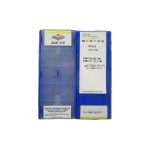
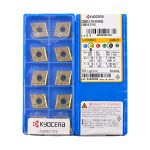
Cast iron turning looks simple from the outside: the material is brittle, the chips break on their own, and the hardness is moderate. In practice, foundry iron is one of the most demanding substrates for a coated carbide insert. The graphite phase interrupts the metal matrix, sand inclusions from the moulding line act as an abrasive, and the surface skin is harder and more irregular than the core. The result is a wear pattern that is dominated by abrasion and notch wear rather than by the crater wear seen on steel.
That is why two brands can offer “cast iron grades” with almost identical cutting speed recommendations and still behave very differently on the same machine. This article compares the cast iron turning portfolios of Kyocera and Korloy — specifically the CA5525 and CA6525 CVD grades against the CC6050 and CC670 CVD grades — and gives practical cutting data for grey, ductile and compacted graphite iron.
Why Cast Iron Rewards a Different Grade Logic
Three mechanisms drive insert life in foundry iron, and they pull the grade design in different directions:
- Abrasion from sand and carbides. Moulding sand (mainly SiO2) and the hard eutectic carbides in chilled or alloyed irons scratch the coating. Wear resistance is a function of total coating thickness and of the hardness of the outer layer — which is why thick CVD Al2O3 dominates this application.
- Notch wear at the depth-of-cut line. The hard cast skin and the work-hardened layer left by the previous pass attack the insert exactly at the ap boundary. Inserts with a sharp, unsupported edge fail there first.
- Mechanical and thermal shock. Ports, risers, core holes and interrupted brake-disc faces produce impact loads. A 12 µm CVD stack on a cobalt-enriched substrate survives them better than a thin PVD film, provided the edge is prepared with a T-land.
The practical consequence: cast iron grades are built around a thick Al2O3 top layer for abrasion resistance, a tough, cobalt-rich substrate, and an edge hone or T-land that prevents chipping. Everything else — speed, feed, coolant — is tuned around that core design.
Grade Architecture: What Each Family Is Built For
Kyocera CA5525 and CA6525
Kyocera’s cast iron turning range is organised around two CVD grades that share a similar coating stack but differ in substrate toughness and edge treatment.
- CA5525 — a CVD grade with a TiN/TiCN base layer and a relatively thick alpha-Al2O3 top layer over a hard, wear-resistant substrate. It is positioned for continuous and lightly interrupted turning of grey iron at higher cutting speeds, where abrasive wear sets the tool life. Typical working range: Vc 180–320 m/min in GJL 200–250.
- CA6525 — the tougher companion grade. The substrate is more cobalt-enriched and the edge is normally delivered with a stronger hone, which trades a small amount of wear resistance for a significant improvement in resistance to chipping and thermal cracking. It is the grade to reach for in ductile iron, in CGI, and in any operation with interrupted entries such as manifold flange faces or brake drum rims. Typical working range: Vc 140–240 m/min in GJS 500-7.
Both grades are designed to run without coolant in grey iron. That is not a limitation — dry cutting avoids the thermal cycling that cracks a thick CVD coating, and the graphite in grey iron provides enough internal lubrication to keep friction manageable.
Korloy CC6050 and CC670
Korloy approaches the same problem with a slightly different split:
- CC6050 — a general-purpose CVD cast iron grade with a TiCN/Al2O3 multilayer and a substrate tuned for a balance between wear resistance and edge strength. It is the “first insert in the turret” grade for mixed cast iron production: it will run grey iron, ductile iron and malleable iron without changing the tool offset. Typical working range: Vc 160–280 m/min in grey iron, Vc 130–220 m/min in ductile iron.
- CC670 — the high-speed, high-abrasion grade. The Al2O3 layer is thicker and the surface is smoother, which reduces friction and built-up edge on the bright machined skin. It is the classic choice for brake discs and brake drums, where the insert runs at 250–400 m/min on a interrupted, scale-covered face and must survive both abrasion and impact.
In Korloy’s naming convention, the two grades are usually paired with different chipbreaker families: SA (semi-finishing) or MA (medium) for CC6050 in general turning, and HM (heavy machining) or a reinforced MA variant for CC670 in brake component work.
Side-by-Side Comparison
| Attribute | Kyocera CA5525 | Kyocera CA6525 | Korloy CC6050 | Korloy CC670 |
|---|---|---|---|---|
| Coating type | CVD, thick Al2O3 | CVD, Al2O3 + tough substrate | CVD multilayer TiCN/Al2O3 | CVD, thick smooth Al2O3 |
| Wear resistance | Very high | High | High | Very high |
| Edge toughness | Medium | High | Medium-high | Medium |
| Best iron type | Grey iron, continuous | Ductile, CGI, interrupted | Mixed grey/ductile/malleable | Grey iron, brake components |
| Typical Vc (grey iron) | 180–320 m/min | 150–260 m/min | 160–280 m/min | 220–400 m/min |
| Typical Vc (ductile iron) | 140–240 m/min | 120–200 m/min | 130–220 m/min | 150–260 m/min |
| Coolant | Dry preferred | Wet or dry | Dry preferred | Dry preferred |
| Edge preparation | Light hone | Strong hone / T-land | Standard hone | Reinforced hone |
The takeaway from the table is that the two brands do not compete grade-for-grade. Kyocera splits along substrate toughness (CA5525 hard, CA6525 tough), while Korloy splits along operating point (CC6050 general, CC670 high speed). On a mixed-iron shop floor, that difference changes which insert stays in the machine.
Cutting Data by Iron Type
The tables below assume a rigid CNC lathe, a coated carbide insert with a 0.8 mm nose radius, and a stable depth of cut of at least 1 mm. Reduce cutting speed by 15–20% for the first pass on a scaly casting skin, and by a further 10% for small-diameter work where heat concentration is higher.
Grey Iron (GJL 200 / GJL 250 / GG25 / GG30)
| Operation | ap (mm) | f (mm/rev) | Vc CA5525 (m/min) | Vc CC670 (m/min) | Ra achievable (µm) |
|---|---|---|---|---|---|
| Rough turning | 3.0–6.0 | 0.25–0.40 | 200–260 | 220–300 | 6.3–12.5 |
| Semi-finish | 1.5–3.0 | 0.20–0.30 | 220–280 | 250–350 | 3.2–6.3 |
| Finish (standard) | 0.5–1.5 | 0.10–0.20 | 240–300 | 280–380 | 1.6–3.2 |
| Finish (wiper) | 0.3–1.0 | 0.25–0.45 | 240–300 | 280–380 | 0.8–1.6 |
| Interrupted face | 1.0–3.0 | 0.15–0.25 | 160–220 | 180–250 | 3.2–6.3 |
Ductile / Nodular Iron (GJS 400-15, 500-7, 600-3)
| Operation | ap (mm) | f (mm/rev) | Vc CA6525 (m/min) | Vc CC6050 (m/min) | Notes |
|---|---|---|---|---|---|
| Rough turning | 2.5–5.0 | 0.25–0.35 | 140–180 | 150–190 | Strong hone required |
| Semi-finish | 1.5–2.5 | 0.20–0.30 | 150–200 | 160–210 | Watch notch wear |
| Finish | 0.5–1.5 | 0.10–0.20 | 160–220 | 170–230 | Wiper optional |
| GJS 600-3, pearlitic | 1.0–3.0 | 0.15–0.25 | 120–160 | 130–170 | Higher hardness, lower Vc |
| Interrupted / ported | 1.0–2.5 | 0.12–0.20 | 110–150 | 120–160 | Reduce feed before speed |
Compacted Graphite Iron (GJV 450 / CGI)
CGI is the hardest of the three to turn because the graphite is compacted rather than flake or nodular: tensile strength reaches 450 MPa and the material generates high cutting forces with strong notch wear tendency. Thick CVD coatings survive longer than PVD here, but the edge must be robust.
| Operation | ap (mm) | f (mm/rev) | Vc (m/min) | Edge preparation |
|---|---|---|---|---|
| Rough turning | 2.0–4.0 | 0.20–0.30 | 80–120 | T-land 0.10 × 20° |
| Semi-finish | 1.0–2.0 | 0.15–0.25 | 100–150 | T-land 0.08 × 20° |
| Finish | 0.3–1.0 | 0.08–0.15 | 120–180 | Honed, sharp |
| Boring (L/D > 3) | 0.5–2.0 | 0.10–0.20 | 70–110 | Honed + anti-vibration bar |
Interrupted-Cut Derating
For castings with more than four interruptions per revolution — brake drums with cooling ribs, manifold flanges, pump housings with cored passages — apply the following correction to the continuous-cutting speed:
| Interruption severity | Example part | Vc correction | Feed correction |
|---|---|---|---|
| Mild (1–3 per rev) | Keyway, single slot | −10% | 0% |
| Moderate (4–8 per rev) | Brake drum ribs | −20% | −10% |
| Severe (> 8 per rev) | Ported manifold face | −30% | −15% |
| Scale-covered first pass | Any raw casting | −15% | −10% |
Geometry, Edge Preparation and Wiper Inserts
Coating decides how long an insert lasts; geometry decides whether it survives the first minute. For cast iron, three geometric decisions matter:
- Lead (approach) angle. A 45° lead angle distributes the cut over a longer edge, thinning the chip and reducing notch pressure at the depth-of-cut line. For roughing scaly castings, 45° is safer than 90°, which concentrates load on a short edge.
- Rake face. Cast iron does not need the positive rake used on stainless steel. A slightly negative to neutral rake with a T-land gives the edge the compressive strength to resist chipping, at the cost of higher cutting force — acceptable because grey iron produces segmented, low-friction chips.
- Wiper geometry. A wiper insert — a small secondary flat behind the nose radius — flattens the feed marks. At f = 0.30 mm/rev and rε = 0.8 mm, a standard insert gives Ra ≈ 2.4 µm (from Ra ≈ f²/32rε ≈ 3.5 µm theoretical, corrected for real edge condition), while a wiper insert on the same pass reaches Ra ≈ 1.0–1.2 µm. That allows one finishing pass instead of two on bores and flange faces.
Both brands offer wiper versions in their cast iron ranges; when specifying, confirm that the wiper edge is available in the same grade as the roughing insert, otherwise tool offsets must be reset between operations.
Application Gallery: Four Typical Castings
| Part | Iron type | Recommended grade | Key parameter | Main failure mode |
|---|---|---|---|---|
| Brake disc (double face) | GJL 250 | Korloy CC670 / Kyocera CA5525 | Vc 280–360, f 0.20–0.30, ap 0.8–1.5 | Abrasion + thermal cracks |
| Exhaust manifold face | GJS 450-10 / SiMo | Kyocera CA6525 | Vc 120–160, f 0.15–0.25 | Chipping at ports |
| Hydraulic valve body bore | GJL 250 | Korloy CC6050 | Vc 200–260, f 0.10–0.18, boring bar L/D < 4 | Notch wear + chatter |
| Cylinder liner (rough + finish) | GJL 300 / alloyed | Kyocera CA5525 + wiper | Vc 220–280, f 0.25 wiper | Edge build-up, Ra drift |
Force and Power Verification
Cast iron is often run at speeds that quietly exceed the spindle or fixture capability. A quick check prevents chatter that would otherwise be blamed on the insert grade.
Using the specific cutting force approach, Fc ≈ kc × ap × f, with kc ≈ 1100–1300 N/mm² for grey iron and 1400–1600 N/mm² for ductile iron:
- Example: GJL 250, ap = 2.5 mm, f = 0.30 mm/rev, Vc = 240 m/min, kc = 1200 N/mm².
- Chip area = 0.75 mm² → Fc ≈ 900 N.
- Net power = Fc × Vc / 60 000 = 900 × 240 / 60 000 ≈ 3.6 kW.
- With 85% machine efficiency, spindle input ≈ 4.2 kW — comfortably inside a 7.5 kW lathe, but close to the limit of a 5.5 kW machine at the top of the speed range.
If the calculated power exceeds 80% of the available spindle power, reduce ap first (it lowers force linearly), then Vc. Reducing feed is the least effective correction because it also raises the specific cutting force per unit volume.
Wear Diagnosis: How the Two Families Differ in Service
| Wear mode | Typical appearance | Behaviour of CA5525 / CC670 | Behaviour of CA6525 / CC6050 | Countermeasure |
|---|---|---|---|---|
| Flank abrasion | Uniform VB band | Long life, gradual | Shorter life, still predictable | Raise Vc slightly; check sand content |
| Notch wear | Groove at ap line | Moderate | Lower with strong hone | Vary ap between passes; 45° lead angle |
| Edge chipping | Small nicks on nose | Frequent in interrupted cuts | Rare | Switch grade, add T-land, reduce Vc |
| Thermal cracks | Comb cracks on rake | Appears with wet cutting | Appears with wet cutting | Run dry, or flood coolant without interruption |
| Built-up edge | Smearing on rake | Low tendency | Low tendency | Raise Vc; check coating smoothness |
| Plastic deformation | Rounded nose | Only above 400 m/min | Rare | Reduce Vc, use tougher substrate |
In a mixed production cell the practical rule is: start with the high-wear grade (CA5525 or CC670), and move to the tougher grade (CA6525 or CC6050) only when the failure mode is chipping rather than wear. Many shops do the opposite — they start with the toughest available insert, then compensate for the resulting poor surface finish by lowering speed, which costs cycle time on every part.
Coolant Strategy
Cast iron turning is one of the few operations where dry machining is usually the better default:
- Grey iron, dry: graphite acts as a solid lubricant, chips are free-flowing and the workpiece does not need cooling. Eliminating coolant also removes the thermal cycling that produces comb cracks in thick CVD coatings.
- Ductile iron, dry or minimum quantity: graphite is nodular and less lubricating, so friction and edge build-up increase. MQL at 30–60 ml/h is often sufficient; full flood only if the part has thin walls that would otherwise grow thermally.
- CGI, high-pressure coolant: the compacted graphite structure produces high forces and heat concentration. Through-tool coolant at 50–80 bar is recommended for boring and deep turning, and it must be continuous — intermittent coolant on a thick Al2O3 coating is the fastest route to thermal cracking.
- Any iron, wet: never switch coolant off mid-cut. A single dry interruption on a hot insert is enough to initiate cracks that appear as chipping two parts later.
Where Other Brands Sit
The Kyocera and Korloy ranges described above sit in the mainstream of cast iron CVD technology. For reference when building a standard tool list:
- Sandvik Coromant — GC3205 and GC3210 cover grey and ductile iron with a similar thick-Al2O3 concept; GC3210 is the higher-abrasion variant.
- Iscar — the IC5010 family is the direct counterpart to CC670 / CA5525 in brake disc and high-speed grey iron work.
- Seco — the TK series (TK1001, TK2001) follows the same trade-off between thick CVD wear resistance and substrate toughness, with a strong position in CGI.
- Sumitomo — its cast iron CVD grades are frequently specified in Japanese-transfer programmes alongside Kyocera, which makes them useful as a second source when a Kyocera grade is on allocation.
Selection Checklist
| If your operation is… | Choose | Starting point |
|---|---|---|
| High-volume grey iron, continuous | Kyocera CA5525 or Korloy CC670 | Vc 250 m/min, f 0.25, ap 2.5 |
| Brake disc / drum, interrupted | Korloy CC670 with reinforced hone | Vc 300 m/min, f 0.25, ap 1.2 |
| Ductile iron with ports | Kyocera CA6525 | Vc 140 m/min, f 0.20, ap 2.0 |
| Mixed grey/ductile, one insert offset | Korloy CC6050 | Vc 180 m/min, f 0.22, ap 2.0 |
| CGI block or head | Tough CVD grade, T-land edge | Vc 100 m/min, f 0.20, ap 2.5 |
| Finish bore requiring Ra < 1.6 µm | Wiper insert in CA5525 or CC670 | Vc 260 m/min, f 0.35, ap 0.5 |
Conclusion
The Kyocera and Korloy cast iron ranges are both built on thick CVD Al2O3, and on a specification sheet they look interchangeable. In production they are not. Kyocera divides the work by substrate toughness — CA5525 for wear-dominated grey iron, CA6525 for shock-dominated ductile iron and CGI — while Korloy divides it by operating point, with CC6050 as the mixed-production workhorse and CC670 as the high-speed brake component grade.
Choose by failure mode, not by brand loyalty: if the insert is wearing out gradually, the high-abrasion grade is under-used and speed can go up; if it is chipping, no amount of speed reduction will fix a grade that is too hard for the interruption. Get that decision right, and the parameter tables above become a starting point rather than a ceiling.
Shop Related Products at HOOGUU