
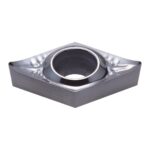

Machining Nitrided Steel and Nitralloy: Korloy Strategy for Hard Surface / Soft Core
The Unique Challenge of Nitrided Components
Nitrided steel presents one of the most unusual machining challenges in manufacturing: a component with two distinctly different material properties in immediate proximity. The nitrided case, typically 0.2-0.5mm deep, reaches hardness levels of 62-70 HRC due to the formation of iron nitrides and nitrogen-saturated solid solution. Beneath this extremely hard shell lies the original core material at a relatively soft 30-35 HRC.
This dual-hardness structure means that no single tool can optimally machine the entire cross-section. A CBN insert that excels in the hard case will experience excessive wear rates and poor economy when used on the softer core. Conversely, a carbide insert ideal for the core material will be destroyed immediately upon contacting the nitrided surface.
Common nitriding steels include Nitralloy 135 (AMS 6470), Nitralloy N (AMS 6475), 4140/4340 nitrided, and specialized alloys like 31CrMoV9. The nitriding process (gas, plasma, or salt bath) creates the hard case without the dimensional distortion associated with carburizing and quenching, which is precisely why post-nitriding machining is sometimes required.
Two Fundamental Approaches
Approach 1: Machine After Nitriding (Preferred for Precision)
When dimensional tolerances demand it, components are finish-machined after the nitriding process. This eliminates any concern about dimensional changes from the nitriding cycle (typically 0.005-0.015mm growth) but requires cutting through the hard case. This is the recommended approach for bearing surfaces, seal diameters, and precision bores where final dimensions must be held within tight tolerances.
The strategy involves a two-stage cutting process: first, remove the hard nitrided case with CBN tooling, then switch to carbide for efficient machining of the soft core if deeper material removal is needed.
Approach 2: Machine Before Nitriding (Simpler but Less Precise)
For components where tolerances allow for nitriding-induced dimensional changes, completing all machining before nitriding eliminates the need for expensive CBN tooling. Standard carbide grades machine the unhardened material easily. However, this approach requires understanding and compensating for the dimensional growth that occurs during nitriding, which can vary with case depth, part geometry, and process parameters.
Strategy Comparison Table
| Factor | Machine After Nitriding | Machine Before Nitriding |
|---|---|---|
| Dimensional accuracy | Excellent (final dimensions cut directly) | Limited by nitriding distortion prediction |
| Tooling cost | Higher (CBN required for case) | Lower (standard carbide only) |
| Case integrity | Partially removed where machined | Fully intact on all surfaces |
| Surface finish capability | Ra 0.2-0.8 with CBN finishing | Dependent on nitriding surface quality |
| Typical tolerance achievable | +/-0.005mm | +/-0.02-0.05mm |
| Korloy primary grade | KBN10M (case) + PC5300 (core) | PC5300 throughout |
Korloy Tooling for Case Removal (Post-Nitriding Machining)
CBN Grade Selection: KBN10M
Korloy’s KBN10M is the primary recommendation for machining through the nitrided case. This CBN grade offers the combination of hardness and toughness needed for the interrupted-like cutting action that occurs when transitioning from hard case to soft core. The high CBN content provides wear resistance against the extremely hard nitride compounds while the binder system prevents micro-fracture.
For cases exceeding 65 HRC or where surface finish requirements are particularly demanding (Ra < 0.4), the KBN10M with a chamfered edge preparation provides the most predictable performance. The chamfer width should be 0.1-0.15mm at 20 degrees for nitrided steel applications.
Parameters for Nitrided Case Machining
Cutting speed for the nitrided case should be 80-120 m/min. This range provides adequate surface speed for proper CBN cutting mechanics while avoiding excessive thermal loading on the thin hard layer. Feed rate must remain light at 0.05-0.10 mm/rev to prevent case fracture and maintain surface integrity.
Critical parameter: depth of cut must remain less than the case depth. If the nitrided case is 0.3mm deep, set DOC to 0.2-0.25mm maximum. This keeps the CBN insert working entirely within the hard material where it performs best. Attempting to cut through both case and core simultaneously creates wildly varying cutting forces that accelerate CBN wear.
Transition to Core Machining: PC5300
Once the hard nitrided case has been removed by the CBN insert, switch to Korloy PC5300 for machining the exposed core material. PC5300 is a versatile CVD-coated carbide grade optimized for medium-hardness steels (28-38 HRC), making it ideal for the revealed core at 30-35 HRC.
After breaking through the case, cutting parameters increase dramatically: 200-280 m/min cutting speed with feeds of 0.15-0.30 mm/rev. The core material machines like standard alloy steel, allowing productive material removal rates. This two-tool approach maximizes both tool life and productivity by matching each tool to its optimal hardness range.
Cutting Parameters Summary
| Operation | Material Zone | Hardness | Korloy Grade | Speed (m/min) | Feed (mm/rev) | DOC (mm) |
|---|---|---|---|---|---|---|
| Case removal – finishing | Nitrided case | 62-65 HRC | KBN10M | 100-120 | 0.05-0.08 | 0.10-0.20 |
| Case removal – moderate | Nitrided case | 65-70 HRC | KBN10M | 80-100 | 0.05-0.10 | 0.10-0.25 |
| Core roughing | Base steel core | 30-35 HRC | PC5300 | 220-280 | 0.20-0.30 | 1.0-2.5 |
| Core finishing | Base steel core | 30-35 HRC | PC5300 | 200-250 | 0.10-0.15 | 0.2-0.5 |
| Pre-nitriding (all machining) | Unhardened steel | 22-28 HRC | PC5300 | 250-320 | 0.20-0.35 | 1.5-3.0 |
Case Depth Measurement: Critical Process Control
Why Case Depth Knowledge Matters
Before machining any nitrided component, precise knowledge of the case depth is essential. Setting depth of cut incorrectly relative to case depth leads to one of two failure modes: cutting too shallow means multiple expensive CBN passes are needed, while cutting too deep plunges the CBN insert into the soft core where it generates excessive heat and poor surface finish.
Case depth should be verified through micro-hardness traverse on a sample part from the same nitriding batch. The effective case depth (depth to a specified hardness, typically 50 HRC) defines the maximum DOC for the CBN operation. Specification documents (such as AMS 6475 for Nitralloy) define minimum case depth requirements that constrain how much material can be removed post-nitriding.
Practical Verification Methods
For production environments, eddy current testing or micro-hardness testing on sacrificial sections provides the case depth data needed for programming. The nitriding process should include witness coupons that can be sectioned and measured before committing to machining the production parts.
Insert Geometry and Chipbreaker Selection
For CBN case machining, negative rake inserts (CNGA, DNGA) with chamfered edges provide the best results. The negative geometry supports the cutting edge against the high forces generated by the hard case material. Nose radius of 0.4-0.8mm balances surface finish against edge stability.
For the subsequent carbide core machining with PC5300, standard positive or negative geometry inserts with general-purpose chipbreakers work well. The core material behaves as conventional alloy steel and does not require specialized geometry. CNMG with medium chipbreaker is an excellent default choice for core material removal.
Process Recommendations
Coolant should be used for both operations. For CBN case machining, dry cutting or MQL is acceptable if the machine setup does not permit coolant, but wet cutting extends CBN tool life by 20-30% in nitrided steel applications. For core machining with carbide, standard flood coolant at 6-10% concentration provides optimal results.
Contact Hooguu technical support for assistance with specific nitrided component applications, including case depth analysis and process planning for complex geometries requiring post-nitriding machining.
Shop Related Products at HOOGUU