

Machining Pre-Sintered Tungsten Carbide and Cemented Carbide: Korloy PCD and CBN Solutions
Understanding Tungsten Carbide Workpiece States
Tungsten carbide (WC-Co) presents a unique machining challenge because its properties change dramatically depending on its processing state. The material exists in two fundamentally different conditions that require completely different tooling strategies: the pre-sintered “green” state and the fully sintered hardened state.
Pre-sintered tungsten carbide, commonly referred to as green-state carbide, has been pressed into shape but not yet subjected to the full sintering cycle. In this condition, the material exhibits a hardness of approximately 60-70 HRA. While this is considerably harder than most steels, it remains within the cutting capability of advanced carbide tooling with appropriate edge preparation. The binder phase (typically cobalt) has not yet fully densified, leaving micro-porosity that reduces effective hardness.
Fully sintered tungsten carbide, by contrast, achieves hardness levels exceeding 90 HRA (equivalent to 1400-1800 HV depending on grade and cobalt content). At this hardness, conventional carbide tooling fails almost immediately. Only polycrystalline diamond (PCD) or electrical discharge machining (EDM) can produce acceptable results on fully sintered material.
Machining Green-State Tungsten Carbide (Pre-Sintered)
Tool Material Selection
For pre-sintered WC in the 60-70 HRA range, carbide inserts with heavy edge preparation provide the best balance of performance and economy. The key requirement is a substrate tough enough to withstand the interrupted, abrasive cutting action while the edge preparation prevents micro-chipping at the cutting lip.
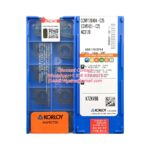
Korloy’s PC8110 grade is the primary recommendation for green-state carbide machining. This is a micro-grain carbide substrate with a specialized PVD coating that resists the abrasive nature of the tungsten carbide particles. The fine grain structure provides the edge strength necessary for consistent performance in this demanding application.
For situations requiring additional toughness, such as interrupted cuts or variable stock conditions common in pressed blanks, the PC3545 grade offers a tougher substrate with enhanced fracture resistance. This comes at some cost in wear resistance but significantly reduces the risk of catastrophic edge failure.
Cutting Parameters for Green-State WC
Speed recommendations for green-state carbide fall in the 20-40 m/min range. This is dramatically slower than steel machining but appropriate for the hardness and abrasiveness of the material. Feed rates should be moderate (0.05-0.15 mm/rev) to avoid excessive edge loading while maintaining productive material removal.
Depth of cut should be kept below 0.5mm where possible. The pressed compact structure of green carbide means that excessive depth can cause chunk-out rather than clean cutting, resulting in poor surface quality and potential part damage.
Coolant is recommended but not critical in green-state machining. The primary purpose is chip evacuation and dust suppression rather than thermal management, as the cutting speeds are low enough that heat generation remains manageable.
Machining Fully Sintered Tungsten Carbide
PCD as the Only Viable Cutting Solution
Once tungsten carbide has been fully sintered, the hardness exceeds what any carbide or CBN tool can handle economically. Korloy’s KPD010 PCD (polycrystalline diamond) grade becomes the only practical cutting tool option. PCD’s extreme hardness (approximately 8000 HV) provides the necessary wear resistance to cut sintered carbide, though tool life remains limited compared to machining conventional materials.
The alternative to PCD cutting is EDM (Electrical Discharge Machining), which removes material through spark erosion rather than mechanical cutting. Many shops use a combined approach: rough machining in the green state, sintering, then finish-machining critical surfaces with PCD or EDM.
Diamond-Coated vs PCD Brazed Inserts
Diamond-coated carbide inserts offer a lower-cost alternative to solid PCD for some applications. However, the coating thickness (typically 8-20 micrometers) limits their useful life in sintered carbide machining. Once the diamond coating wears through, the underlying carbide substrate fails rapidly.
PCD brazed inserts (like the KPD010) feature a solid PCD cutting tip brazed to a carbide body. The PCD layer is typically 0.5-1.5mm thick, providing substantially more diamond material at the cutting edge. For sintered carbide machining, PCD brazed tools consistently outperform diamond-coated tools by 10-20x in tool life.
Cutting Parameters for Sintered WC with PCD
Machining fully sintered tungsten carbide with PCD requires extremely conservative parameters. Cutting speeds range from 10-30 m/min, with feed rates of 0.02-0.08 mm/rev. Flood coolant is mandatory to manage the extreme interface temperatures and flush the abrasive chips away from the cutting zone.
Depth of cut must remain below 0.2mm, and finishing passes of 0.02-0.05mm are common. The goal is typically to achieve dimensional accuracy and surface finish rather than bulk material removal, as most stock should be removed in the green state before sintering.
Comprehensive Comparison Table
| WC Condition | Hardness | Tool Material | Korloy Grade | Speed (m/min) | Feed (mm/rev) | DOC (mm) | Coolant |
|---|---|---|---|---|---|---|---|
| Green state (pressed) | 60-65 HRA | Coated carbide | PC8110 | 30-40 | 0.08-0.15 | 0.2-0.5 | Recommended |
| Green state (interrupted) | 60-70 HRA | Tough carbide | PC3545 | 20-30 | 0.05-0.12 | 0.1-0.3 | Recommended |
| Partially sintered | 70-80 HRA | PCD or carbide | PC8110 / KPD010 | 15-25 | 0.05-0.10 | 0.1-0.3 | Required |
| Fully sintered (6-15% Co) | 88-92 HRA | PCD brazed | KPD010 | 10-20 | 0.02-0.06 | 0.02-0.15 | Flood mandatory |
| Fully sintered (3-6% Co) | 92-94 HRA | PCD brazed | KPD010 | 8-15 | 0.02-0.05 | 0.02-0.10 | Flood mandatory |
Application Areas
Die and Punch Manufacturing
Stamping dies and punches made from tungsten carbide are typically roughed in the green state (using PC8110 at 30-40 m/min) before sintering. After sintering, only final profile corrections and surface finishing are performed with PCD tooling. This approach minimizes expensive PCD tool consumption while achieving the required final geometry.
Wire Drawing Dies
Drawing dies require exceptional surface finish in the bore area. These are often finish-machined after sintering using KPD010 PCD inserts at very low feeds (0.02-0.04 mm/rev) to achieve Ra values below 0.2 micrometers. The bore geometry is critical to wire quality, making PCD machining preferable to EDM where possible due to the superior surface integrity.
Wear Parts and Tooling Components
Industrial wear parts such as nozzles, valve seats, and guide bushings in tungsten carbide follow similar manufacturing strategies. Maximum material removal occurs in the green state, with PCD finishing reserved for critical mating surfaces and seal areas after sintering.
Process Planning Recommendations
The most cost-effective approach to tungsten carbide part manufacturing involves careful process planning that maximizes green-state machining. Leave minimal stock (0.1-0.3mm per side) for post-sintering PCD finishing. Account for sintering shrinkage (typically 15-22% linear) when designing green-state machining programs.
For prototype work or one-off parts where green-state access is not available, fully sintered machining with KPD010 remains viable but expect significantly higher tooling costs and longer cycle times. Contact Hooguu for specific Korloy PCD grade recommendations based on your exact carbide composition and application requirements.
Shop Related Products at HOOGUU