
Category: Borings
How to Choose Boring Bars and Boring Heads
Boring deep holes is where many shops lose hours to chatter, taper, and surface finish problems. The right boring bar choice depends entirely on your length-to-diameter (L:D) ratio. Hooguu stocks boring tools from Sandvik (Silent Tools), Iscar (Whisperline), Big Daishowa, Kennametal, and Mitsubishi.
The L:D Rule (most important)
- L:D ≤ 3 — Standard steel-shank boring bar with carbide insert
- L:D 3-4 — Heavy-metal (tungsten alloy) shank or solid carbide bar
- L:D 4-7 — Solid carbide bar with internal coolant required
- L:D 7-10 — Anti-vibration (damped) bars only — Sandvik Silent Tools, Iscar Whisperline
- L:D > 10 — Damped bars + reduced cutting parameters; consult specialist
Bar Material Comparison
- Steel shank — Cheapest, OK to L:D=3. Most common for shallow boring.
- Heavy metal (tungsten alloy) — Density 17 g/cm³, dampens vibration better than steel. Good to L:D=4.
- Solid carbide — 3× stiffer than steel. Required L:D=4-7. Cost premium 3-5× steel.
- Damped (Silent Tools) — Tuned-mass damper inside the bar. $500-$2000 each but only option above L:D=7.
Insert Geometry for Boring
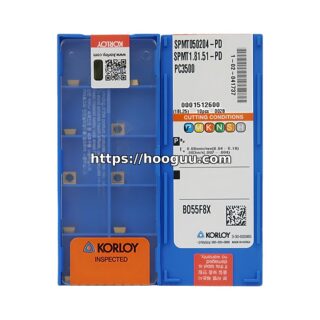
Use POSITIVE-rake inserts (CCMT, CCGT, DCMT, TCMT). Reduces cutting forces 30-40% versus negative-rake (CNMG), which means less tool deflection and better surface finish. Common boring inserts:
- CCMT — 80° rhombic, light to medium boring
- DCMT — 55° rhombic, profiling and deep boring
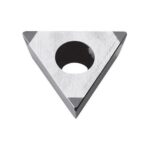
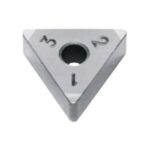
- TCMT — Triangular 60°, heavy boring
- VBMT — 35° rhombic, fine finishing
Internal Coolant is Critical for Deep Boring
For L:D > 4, internal coolant at 500+ PSI is mandatory. External flood cannot reach the cutting zone past the chips. Always order internal-coolant boring bars with through-coolant tool holders.
Cutting Parameters for Deep Boring
- Speed (Vc): 60-80% of normal turning
- Feed: 70% of normal
- Depth of cut: limit to 50% of insert nose radius for L:D > 5
- Plunge slowly to avoid initial deflection
Boring Head vs Boring Bar
For diameters above 25mm, an adjustable BORING HEAD (Wohlhaupter, BIG Kaiser, Komet) gives micron-level diameter adjustment via dial. Best for one-off custom holes. Boring BARS use replaceable inserts and are best for repeat production at fixed diameters.
Browse our boring tools catalog. See our complete deep-hole boring selection guide.
How to Choose Boring Bars and Boring Heads
Boring deep holes is where many shops lose hours to chatter, taper, and surface finish problems. The right boring bar choice depends entirely on your length-to-diameter (L:D) ratio. Hooguu stocks boring tools from Sandvik (Silent Tools), Iscar (Whisperline), Big Daishowa, Kennametal, and Mitsubishi.
The L:D Rule (most important)
- L:D ≤ 3 — Standard steel-shank boring bar with carbide insert
- L:D 3-4 — Heavy-metal (tungsten alloy) shank or solid carbide bar
- L:D 4-7 — Solid carbide bar with internal coolant required
- L:D 7-10 — Anti-vibration (damped) bars only — Sandvik Silent Tools, Iscar Whisperline
- L:D > 10 — Damped bars + reduced cutting parameters; consult specialist
Bar Material Comparison
- Steel shank — Cheapest, OK to L:D=3. Most common for shallow boring.
- Heavy metal (tungsten alloy) — Density 17 g/cm³, dampens vibration better than steel. Good to L:D=4.
- Solid carbide — 3× stiffer than steel. Required L:D=4-7. Cost premium 3-5× steel.
- Damped (Silent Tools) — Tuned-mass damper inside the bar. $500-$2000 each but only option above L:D=7.
Insert Geometry for Boring
Use POSITIVE-rake inserts (CCMT, CCGT, DCMT, TCMT). Reduces cutting forces 30-40% versus negative-rake (CNMG), which means less tool deflection and better surface finish. Common boring inserts:
- CCMT — 80° rhombic, light to medium boring
- DCMT — 55° rhombic, profiling and deep boring
- TCMT — Triangular 60°, heavy boring
- VBMT — 35° rhombic, fine finishing
Internal Coolant is Critical for Deep Boring
For L:D > 4, internal coolant at 500+ PSI is mandatory. External flood cannot reach the cutting zone past the chips. Always order internal-coolant boring bars with through-coolant tool holders.
Cutting Parameters for Deep Boring
- Speed (Vc): 60-80% of normal turning
- Feed: 70% of normal
- Depth of cut: limit to 50% of insert nose radius for L:D > 5
- Plunge slowly to avoid initial deflection
Boring Head vs Boring Bar
For diameters above 25mm, an adjustable BORING HEAD (Wohlhaupter, BIG Kaiser, Komet) gives micron-level diameter adjustment via dial. Best for one-off custom holes. Boring BARS use replaceable inserts and are best for repeat production at fixed diameters.
Browse our boring tools catalog. See our complete deep-hole boring selection guide.