
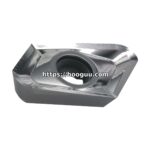

When it comes to continuous and lightly interrupted turning of steels, two CVD-coated carbide grades consistently appear in tooling recommendations: Sandvik Coromant GC1115 and Iscar IC810. Both grades occupy the premium tier of their respective portfolios, targeting ISO P10-P30 application ranges with emphasis on high cutting speeds, predictable wear patterns, and extended tool life in stable machining conditions.
This article provides a detailed technical comparison of GC1115 and IC810, examining substrate composition, coating architecture, insert geometry compatibility, recommended cutting parameters, and real-world performance characteristics to help machinists and process engineers select the optimal grade for their specific steel turning operations.
Grade Overview and Positioning
Sandvik Coromant GC1115
GC1115 belongs to Sandvik’s modern CVD-coated grade family, positioned as a first-choice grade for semi-finishing to roughing of steels in stable conditions. It features a thick CVD multilayer coating applied over a cobalt-enriched, fine-grained cemented carbide substrate. The grade is optimized for high metal removal rates where controlled flank wear is the dominant failure mode.
Key characteristics include:
- Excellent wear resistance at elevated cutting temperatures
- Strong performance in continuous cuts and light interruptions
- Reliable edge security in long-chipping materials such as low-alloy and carbon steels
- Compatible with a wide range of negative and positive insert geometries
Iscar IC810
IC810 is Iscar’s flagship CVD-coated grade for steel machining, developed for general turning and boring operations across a broad spectrum of ferrous materials. The grade utilizes a tough carbide substrate combined with a multi-layer TiCN/Al2O3 CVD coating, engineered to balance wear resistance with adequate toughness for mild interrupted cuts.
Key characteristics include:
- High thermal stability due to alpha-Al2O3 outer layer
- Good adhesion between coating and substrate minimizes flaking
- Versatile performance from finishing to medium roughing
- Suitable for both external and internal machining with standard geometries
Substrate and Coating Architecture
Understanding the physical construction of each grade reveals why they perform differently under specific cutting conditions.
| Property | Sandvik GC1115 | Iscar IC810 |
|---|---|---|
| Coating Type | CVD Multi-layer (TiCN + Al2O3 + TiN) | CVD Multi-layer (TiCN + Al2O3) |
| Total Coating Thickness | ~12-16 μm | ~10-14 μm |
| Outer Layer | TiN (gold color, low friction) | Alpha-Al2O3 (black/gray, thermal barrier) |
| Substrate Class | Fine-grained WC-Co with cobalt enrichment | Medium-fine WC-Co, high toughness |
| Hardness (HV30) | ~1,550 | ~1,480 |
| Transverse Rupture Strength | ~2,400 MPa | ~2,600 MPa |
| Color | Gold | Black/Dark Gray |
The gold TiN outer layer of GC1115 provides lower friction and improved chip evacuation, particularly beneficial in long-chipping steels where built-up edge (BUE) formation is a risk. The Al2O3-dominated surface of IC810 acts as a superior thermal barrier, reflecting heat into the chip and protecting the substrate during high-speed continuous cutting.
Recommended Cutting Parameters
Both grades are designed for high-productivity steel turning, but their optimal parameter windows differ slightly due to coating and substrate variations.
Continuous Turning of Carbon and Low-Alloy Steels (ISO P.1 / P.2)
| Parameter | Sandvik GC1115 | Iscar IC810 |
|---|---|---|
| Cutting Speed (Vc) | 280-450 m/min | 250-400 m/min |
| Feed Rate (fn) | 0.15-0.40 mm/rev | 0.15-0.35 mm/rev |
| Depth of Cut (ap) | 1.0-5.0 mm | 1.0-6.0 mm |
| Preferred Application | Semi-finishing, medium roughing | Roughing, heavy roughing |
Stainless Steel Turning (ISO M.1 / M.2, Austenitic)
| Parameter | Sandvik GC1115 | Iscar IC810 |
|---|---|---|
| Cutting Speed (Vc) | 180-280 m/min | 160-250 m/min |
| Feed Rate (fn) | 0.12-0.25 mm/rev | 0.12-0.25 mm/rev |
| Depth of Cut (ap) | 0.5-3.0 mm | 0.5-4.0 mm |
| Notes | Requires sharp edge geometry | Good with standard honed edges |
Cast Iron Turning (ISO K.2 / K.3, Grey Cast Iron)
| Parameter | Sandvik GC1115 | Iscar IC810 |
|---|---|---|
| Cutting Speed (Vc) | 150-220 m/min | 140-200 m/min |
| Feed Rate (fn) | 0.20-0.50 mm/rev | 0.20-0.60 mm/rev |
| Depth of Cut (ap) | 1.5-6.0 mm | 2.0-8.0 mm |
| Application | Moderate loads, good surface finish | Heavy roughing, interrupted cuts |
Insert Geometry Compatibility
Both grades are available in standard ISO insert shapes, but their performance varies depending on edge preparation and chipbreaker design.
| Insert Shape | GC1115 Availability | IC810 Availability | Recommended Use |
|---|---|---|---|
| CNMG (Negative, 80°) | Yes, wide range | Yes, wide range | Roughing and medium machining |
| WNMG (Negative, 80°) | Yes | Yes | Heavy roughing, high stability |
| DNMG (Negative, 55°) | Yes | Yes | General purpose turning |
| TNMG (Negative, 60°) | Yes | Yes | Profiling and copying |
| VBMT (Positive, 35°) | Limited | Yes | Finishing, low cutting forces |
| CCMT (Positive, 80°) | Yes | Yes | Internal boring, finishing |
GC1115 tends to perform best with negative rake geometries and moderate to strong chipbreakers, where its wear resistance can be fully exploited. IC810 offers slightly better versatility across positive rake inserts due to its tougher substrate, making it a safer choice for lower-rigidity setups or internal machining where vibration is a concern.
Wear Characteristics and Failure Modes
Understanding how each grade fails helps predict tool life and optimize replacement strategies.
GC1115 Wear Behavior
- Primary wear mechanism: Uniform flank wear (VB) progressing steadily at high cutting speeds
- Secondary wear: Crater wear (KT) on the rake face, controlled by the thick Al2O3 layer
- Failure mode in unstable conditions: Coating delamination at the flank, leading to rapid substrate erosion
- Edge condition: Maintains a keen cutting edge until late in tool life; micro-chipping is rare in continuous cutting
IC810 Wear Behavior
- Primary wear mechanism: Flank wear with localized notching at the depth-of-cut line in interrupted cuts
- Secondary wear: Thermal cracking on the rake face when coolant is applied intermittently
- Failure mode in overloading: Plastic deformation of the cutting edge due to substrate softness at extreme temperatures
- Edge condition: Slightly more robust edge line; minor chipping can occur but does not immediately propagate to catastrophic failure
| Wear Criterion | GC1115 | IC810 |
|---|---|---|
| Typical Tool Life at Vc=350 m/min (1045 Steel) | 12-18 min | 10-15 min |
| Flank Wear Limit (VBmax) | 0.3 mm | 0.3 mm |
| Crater Wear Resistance | Excellent | Good |
| Notch Wear Resistance | Moderate | Good |
| Thermal Crack Resistance | Moderate | Good |
| Built-Up Edge Resistance | Good | Moderate |
Application Recommendations
Choose Sandvik GC1115 When:
- Machining conditions are stable with minimal interruption
- High cutting speeds (>350 m/min) are required for productivity
- Surface finish is critical and edge sharpness must be maintained
- The material tends to produce long, stringy chips that benefit from low-friction coating
- Tool life consistency is more important than maximum depth of cut capability
Choose Iscar IC810 When:
- Operations involve light to moderate interruptions or varying depths of cut
- Machine tool rigidity is limited, requiring a more forgiving insert grade
- Heavy roughing with depths exceeding 5 mm is the primary requirement
- Cast iron or mixed-material batch production demands a single-grade solution
- Coolant supply is intermittent or unreliable
Practical Machining Example
Consider a typical shaft-turning operation on SAE 1045 normalized steel using a CNC lathe with 15 kW spindle power:
| Scenario | GC1115 Setup | IC810 Setup |
|---|---|---|
| Insert | CNMG 12 04 08-WM | CNMG 12 04 08-TF |
| Vc | 400 m/min | 350 m/min |
| fn | 0.25 mm/rev | 0.30 mm/rev |
| ap | 2.5 mm | 3.0 mm |
| Coolant | High-pressure, directed at insert | Standard flood coolant |
| Tool Life | 16 min (predictable flank wear) | 14 min (minor edge chipping at end) |
| Surface Roughness (Ra) | 1.2 μm | 1.6 μm |
In this scenario, GC1115 delivers superior surface finish and higher cutting speed, while IC810 achieves greater material removal per revolution due to the heavier feed and depth of cut. The choice depends on whether the production target prioritizes cycle time (GC1115) or material removal rate per cutting edge (IC810).
Summary and Selection Guide
| Decision Factor | Recommended Grade |
|---|---|
| Maximum cutting speed | GC1115 |
| Heavy roughing, large depths of cut | IC810 |
| Interrupted cuts, varying engagement | IC810 |
| Surface finish priority | GC1115 |
| Long-chipping steels (low carbon) | GC1115 |
| Mixed steel and cast iron production | IC810 |
| Low-rigidity machine or setup | IC810 |
| High-volume, stable automation | GC1115 |
Both Sandvik GC1115 and Iscar IC810 represent mature, reliable CVD-coated solutions for steel turning. Neither grade is universally superior; the optimal selection depends on machine stability, workpiece material consistency, and production priorities. For shops running stable CNC lathes with consistent material supply, GC1115 offers measurable productivity advantages. For general engineering environments with varied components and machine conditions, IC810 provides the broader safety margin and operational flexibility that reduces unexpected insert failures.
Shop Related Products at HOOGUU