
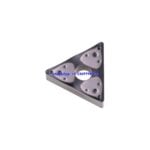
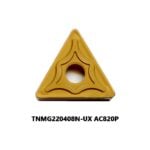
Insert geometry gets the attention, but on a modern steel turning insert most of the productivity gain is buried in a coating stack only ten to fifteen micrometres thick. Walter’s Tiger·tec Silver family is one of the clearest examples of how a CVD multilayer architecture — rather than a single hard film — determines whether an insert survives a roughing pass on forged 42CrMo4 or fails after eight minutes. This guide breaks down the coating system, the grade ladder, and the cutting data that goes with it, then compares the family against the main CVD-coated alternatives from Sandvik and Iscar.
Why Coating Architecture Beats Coating Hardness
The traditional approach to coated carbides was simple: make the surface as hard as possible. Hardness alone, however, does not survive a real steel turning operation. The insert face sees three hostile conditions at once:
- Adhesive wear — steel welds to the rake face at 600–900 °C, pulling coating grains away with the chip.
- Thermal cycling — interrupted cuts and scale drop the surface temperature by 200–400 °C within milliseconds, generating crack networks.
- Abrasive wear — forged skin, sand-cast surfaces, and hard inclusions grind the flank land.
Each wear mode wants a different material property. A single TiN or TiCN film is hard but brittle and oxidises above roughly 700 °C. Al2O3 resists oxidation and crater wear but has poor thermal conductivity and is brittle in tension. Stacking these materials in the right order, with the right crystal structure and residual stress, is what separates a 15-minute insert from a 4-minute insert. This is the design logic behind multilayer CVD systems such as Tiger·tec Silver, Sandvik’s Inveio-based GC4325, and Iscar’s SumoTec CVD grades.
Tiger·tec Silver Coating Architecture
The Tiger·tec Silver system is a medium-temperature CVD (MT-CVD) process that deposits three functional zones on a tough cobalt-enriched substrate. The silver-grey appearance comes from the top layer, which is deliberately not a gold TiN — the light colour makes wear marks and the flank wear land far easier to read at the machine, which is a small but genuine shop-floor advantage during first-article trials.
| Layer | Material | Typical thickness | Function |
|---|---|---|---|
| Top | TiN / TiCN functional top coat | 1–2 µm | Wear indication, friction reduction, chemical stability at the rake face |
| Middle | Alpha-Al2O3, columnar growth | 3–6 µm | Crater wear resistance, oxidation barrier above 900 °C |
| Bond | TiCN transition layer | 1–2 µm | Grain refinement, stress accommodation between oxide and carbide |
| Base | MT-CVD TiCN, fine-grained | 6–9 µm | Adhesion to substrate, abrasive wear resistance, crack deflection |
| Substrate | Cobalt-enriched WC-Co, 6–10 % Co | — | Toughness reserve, resistance to thermal shock and plastic deformation |
Total coating thickness lands between 10 and 15 µm — thin enough to preserve edge sharpness and thick enough to outlast a PVD film in abrasive steel work. The columnar alpha-Al2O3 is the key detail. Grains growing perpendicular to the surface create a structure that arrests thermal cracks at grain boundaries instead of letting them run straight through to the substrate, which is precisely the failure mode that kills inserts in interrupted turning of forged components with mill scale.
Substrate Choice and Why It Is Not Trivial
A 10 % cobalt substrate with a fine WC grain size gives a hardness around 1,550–1,650 HV with enough transverse rupture strength to tolerate a 5 mm depth of cut on a cast skin. Harder substrates (lower cobalt, ~6 %) push wear resistance up but convert thermal cracks into edge chipping. In the Tiger·tec Silver family, the substrate is paired to the coating thickness: the tougher grades use less total coating so the ductile substrate is still doing work close to the edge.
The Grade Ladder
Four ISO P grades cover the steel turning range, with a fifth grade bridging into ISO S. The numbering is not arbitrary — it tracks ISO application class from P05 finishing to P35 roughing, with each step trading edge strength for depth-of-cut capacity.
| Grade | ISO range | Typical Vc (m/min) | Feed f (mm/rev) | Depth ap (mm) | First choice for |
|---|---|---|---|---|---|
| WPP05S | P05–P15 | 220–320 | 0.08–0.30 | 0.3–2.0 | Finish turning of clean, pre-machined steel; high surface finish demands |
| WPP10S | P10–P25 | 190–290 | 0.12–0.45 | 0.5–3.5 | General purpose turning, mixed batch work, light interrupted cuts |
| WPP20S | P20–P30 | 160–250 | 0.18–0.55 | 1.0–5.0 | Medium roughing, forged surfaces, moderate scale |
| WPP30S | P25–P35 | 140–220 | 0.25–0.70 | 1.5–6.0 | Heavy roughing, sand-cast skin, strongly interrupted cuts |
| WSP45S | S15–S25 (also P30) | 120–200 | 0.15–0.50 | 1.0–4.5 | Stainless and heat-resistant alloys, adhesive wear resistance |
Rule of thumb: step down one grade whenever the cutting edge is interrupted more than roughly 30 times per revolution, or when the workpiece surface carries scale, casting skin, or weld spatter.
Where Each Grade Actually Earns Its Keep
- WPP05S — finishing only. Running it on a roughing pass with 4 mm depth of cut produces edge chipping within the first component. Its value is surface finish and dimensional repeatability on clean stock, typically Ra 0.8–1.6 µm at f = 0.15 mm/rev and a 0.8 mm tool nose radius.
- WPP10S — the workhorse. On 1045 carbon steel at 220 m/min, 0.3 mm/rev, 2.5 mm depth, this grade delivers predictable 15–20 minute tool life in continuous cutting and around 12 minutes with a single keyway interruption.
- WPP20S — the first choice for forged blanks with intermittent cuts. The thicker coating plus cobalt-enriched substrate absorbs the thermal cycling that turns a finishing grade into a chipped edge in under one pass.
- WPP30S — heavy roughing at low speed. Vc must be pulled back; the temptation to keep 200 m/min with a 5 mm depth of cut on a cast skin is the fastest route to a broken edge.
- WSP45S — stainless and heat-resistant alloys. Its coating stack is tuned for adhesive wear and built-up-edge control rather than for the diffusion wear that dominates plain carbon steel.
Cutting Data in Practice
Catalog values assume a rigid setup, flood coolant, and a stable tool holder. Real shops need to derate. The tables below show start values and the direction to move when the insert misbehaves.
ISO P — Carbon and Alloy Steel, Continuous Cut
| Workpiece | Hardness | Grade | Vc (m/min) | f (mm/rev) | ap (mm) | Expected tool life |
|---|---|---|---|---|---|---|
| 1045 / C45 | 180–220 HB | WPP10S | 220–260 | 0.25–0.35 | 1.5–3.0 | 15–20 min |
| 4140 / 42CrMo4 | 250–300 HB | WPP10S | 180–220 | 0.20–0.30 | 1.5–3.5 | 14–18 min |
| 42CrMo4 forged, scaly | 260–320 HB | WPP20S | 150–190 | 0.25–0.45 | 2.5–5.0 | 10–14 min |
| Cast steel skin, heavy | — | WPP30S | 120–160 | 0.35–0.60 | 4.0–6.0 | 8–12 min |
| 1045 pre-machined finish | 180–220 HB | WPP05S | 260–320 | 0.10–0.20 | 0.5–1.5 | 20–30 min |
ISO P — Interrupted and Heavy-Duty Conditions
| Condition | Interruptions per rev | Recommended grade | Vc derating | Feed strategy |
|---|---|---|---|---|
| Single keyway | 1–2 | WPP10S → WPP20S | −10 % | Keep f above 0.2 mm/rev to avoid work hardening and rubbing |
| Cross holes / slots | 4–8 | WPP20S | −15 to −20 % | Increase f, reduce ap to keep chip thickness above 0.1 mm |
| Cast skin, sand inclusions | continuous irregular | WPP30S | −25 % | Heavy feed, deep cut, one pass instead of two |
| Weld spatter, flame-cut edge | irregular shock | WPP30S or WSP45S | −30 % | Enter from the clean side, never plunge into spatter |
The single most common mistake with coated CVD inserts is running the feed too light. Below roughly 0.1 mm/rev the chip no longer shears properly; the edge rubs, work-hardens the surface, and both flank and crater wear accelerate. A tougher grade run at a proper feed almost always outlasts a harder grade run at a light feed.
Competitive Comparison
| Property | Walter Tiger·tec Silver (WPP10S) | Sandvik GC4325 | Iscar SumoTec IC8250 | Sandvik GC4335 |
|---|---|---|---|---|
| Coating type | MT-CVD TiCN + columnar Al2O3 + TiN | CVD TiCN + textured Al2O3 (Inveio) | CVD TiCN + Al2O3 multilayer | CVD, thicker Al2O3, tougher substrate |
| ISO range | P10–P25 | P15–P25 | P15–P30 | P25–P35 |
| Typical Vc, 42CrMo4 (m/min) | 180–220 | 200–240 | 170–210 | 150–190 |
| Typical f (mm/rev) | 0.20–0.35 | 0.20–0.35 | 0.20–0.40 | 0.25–0.50 |
| Max ap recommendation (mm) | 3.5 | 4.0 | 4.5 | 6.0 |
| Wear-mark visibility | High — silver top coat | Medium | Medium | Medium |
| Strength | Balanced finish/toughness, easy wear reading | High-speed stability, texture-controlled oxide | Depth-of-cut capacity | Shock resistance |
| Trade-off | Slightly lower top-end Vc than Inveio grades | Less forgiving below 160 m/min on scale | Coating thickness limits finish quality | Lower Vc ceiling |
The practical read: the three families are within roughly 10–15 % of one another in continuous steel turning, and the difference shows up at the extremes. Sandvik’s textured Al2O3 offers the strongest high-speed continuous performance; Iscar’s SumoTec CVD grades lean toward depth of cut; Walter’s silver top coat gives the best visibility of wear progression, which reduces the trial-and-error cycle when setting up an unfamiliar material. On a 42CrMo4 forging with a moderate skin, all three should be tested at 180–220 m/min and compared on tool life per edge rather than on catalog Vc alone.
Application Best Practices
- Enter on the clean face. Plunge or ramp into scale only with a roughing grade; a hard grade entering scale at full feed chips immediately.
- Keep the depth above the nose radius. A 0.8 mm nose radius with a 0.3 mm depth of cut produces rubbing, not cutting. Either reduce the nose radius or increase depth.
- Use flood coolant for steel, but never thermal-shock a hot edge. Coolant on a 900 °C rake face during an interrupted cut is a valid trade; coolant switched off mid-cycle is not.
- Control chip thickness, not chip width. Feed rate governs chip thickness and therefore the load on the coating. Reducing ap reduces load but does not fix rubbing.
- Read the wear pattern before changing grade. Crater wear means the coating is being chemically attacked — go harder or reduce Vc. Flank wear means abrasion — go harder or reduce surface speed. Thermal cracks mean the grade is too brittle — go tougher and reduce Vc simultaneously.
- Do not exceed 6 mm depth on a 10 mm inscribed-circle insert without a dedicated roughing geometry; edge strength, not coating, becomes the limit.
Wear Diagnosis Table
| Wear pattern | Cause | Action |
|---|---|---|
| Uniform flank wear, long life | Normal abrasion | Nothing — adjust Vc for the next batch |
| Deep crater, flank OK | Diffusion / chemical attack at high Vc | Reduce Vc 15–20 %, or move to a more oxidation-resistant grade |
| Parallel thermal cracks | Interrupted cutting, insufficient toughness | Step one grade tougher, reduce Vc, raise feed |
| Edge chipping | Entry shock, scale, or ap too large | Tougher grade, ramp entry, reduce ap |
| Built-up edge on finish pass | Speed too low for the steel grade | Increase Vc or use a sharper positive geometry |
| Plastic deformation of the edge | Substrate too soft for the temperature | Harder grade or lower Vc |
Selection Summary
Treat the grade ladder as a map from the shop floor back to the catalog, not the other way round. If the operation is continuous, clean, and finish-critical, start at WPP05S. If it is continuous and general purpose, start at WPP10S. If there is any interruption or skin, start at WPP20S. If the depth of cut exceeds 4 mm or the surface is a sand-cast skin, start at WPP30S. Stainless and heat-resistant alloys belong to WSP45S regardless of how the cut looks geometrically, because the dominant wear mechanism is adhesive rather than abrasive.
The coating stack is the reason these five grades behave differently at the same nominal hardness. A columnar Al2O3 middle layer deflects thermal cracks, a fine-grained MT-CVD TiCN base resists abrasion, and a tough cobalt-enriched substrate provides the plastic reserve that keeps the edge from collapsing under shock. Understanding that architecture turns grade selection from trial and error into a deterministic decision.
Shop Related Products at HOOGUU