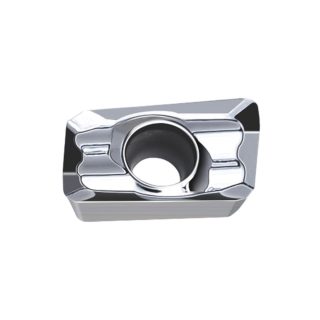


ZCC.CT (Zhuzhou Cemented Carbide Cutting Tools) has quietly become one of the most widely distributed carbide insert brands in the world, yet its grade system is still poorly documented in Western machining shops. The YBC series is the company’s flagship CVD family for steel turning, built on the classic three-layer coating concept: MT-TiCN, alumina and a gold TiN top layer. In this article we break down the three core grades — YBC151, YBC251 and YBC351 — explain how their coating architecture and gradient substrates differ, and provide practical cutting data tables plus a direct cross-reference against Sandvik, Iscar, Walter and Seco grades you may already be running.
The YBC Series at a Glance
Unlike brands that name grades after coating plants or marketing platforms, ZCC.CT follows a simple numeric ladder: the second and third digits indicate the toughness level. Grades ending in -51 sit at three positions on that ladder, mirroring the 15/25/35 structure familiar from other manufacturers.
| Grade | ISO Range | Intended Operation | Coating System | Substrate Character |
|---|---|---|---|---|
| YBC151 | P10–P15 | Finishing, light continuous cuts | Thin MT-TiCN + fine Al2O3 + TiN | Fine-grain, hard gradient |
| YBC251 | P15–P35 | Medium-duty universal steel turning | MT-TiCN + medium Al2O3 + TiN | Balanced hardness/toughness gradient |
| YBC351 | P30–P45 | Roughing, heavy and interrupted cuts | Thick MT-TiCN + Al2O3 + TiN | Tough core, cobalt-enriched edge |
All three grades share the same coating sequence and differ mainly in layer thickness, alumina microstructure tuning and substrate strength. That is why the series covers the full P range without a separate cast-iron or stainless variant — a deliberate simplification compared with brands offering a dozen parallel steel grades.
Coating Architecture of the YBC Grades
The YBC grades use a medium-temperature chemical vapor deposition (MT-CVD) stack. Understanding each layer explains both the strength and the limits of the family.
Layer 1: MT-TiCN Adhesion and Wear Resistance Base
The first layer, grown at roughly 900 °C, is a medium-temperature titanium carbonitride. MT-TiCN has a fine, almost columnar microstructure with far fewer pinholes than older high-temperature TiC. Its job is flank wear resistance and adhesion: carbon-rich MT-TiCN bonds well to the WC substrate and forms a crack-arresting base for the alumina above it. On YBC351 the MT-TiCN layer is grown thicker to support long, aggressive roughing passes; on YBC151 it is kept thin so the total coating does not blunt the finishing edge.
Layer 2: CVD Alumina for Crater and Heat Barrier
The aluminum oxide layer is the thermal shield. Steel machining at 250–350 m/min pushes chip-interface temperatures above 900 °C; at that level tungsten carbide diffuses into the chip and crater wear explodes. Al2O3 is chemically inert to steel and has low thermal conductivity, so it keeps heat in the chip instead of the substrate. Depending on the grade, the deposition conditions favor fine κ-Al2O3, more stable α-Al2O3, or a controlled mixture — a tuning lever ZCC.CT uses to balance flank wear (better with κ) against crater resistance (better with α).
Layer 3: Gold TiN Top Layer
The final TiN layer is thin and its function is practical rather than metallurgical: it gives the familiar golden color for easy wear identification in the shop, and it slightly reduces friction at the rake face during the first minutes of cutting. Once worn, the underlying alumina continues to do the thermal work.
| Layer | Primary Function | Failure Mode It Prevents |
|---|---|---|
| TiN (outermost) | Friction reduction, wear identification | Initial seizure, built-up edge at startup |
| Al2O3 | Thermal and chemical barrier | Crater wear, diffusion wear at high Vc |
| MT-TiCN | Flank wear resistance, adhesion base | Abrasive flank wear, coating spalling |
| Gradient substrate | Edge strength with tough core | Chipping and edge fracture |
Gradient Substrate Design
All YBC substrates are functionally graded: near the cutting edge, the cobalt content is reduced (in harder grades) or selectively enriched (in tougher grades) during sintering. The edge zone on YBC151 is cobalt-lean and fine-grained, raising hardness to roughly HV 1600+ and resisting plastic deformation at finishing temperatures. The YBC351 edge zone retains more binder, sacrificing a few points of hardness for a significantly higher resistance to chipping under interrupted cuts. The core remains uniformly tough in both cases, so crack propagation from a damaged edge cannot run straight into the bulk.
Grade-by-Grade Breakdown
YBC151 — Finishing Steel
YBC151 is aimed at continuous finishing cuts in unalloyed and low-alloy steel: diameters stable, ap below roughly 1.5 mm, feeds from 0.05 to 0.20 mm/rev. The thin coating stack preserves a sharp cutting edge, and the hard, cobalt-lean gradient substrate holds the edge line against plastic deformation at high speeds — the classic finishing failure when a grade meant for medium duty is pushed to 350 m/min. Typical finishing speeds run 260–400 m/min depending on workpiece hardness, with the upper end reserved for C45/1045-type carbon steels.
YBC251 — The Workhorse
YBC251 is the grade most shops will use 80% of the time. It handles medium turning of steel across the P15–P35 band: shafts, discs, gear blanks, general jobbing work. The coating thickness sits between the two extremes, giving a good compromise between crater resistance (thicker Al2O3) and edge sharpness. Recommended starting window: Vc 220–320 m/min, f 0.15–0.40 mm/rev, ap up to 4 mm in favorable conditions. It tolerates a lightly interrupted cut far better than YBC151.
YBC351 — Roughing and Interrupted Cuts
YBC351 moves down the speed ladder and up the feed ladder: Vc 160–260 m/min, f 0.25–0.60 mm/rev, ap 4–8 mm in stable conditions. The thicker MT-TiCN and tougher substrate target two roughing failure modes: chipping on scale-covered or forged surfaces, and edge breakage on entry/exit in interrupted turning (keyways, cross-holes, segment-like profiles). For heavy forgings with mill scale, YBC351 is the correct entry point — YBC251 will chip prematurely on the first pass.
Cutting Data Tables for Steel Turning
The tables below give first-pass starting values. Always adjust against observed wear: if flank wear grows too fast, reduce Vc; if edges chip, reduce feed first, then speed.
Unalloyed Steel (C45, 1045, S355 — 180–250 HB)
| Grade | Vc (m/min) | Feed f (mm/rev) | Depth of cut ap (mm) |
|---|---|---|---|
| YBC151 | 300–400 | 0.08–0.20 | 0.3–1.5 |
| YBC251 | 240–330 | 0.15–0.40 | 1.0–4.0 |
| YBC351 | 180–270 | 0.25–0.60 | 3.0–8.0 |
Low-Alloy Steel (42CrMo4 / 4140, 34CrMo4 — 250–320 HB)
| Grade | Vc (m/min) | Feed f (mm/rev) | Depth of cut ap (mm) |
|---|---|---|---|
| YBC151 | 240–330 | 0.08–0.18 | 0.3–1.2 |
| YBC251 | 200–280 | 0.15–0.35 | 1.0–3.5 |
| YBC351 | 150–230 | 0.25–0.50 | 2.5–6.0 |
Tool Steel / Low-Alloy Annealed (1.2343/H11, 1.2311/P20 type — 180–260 HB)
| Grade | Vc (m/min) | Feed f (mm/rev) | Depth of cut ap (mm) |
|---|---|---|---|
| YBC151 | 220–300 | 0.08–0.15 | 0.3–1.0 |
| YBC251 | 180–250 | 0.12–0.30 | 0.8–3.0 |
| YBC351 | 130–200 | 0.25–0.45 | 2.0–5.0 |
Two notes on these numbers. First, above roughly 300 m/min the alumina layer is doing most of the work; below about 180 m/min the cutting zone is cool enough that built-up edge becomes the dominant wear mechanism, and a PVD grade is usually the better choice. Second, feed affects specific cutting force: raising f from 0.25 to 0.40 mm/rev at constant Vc increases power draw by roughly 50% because chip thickness rises — check the spindle load before pushing roughing feeds.
Chipbreaker and Geometry Selection
YBC grades are offered across ZCC.CT’s CNMG, DNMG, TNMG, WNMG and SNMG programs. The chipbreaker class matters as much as the grade choice.
| Operation | Chipbreaker Class | Typical Nose Radius | Edge Preparation |
|---|---|---|---|
| Finishing (YBC151) | Fine/sharp, positive effective rake | 0.2–0.4 mm | Light hone |
| Medium universal (YBC251) | Medium M-class, wide feed range | 0.4–0.8 mm | Medium hone |
| Roughing (YBC351) | Robust R-class, reinforced edge | 0.8–1.2 mm | Heavy hone / T-land |
A practical rule: match nose radius to ap. Depth of cut should stay at or below roughly two-thirds of the nose radius value times ten (e.g. 0.8 mm radius handles up to about 5 mm ap comfortably in stable conditions). Exceeding that drives radial forces up and pushes the deflection load onto the workpiece, showing up as taper and poor surface finish on slender shafts.
Competitor Cross-Reference
If your tool crib is built around another brand, this mapping places each YBC grade at the equivalent toughness position. The positions match closely because all major manufacturers sell the same three-layer CVD concept at the same ladder points.
| ZCC.CT | Sandvik Coromant | Iscar | Walter | Seco |
|---|---|---|---|---|
| YBC151 | GC4315 | IC8150 | WPP10S | TP2501 |
| YBC251 | GC4325 | IC8250 | WPP20S | TP3501 |
| YBC351 | GC4335 | IC8350 | WPP30S | TP4501 |
The differences live in the margins. Sandvik’s GC43xx series generally carries a slightly more refined alumina control and publishes tighter cutting-data windows; in side-by-side steel turning the practical difference is usually tool life scatter rather than peak performance. Iscar’s IC82xx/83xx line runs comparable speeds with geometry variety as the differentiator. Walter’s WPP (Tiger·tec Silver) grades lean toward reliable medium-duty behavior, and Seco’s Duratomic TP series is known for strong crater resistance in long-duration finishing. ZCC.CT’s competitive edge is rarely a single number — it is the combination of a straightforward three-grade ladder and consistent availability across a broad insert catalog.
When switching a job from any of these reference grades to the equivalent YBC grade, start at about 90% of the incumbent speed and restore to 100% after confirming the first edge wears predictably. The toughness ladder position transfers, but the exact speed ceiling is grade-specific.
Grade Selection Guide
- Classify the cut. Continuous finish (ap < 1.5 mm, no interruption) → YBC151. Mixed/medium work → YBC251. Roughing, scale, heavy interruptions → YBC351.
- Check the speed window. If the job needs more than ~350 m/min, none of the YBC grades is ideal — look at the brand’s higher-speed steel grades or accept shorter life.
- Check the feed demand. Roughing above 0.45 mm/rev on small insert sizes (CNMG 12 04) risks edge overload; step up to a larger IC size or the tougher grade before raising feed further.
- Match the chipbreaker to the ap/f window, not to the grade: a YBC251 with a fine chipbreaker can finish better than a YBC151 with a heavy one.
- Validate with wear inspection. Pull the edge at roughly the expected life and check wear type against the table below before committing batch quantities.
Wear Diagnosis and Corrective Action
| Observed Symptom | Likely Cause | Corrective Action |
|---|---|---|
| Fast flank wear band (VB growing quickly) | Vc too high for the layer stack; abrasive steel | Reduce Vc 15–20%; verify grade toughness position |
| Deep crater close to edge | Alumina exhausted; ap/f combination too hot | Lower feed and/or ap; move up the speed if crater coexists with BUE |
| Edge chipping, small frits | Feed too high for nose radius, or interruption | Reduce feed; increase nose radius; switch to tougher grade |
| Built-up edge, poor finish at low speed | Cutting zone below ~180 m/min; CVD stack running cold | Raise Vc or switch to a PVD grade designed for low-speed ductile steels |
| Notch wear at depth-of-cut line | Hardened layer or scale at DOC boundary | Vary ap between passes; use tougher grade or reinforced edge |
| Thermal cracks perpendicular to edge | Cyclic thermal load — coolant on/off, interrupted cut | Run consistently dry or with steady high-pressure coolant |
Worked Examples
Example 1: Medium Turning of a 42CrMo4 Shaft (Ø120 mm)
YBC251, CNMG 120408 with M-class chipbreaker, target ap 2.0 mm, f 0.28 mm/rev, Vc 280 m/min.
- Spindle speed: n = 280,000 / (π × 120) ≈ 743 rpm
- Feed rate: vf = 743 × 0.28 ≈ 208 mm/min
- MRR = 280,000 × 2.0 × 0.28 ≈ 157 cm³/min
- Estimated cutting power (kc ≈ 2,100 N/mm² at this chip thickness): Pc ≈ 157,000 × 2,100 / 60,000,000 ≈ 5.5 kW — comfortable on a 15 kW lathe with margin for the 80% load rule.
Example 2: Finishing a C45 Flange Face (Ø80 mm)
YBC151, DNMG 110404, ap 0.8 mm, f 0.12 mm/rev, Vc 340 m/min.
- Spindle speed: n = 340,000 / (π × 80) ≈ 1,353 rpm
- Feed rate: vf = 1,353 × 0.12 ≈ 162 mm/min
- MRR ≈ 340,000 × 0.8 × 0.12 ≈ 33 cm³/min
- Predicted Ra from feed point radius model: Ra ≈ f²/(32·rε) = 0.0144/12.8 ≈ 1.1 µm theoretical — realistic values land around 1.5–2.0 µm with the light hone on a finishing edge.
Common Mistakes When Running the YBC Series
- Treating YBC251 as a finishing grade. It will finish, but edge sharpness is not its design target — YBC151 delivers better Ra at the same feed.
- Roughing scale with YBC151. The hard, cobalt-lean edge chips on the first pass; keep YBC151 for clean material.
- Running below 180 m/min with coolant cycling. Thermal cracks appear quickly; be consistent with coolant or go dry.
- Copying another brand’s speed literally. The ladder position transfers, the ceiling does not — start at 90% and climb.
- Ignoring insert corner count economics. The same CNMG corner turned with YBC251 at moderate data often outperforms YBC351 run aggressively on a per-corner basis.
Conclusion
The YBC series is a compact, logically structured three-layer CVD family that maps cleanly onto the standard steel-turning ladder: YBC151 for finishing, YBC251 as the universal workhorse, YBC351 for roughing and interrupted conditions. Its coating architecture — MT-TiCN base, tuned alumina barrier, TiN identifier over a gradient substrate — is the same concept the major Western brands sell, with cutting data windows that overlap closely. For shops standardizing on ZCC.CT, the practical workflow is simple: classify the cut, pick the ladder position, match the chipbreaker to the ap/f window, then fine-tune speed against observed flank wear. Combined with the cross-reference table above, switching existing jobs into the YBC series becomes a low-risk, one-test-cycle process.
Shop Related Products at HOOGUU