
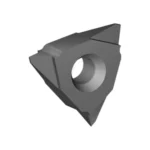

Turning steel at 62 HRC sounds like a recipe for destroyed inserts, yet modern CBN (cubic boron nitride) grades make hard part turning one of the most productive finishing processes available to a CNC machine shop. Machining hardened steels between 45 and 65 HRC with single-point inserts routinely replaces cylindrical grinding for shafts, bearing rings, gears and mould components, cutting cycle times significantly while eliminating an entire re-clamping operation between the lathe and the grinder.
This guide explains how CBN insert grades are engineered, which grade class fits which cutting condition, what cutting parameters to start with for each hardness band, and how to control surface finish and white layer formation in production hard turning. Grade examples from Sandvik and Kyocera are used as reference points; equivalent CBN product lines exist across the Sumitomo, Tungaloy, Mitsubishi and Korloy catalogues.
What Counts as Hard Part Turning?
Hard part turning is generally defined as single-point turning of ferrous workpieces hardened to 45–65 HRC. The most common workpiece families are:
- Through-hardened bearing steels such as 100Cr6 (SAE 52100), used for bearing rings, rollers and precision bushings.
- Case-hardened alloys like 16MnCr5, 20MnCr5 or SAE 8620 after carburising and quenching, typical for gear teeth, pinions and camshafts.
- Hardened tool steels such as D2, O1 and H13 for mould and die components.
- Induction-hardened shafts where only a surface layer of 55–62 HRC must be machined over a tough core.
The economics depend on stock allowance. Because the workpiece is already at final hardness, hard turning removes only the grinding allowance left before heat treatment — typically 0.2–0.5 mm per side. Within that envelope, CBN turning delivers roundness and surface finishes that compete directly with grinding, at metal removal rates grinding cannot match.
Carbide, Ceramic or CBN: Choosing the Cutting Material
Below roughly 55 HRC, fine-grain coated carbides remain a cost-effective option. Between 55 and 65 HRC, the realistic choices are ceramic and CBN. Each has a distinct operating window:
| Cutting material | Workpiece hardness | Typical Vc (m/min) | Strengths | Limitations |
|---|---|---|---|---|
| Fine-grain coated carbide | 40–55 HRC | 60–120 | Tough, tolerant of interrupted cuts, low insert cost | Rapid crater and flank wear above 55 HRC |
| Ceramic (mixed Al2O3/TiC, whisker) | 45–62 HRC | 150–300 | Very high cutting speeds, chemical wear resistance | Poor thermal shock resistance, needs rigid setup and continuous cuts |
| CBN | 45–70 HRC | 90–220 | Best balance of tool life, surface finish and process security | Highest insert cost; edge strength limits depth of cut |
| Grinding | Any | — | Still required for tolerances finer than IT5 or Ra below ~0.2 µm | Slow, multiple setups, coolant-intensive |
For most hardened steel turning between 55 and 65 HRC, CBN wins on total cost per part: cutting speeds of 120–180 m/min with cycle times a fraction of grinding, and tool life of tens of minutes of in-cut time per edge.
CBN Grade Architecture Explained
A CBN insert consists of a polycrystalline cubic boron nitride layer, 0.5–1.5 mm thick, sintered onto a cemented carbide substrate that provides strength and impact resistance. The CBN layer itself is a composite of CBN grains held in a binder phase, and the ratio between the two defines the grade class.
High-CBN vs Low-CBN Compositions
High-CBN grades (approximately 80–95 percent CBN) use metallic binders such as cobalt, or no binder at all. High CBN content gives high thermal conductivity and excellent thermal shock resistance, which is exactly what an edge needs when it repeatedly strikes a keyway, cross-hole or interrupted shoulder. These grades are the standard recommendation for interrupted cutting and for rougher operations.
Low-CBN grades (approximately 50–70 percent CBN) use ceramic binder phases such as TiC, TiCN or Al2O3. The ceramic binder raises hot hardness and chemical wear resistance, which matters in long continuous finishing cuts where diffusion and crater wear dominate. These grades hold their edge for long in-cut times at high speed, and they are the standard choice for continuous finishing of hardened bearing and case-hardening steels.
Coatings on CBN
Thin TiN coatings, typically 1–3 µm applied by CVD or PVD, reduce friction and crater wear on low-CBN finishing grades and help chip evacuation in continuous cuts. High-CBN grades for interrupted cutting are frequently offered uncoated, because a brittle coating can spall off under impact loads before the substrate underneath is worn out. The rule of thumb: coated low-CBN for continuous, uncoated or lightly coated high-CBN for interrupted.
Representative Commercial Grades
The table below summarises typical grade classes using well-known Sandvik and Kyocera designations. Exact compositions are proprietary; treat the values as representative orientation rather than specification data, and confirm final selections against the manufacturer’s catalogue.
| Grade class | Representative grades | CBN content (approx.) | Binder phase | Coating | Best application |
|---|---|---|---|---|---|
| Coated low-CBN finishing | Sandvik CB7015, Kyocera KB9025 | 60–70% | TiC / TiCN ceramic | TiN (CVD or PVD) | Continuous finishing, 55–65 HRC, dry cutting |
| Coated medium-CBN universal | Sandvik CB7050 | 60–65% | TiC ceramic | TiN / TiAlN | Mixed continuous and lightly interrupted operations |
| Uncoated high-CBN | Sandvik CB20, Kyocera KB9010 | 85–95% | Metallic (Co) or binderless | Uncoated | Interrupted cuts, roughing, high-Vc cast iron turning |
| Low-CBN precision finishing | Sumitomo BN2500 class | ~50% | TiC / Al2O3 ceramic | Coated | Long continuous mirror-finishing passes |
Cutting Parameters for Hard Turning
The parameter window in hard turning is narrow compared with conventional turning: speeds that are too low promote abrasive flank wear and built-up edge, while speeds and feeds that are too high crack the edge. The following table provides proven starting points for CBN inserts in hardened steel. Always optimise from these values against tool life and first-article results.
| Workpiece hardness | Operation | Vc (m/min) | fn (mm/rev) | ap (mm) | Typical grade class |
|---|---|---|---|---|---|
| 45–50 HRC | Roughing | 120–170 | 0.10–0.20 | 0.15–0.30 | Medium-CBN or fine-grain carbide |
| 45–50 HRC | Finishing | 140–200 | 0.08–0.15 | 0.05–0.15 | Coated low-CBN |
| 50–55 HRC | Roughing | 110–160 | 0.08–0.15 | 0.10–0.25 | Medium-CBN |
| 50–55 HRC | Finishing | 130–180 | 0.06–0.12 | 0.05–0.10 | Coated low-CBN |
| 55–60 HRC | Finishing | 110–160 | 0.05–0.12 | 0.03–0.10 | Coated low-CBN |
| 60–65 HRC | Finishing | 90–140 | 0.05–0.10 | 0.02–0.08 | Coated low-CBN, honed edge |
Feed and Depth of Cut Strategy
Because the hardened envelope is thin, depth of cut is usually dictated by the available stock rather than by insert strength. Plan the process backwards from the finishing pass: leave 0.05–0.15 mm for the final pass on diameter, and rough the remainder in one or two passes. Feed is the primary driver of surface finish, so finishing feeds above 0.15 mm/rev are rarely useful; below 0.05 mm/rev the edge rubs instead of cutting, which accelerates flank wear and increases the risk of white layer formation.
Interrupted Cuts
Keyways, cross-holes and splines change the grade choice completely. For interrupted hard turning:
- Select an uncoated high-CBN grade (Sandvik CB20 or Kyocera KB9010 class).
- Reduce cutting speed by 20–30 percent versus the continuous-cut value.
- Use a heavier edge hone, typically 0.08–0.12 mm, to strengthen the edge against impact.
- Keep depth of cut modest — 0.10–0.20 mm — and avoid abrupt entry angles; ramp into the cut where the programme allows.
Converting Vc to Spindle Speed
Spindle speed follows n = 1000 × Vc / (π × D). For a 50 mm diameter bearing ring turned at Vc = 150 m/min, that gives n ≈ 955 rpm. On hard-turned parts the diameter is usually small, so modern lathes rarely approach spindle speed limits — rigidity, not rpm, is the constraint.
Insert Geometry and Edge Preparation
Hard turning inserts are almost always negative-rake-style geometries with a strong, honed edge. The common ISO shapes and their roles:
- CNGA (80° rhombic) — the workhorse for hard turning. Two effective cutting edges per side, strong corner, suitable for turning, facing and light profiling. Corner radii of 0.2–0.8 mm cover most applications.
- DNGA (55° rhombic) — preferred for shoulders and profiling where a smaller lead angle is acceptable; the acute corner reaches closer to features but is mechanically weaker.
- VNGA (35° rhombic) — used for sharp internal radii and detailed profiles; lowest edge strength, so it is reserved for light finishing passes.
- Wiper variants — double-truncated corner radii that maintain the same surface roughness at two to three times the standard feed, roughly halving finishing cycle time on rigid setups.
Edge preparation is decisive. A typical hard turning edge carries a T-land of 0.10–0.15 mm at 15–20 degrees plus a hone of 0.02–0.06 mm for continuous cuts. The honed edge resists micro-chipping under the high mechanical loads of hardened stock; too heavy a hone, however, raises cutting forces and rubbing, so interrupted applications need the heavier values while mirror finishing wants the lighter ones.
Surface Finish Control
The theoretical roughness of a turned surface follows from feed and corner radius: Ra (µm) ≈ (fn² / (32 × rε)) × 1000, with fn and rε in millimetres. The table shows why finishing feeds are kept small — and why the corner radius matters as much as the feed.
| fn (mm/rev) | Ra with rε = 0.2 mm | Ra with rε = 0.4 mm | Ra with rε = 0.8 mm |
|---|---|---|---|
| 0.05 | 0.39 µm | 0.20 µm | 0.10 µm |
| 0.08 | 1.00 µm | 0.50 µm | 0.25 µm |
| 0.10 | 1.56 µm | 0.78 µm | 0.39 µm |
| 0.15 | 3.52 µm | 1.76 µm | 0.88 µm |
| 0.20 | 6.25 µm | 3.13 µm | 1.56 µm |
In practice, hardened steel turned with a fresh coated low-CBN edge lands close to the theoretical value. Achieving Ra 0.3–0.4 µm — the classic grinding-quality target — is realistic with fn = 0.08–0.10 mm/rev and rε = 0.4–0.8 mm, provided the setup is free of chatter. Where cycle time pressures conflict with finish, wiper geometry is the efficient solution: it holds the same roughness at a substantially higher feed.
Workholding, Rigidity and White Layer Control
Hard turning generates high radial cutting forces. Any compliance in the chain — spindle, turret, boring bar overhang, jaws — converts directly into taper, chatter marks and scrap. Practical rules:
- Keep tool overhang under 3–4 times the shank or bar diameter; for internal boring, use the largest practical bar diameter and anti-vibration damped bars beyond that ratio.
- Bore soft jaws in place on the machine before clamping, and consider laminated or hardened jaws for repeat batches to preserve clamping accuracy.
- Support slender workpieces with a tailstock or steady rest; a 62 HRC part deflects no less than a soft one, and the resulting taper appears as a diameter error after the part cools.
- Watch the thermal balance: hard turning raises part temperature enough to affect measurement, so gauge parts after thermal stabilisation or compensate in-programme.
White layer — a thin, untempered martensitic layer on the machined surface — is the classic hard turning defect. It forms through excessive local heating, so control is thermal: avoid dwell and feed-hold pauses, do not let the finishing feed drop below roughly 0.05 mm/rev where rubbing dominates, keep depth of cut constant to avoid load spikes, and never apply coolant intermittently mid-pass. A consistently dry, thermally stable cut produces a compressive-residual-stress surface that often performs better in fatigue than a ground surface.
Coolant Strategy for CBN
Dry cutting is the standard for CBN finishing of hardened steel. The high thermal conductivity of high-CBN grades, and the controlled friction of coated low-CBN grades, let the chip carry heat away without coolant. Flood coolant is acceptable at the carbide end of the hardness window (45–55 HRC), and MQL is a useful compromise where swarf evacuation demands it. What must be avoided is intermittent coolant — intermittent quenching of a hot CBN edge causes thermal cracking and unpredictable edge failure.
Troubleshooting Common Hard Turning Problems
| Symptom | Likely cause | Corrective action |
|---|---|---|
| Notch wear at the depth-of-cut line | Hardened skin or scale from prior operation; edge too sharp | Use coated low-CBN grade, increase hone, increase lead angle, vary depth of cut between passes |
| Edge micro-chipping | Low-CBN grade in interrupted cut; hone too light | Switch to uncoated high-CBN grade, hone 0.08–0.12 mm, reduce Vc by 20–30% |
| Rapid crater wear | Uncoated grade in long continuous cut; speed too high | Move to coated low-CBN grade, reduce Vc 10–15% |
| Chatter and poor Ra | Excessive overhang, radial forces too high | Shorten overhang, reduce corner radius and ap, increase lead angle with a stiffer holder |
| Taper on slender parts | Radial force deflection | Add tailstock/steady rest support, reduce rε and ap, split stock across two passes |
| White layer on surface | Thermal damage: dwell, feed too low, intermittent coolant | Keep fn ≥ 0.05–0.08 mm/rev, cut dry and continuously, eliminate program pauses |
How Sandvik and Kyocera CBN Lines Position Themselves
Both major manufacturers structure their CBN ranges around the same continuous/interrupted split, which makes grade selection systematic. Sandvik pairs CB7015 — a coated, medium-CBN finishing grade for continuous hardened steel turning — with CB7050 as a more tolerant universal grade and CB20 as the high-CBN interrupted-cut specialist, and backs the grades with wiper geometry options for feed-doubled finishing. Kyocera follows a comparable architecture with KB9025 as the coated finishing grade and KB9010 as the high-CBN impact-resistant option, generally with a focus on edge-honing consistency for small-part automotive applications. Sumitomo, Tungaloy, Mitsubishi and Korloy field equivalent lines, and in practice a process engineer can map any of these grades onto the continuous-versus-interrupted decision matrix above.
Key Takeaways
- Hard part turning replaces grinding for 45–65 HRC parts when tolerance and Ra requirements fall within CBN’s reach — roughly IT5 and Ra 0.3–0.4 µm.
- Match the grade class to the cut: coated low-CBN for continuous finishing, uncoated high-CBN for interrupted cuts.
- Start at Vc 90–200 m/min, fn 0.05–0.20 mm/rev and ap 0.02–0.30 mm depending on hardness band and operation, then optimise against tool life.
- Surface finish is a feed-and-radius problem: Ra ≈ (fn² / (32 × rε)) × 1000 µm, and wiper geometry buys the same finish at double the feed.
- Control white layer thermally: consistent feed, no dwell, dry or consistently applied coolant only.
With the right grade class, a honed negative geometry and a rigid setup, CBN hard turning delivers grinding-class surfaces at turning-class speeds — and it remains one of the highest-leverage process conversions a precision machine shop can make.
Shop Related Products at HOOGUU