

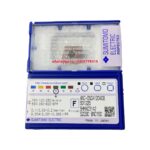
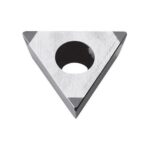
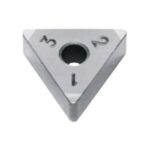
Introduction to Hard Turning of Hardened Steel
Hard turning replaces cylindrical grinding for finishing hardened steel components in the 55 to 65 HRC range, delivering shorter cycle times, greater flexibility, and comparable surface integrity when the process is controlled correctly. The technology is widely applied in automotive gearing, bearing races, hydraulic valves, and transmission shafts where dimensional tolerances of IT5 to IT6 and surface finishes below Ra 0.4 μm are required. Selecting the right cutting tool material, geometry, and cutting parameters is the single most important factor in achieving consistent results and predictable tool life.
This guide focuses on insert selection for finishing and semi-finishing operations on case-hardened, through-hardened, and induction-hardened steels. It compares cubic boron nitride (CBN) and ceramic insert grades from Sandvik, Sumitomo, and Tungaloy, and provides concrete cutting speed, feed, and depth-of-cut recommendations for production environments.
Why Hard Turning Replaces Grinding
Hard turning offers several measurable advantages over grinding for finishing hardened components:
- Flexibility: A single CNC turning center can perform OD, ID, and face operations without re-fixturing, while grinding typically requires dedicated machines per geometry.
- Cycle time: Material removal rates of 3 to 8 cm³/min are achievable with CBN, often 30 to 50 percent faster than cylindrical grinding for the same stock allowance.
- Surface integrity: When cutting parameters and edge preparation are optimized, hard turning produces compressive residual stresses at the surface, comparable to grinding, without the burn risk associated with abusive grinding.
- Cost: Elimination of coolant (dry cutting is standard for CBN), reduced wheel inventory, and lower machine investment favor hard turning in medium-batch production.
The trade-off is tighter process control. Hard turning is sensitive to machine stiffness, runout, and tool edge condition. A rigid machine tool with spindle runout below 2 μm and minimal tailstock deflection is essential for sub-Ra 0.4 finishes.
Workpiece Material Considerations by HRC Range
Hardened steel is not a single material. The selection of insert grade depends on hardness, microstructure, and the presence of carbides or retained austenite. The table below summarizes the most common workpiece groups and their implications for tool selection.
| Material Group | Typical Grades | Hardness (HRC) | Microstructure Notes | Recommended Tool Material |
|---|---|---|---|---|
| Case-hardened alloy steel | AISI 4320, 8620, 9310 | 58–63 | High-carbon martensite case, tough core | Low-CBN or ceramic finishing |
| Through-hardened bearing steel | AISI 52100, SUJ2 | 60–64 | Tempered martensite with carbides | Low-CBN (preferred) or high-CBN roughing |
| Tool and die steel | D2, A2, H13 | 55–60 | Large primary carbides, abrasive | High-CBN or whisker ceramic |
| Induction-hardened shaft | AISI 4140, 1045 (surface) | 52–58 | Hardened layer 1–4 mm, soft core | Ceramic or low-CBN |
| High-speed steel | M2, M42 | 62–66 | Very fine carbides, high hot hardness | Low-CBN finishing only |
Bearing steels such as AISI 52100 represent the most demanding application because of uniformly distributed carbides that accelerate flank wear. Tool steels like D2 contain large primary chromium carbides that cause notching at the depth-of-cut line, favoring high-CBN grades with tougher binders.
CBN vs Ceramic: Choosing the Right Tool Material
Two tool material families dominate hard turning: cubic boron nitride (CBN) and ceramic. Each occupies a distinct performance window defined by cutting speed, surface finish requirement, and workpiece hardness.
Cubic Boron Nitride (CBN)
CBN is the second-hardest cutting material after diamond, with a hardness of approximately 4,500 HV. It retains hardness above 1,000 °C and is chemically stable against ferrous alloys, making it the preferred choice for hard turning above 50 HRC. CBN inserts are classified by binder content:
- High-CBN (80–95 percent CBN): Metallic binder (Co, Ni) or ceramic binder (TiC, TiN). Tougher, suitable for interrupted cuts and roughing. Higher cutting-edge wear resistance in abrasive materials. Typical Vc 100–150 m/min.
- Low-CBN (50–70 percent CBN): Ceramic binder (TiC, Al2O3). Higher chemical stability and superior surface finish, ideal for continuous finishing of bearing steels. Typical Vc 120–200 m/min.
Solid CBN inserts (full CBN tip) are used for heavy roughing and interrupted cuts, while tipped inserts (CBN brazed to a carbide substrate) are economical for finishing where only a small depth of cut is taken.
Ceramic Inserts
Ceramic inserts are based on aluminum oxide (Al2O3) with reinforcing phases. They are less expensive than CBN and operate at higher cutting speeds, but they are more brittle and limited to continuous cuts. Two compositions are relevant for hard turning:
- Mixed ceramic (Al2O3 + TiC/TiN, 70/30): Black ceramic with improved toughness and thermal shock resistance. Used for hard turning up to HRC 62 at Vc 150–300 m/min.
- Whisker-reinforced ceramic (Al2O3 + SiC whiskers): Highest fracture toughness among ceramics, suitable for interrupted cuts and high-temperature alloys. Cutting speeds of 200–400 m/min are achievable on hardened steel.
Ceramics require a rigid setup and cannot tolerate entry or exit shocks. They are the economical choice when surface finish requirements are Ra 0.4 to 0.8 μm and the cut is fully continuous.
Insert Geometry and Edge Preparation
In hard turning, geometry is as important as grade. The cutting edge must be reinforced to withstand high contact pressures without chipping, yet sharp enough to generate the required surface finish. Key geometry parameters:
- Edge preparation (honed/T-land): A hone of 15–30 μm or a T-land (chamfer) of 20° × 0.15–0.25 mm is standard. Larger hones increase edge strength but raise cutting forces and surface roughness. For Ra below 0.2 μm, a light hone of 10–15 μm is required.
- Rake angle: Negative rake (−5° to −7°) is universal for CBN and ceramic to support the edge. Positive geometries are reserved for low-CBN finishing on stable machines.
- Clearance angle: 5° to 7° is typical. Larger clearance reduces flank contact but weakens the edge.
- Nose radius (rε): 0.4 and 0.8 mm dominate finishing. A smaller nose radius lowers radial force and reduces vibration, while a larger radius improves surface finish and edge strength. Theoretical surface roughness follows Rt ≈ fn² / (8 × rε).
- Wiper geometry: Wiper inserts allow feed rates 2–3 times higher than conventional inserts at the same surface finish, improving productivity by 40–60 percent in finishing passes.
For bearing race finishing targeting Ra 0.2 μm, a low-CBN insert with 0.4 mm nose radius, 15 μm hone, and wiper geometry is the benchmark configuration.
Cutting Parameters for Hard Turning HRC 55–65
The following parameters are starting values for continuous finishing cuts on through-hardened steel. They should be validated by cutting trials on the actual workpiece and machine. All values assume dry cutting, rigid workholding, and a machine tool with thermal stability.
| Operation | Tool Material | Vc (m/min) | fn (mm/rev) | ap (mm) | Expected Surface |
|---|---|---|---|---|---|
| Finishing, HRC 58–62 | Low-CBN, wiper | 150–200 | 0.05–0.12 | 0.1–0.3 | Ra 0.2–0.4 μm |
| Finishing, HRC 62–65 | Low-CBN | 120–160 | 0.05–0.10 | 0.1–0.25 | Ra 0.3–0.5 μm |
| Semi-finishing, HRC 55–60 | High-CBN | 100–150 | 0.10–0.20 | 0.3–0.8 | Ra 0.6–1.2 μm |
| Light roughing, HRC 55–60 | High-CBN, solid | 90–130 | 0.15–0.30 | 0.5–2.0 | Ra 1.0–2.0 μm |
| Finishing, HRC 55–60 | Mixed ceramic | 180–280 | 0.05–0.15 | 0.1–0.4 | Ra 0.4–0.8 μm |
| Finishing, HRC 60–65 | Mixed ceramic | 150–220 | 0.04–0.10 | 0.1–0.3 | Ra 0.4–0.6 μm |
| Interrupted, HRC 55–62 | Whisker ceramic | 150–250 | 0.08–0.15 | 0.2–0.5 | Ra 0.6–1.0 μm |
Depth of cut in finishing should not exceed 0.3 mm for low-CBN grades to avoid rapid notch wear at the depth-of-cut line. When more stock must be removed, a two-pass strategy (semi-finishing with high-CBN at ap 0.5 mm, then finishing with low-CBN at ap 0.15 mm) maximizes total tool life.
Brand and Grade Recommendations
Three manufacturers with mature CBN and ceramic portfolios are compared below. Grade selection should match the workpiece hardness, operation type, and machine rigidity.
Sandvik Coromant
Sandvik offers a complete CBN range under the CB designation and ceramics under CC. Key grades for hardened steel hard turning:
- CB7025: Low-CBN with ceramic binder, the first choice for finishing bearing steel HRC 60–65. Combines chemical stability with a honed edge; achieves Ra 0.3 μm at Vc 150 m/min, fn 0.08 mm/rev.
- CB7015: Low-CBN optimized for higher cutting speeds up to 220 m/min on case-hardened steel. Excellent surface finish, slightly lower notch resistance than CB7025.
- CB7050: High-CBN for semi-finishing and light interrupted cuts on tool steels. Tougher than the low-CBN grades, tolerates ap up to 1.5 mm.
- CC6090: Mixed ceramic (Al2O3/TiC) for high-speed finishing of induction-hardened shafts. Cutting speeds of 250 m/min are typical; limited to continuous cuts.
- CC670: Whisker-reinforced ceramic for interrupted cuts and hardened tool steel, providing the fracture toughness needed for keyway or spline interruptions.
Sumitomo Electric Hardmetal
Sumitomo’s BNC series is a benchmark in bearing steel hard turning, widely adopted in automotive and wind-turbine bearing production:
- BNC200: Low-CBN with TiC binder, the industry standard for finishing AISI 52100 at HRC 60–64. Delivers tool life of 30–60 minutes at Vc 140 m/min, fn 0.07 mm/rev, ap 0.15 mm, with Ra 0.25 μm.
- BNC100: Low-CBN with a smoother edge finish for mirror-finish applications, targeting Ra below 0.2 μm on bearing races. Lower cutting speed window of 100–140 m/min.
- BNC300: Low-CBN with improved notch wear resistance for heavier finishing passes (ap up to 0.4 mm) on case-hardened gears.
- BN7000: High-CBN solid insert for roughing and interrupted cuts on tool steel and forged hardened components. Toughness supports ap up to 2.0 mm.
- BX480: Mixed ceramic for high-speed finishing of induction-hardened shafts, operating at Vc 200–300 m/min with good thermal shock resistance.
Tungaloy
Tungaloy’s BNX series covers both high- and low-CBN grades with a strong focus on automotive gear and shaft finishing:
- BNX10: Low-CBN with TiC binder for finishing case-hardened steel HRC 58–62. Stable at Vc 130–180 m/min with wiper geometry.
- BNX20: Low-CBN with enhanced notch resistance, recommended for bearing steel HRC 60–64 at ap up to 0.35 mm.
- BNX25: Low-CBN bridging BNX10 and BNX20, offering a balance of speed and depth-of-cut capability for mixed production batches.
- BNX40: High-CBN for semi-finishing and light roughing on hardened tool steel; tolerates interrupted cuts with proper edge honing.
- HW2: Mixed ceramic for high-speed finishing of hardened steel up to HRC 62, offering a cost-effective alternative to CBN where surface finish tolerance is Ra 0.5 μm.
Comparative Grade Selection Table
The table consolidates the recommended grade for each common hard-turning scenario across the three brands. Use it as a starting point and adjust based on cutting trials.
| Application | Hardness (HRC) | Sandvik | Sumitomo | Tungaloy | Vc Range (m/min) |
|---|---|---|---|---|---|
| Finishing, bearing steel | 60–65 | CB7025 | BNC200 | BNX20 | 120–180 |
| Finishing, case-hardened | 58–62 | CB7015 | BNC300 | BNX10 | 150–220 |
| Mirror finish | 60–64 | CB7015 | BNC100 | BNX10 | 100–150 |
| Semi-finishing | 55–60 | CB7050 | BN7000 | BNX40 | 100–150 |
| Interrupted cut | 55–62 | CB7050 / CC670 | BN7000 | BNX40 | 90–150 |
| High-speed ceramic finishing | 55–62 | CC6090 | BX480 | HW2 | 200–300 |
| Interrupted, whisker ceramic | 55–62 | CC670 | BX480 | HW2 | 150–250 |
Application Best Practices
- Machine rigidity: Use a turning center with hydrostatic or high-precision roller bearings, spindle runout under 2 μm, and a live center with minimal deflection. The machine should be dedicated or thermally stabilized for hard turning.
- Workholding: Collet chucks or hydraulic chucks with runout below 5 μm are preferred. For thin-walled components, use segment chucks or face-drivers to avoid distortion.
- Coolant strategy: Dry cutting is standard for CBN and ceramic to avoid thermal shock. If coolant is required for chip evacuation, use high-pressure through-tool coolant at 70 bar or higher to ensure consistent delivery; intermittent coolant causes rapid edge failure.
- Stock allowance: Leave 0.15 to 0.3 mm per side for finishing after heat treatment. Excessive stock causes notch wear and shortens CBN life; insufficient stock leaves scale or decarburized layer on the surface.
- Tool path: Constant surface speed (G96) is mandatory to maintain cutting speed as diameter changes. Set a maximum spindle speed (G50) to prevent exceedance at small diameters.
- Entry and exit: Use a lead-in and lead-out arc to avoid shock at cut entry and exit. A 0.5 mm lead-out protects the edge from the tensile stress wave that occurs when the tool leaves the cut.
- Tool life monitoring: Replace CBN inserts at a flank wear land (VB) of 0.15 mm for finishing. Beyond VB 0.2 mm, surface finish degrades rapidly and white-layer formation risk increases. Ceramic inserts should be replaced at VB 0.1 mm.
- Surface integrity: Monitor for white layer (untempered martensite) formation. Cutting speeds above 200 m/min with low-CBN can generate white layer thickness exceeding 1 μm; reduce Vc or increase feed slightly to dissipate heat into the chip rather than the workpiece.
Troubleshooting Common Defects
| Defect | Likely Cause | Corrective Action |
|---|---|---|
| Poor surface finish (Ra above target) | Excessive feed, worn edge, vibration | Reduce fn, check insert wear, verify workholding rigidity |
| Rapid flank wear | Cutting speed too high for grade | Reduce Vc by 15–20 percent or switch to more wear-resistant low-CBN grade |
| Notch wear at depth-of-cut line | Hard material with abrasive carbides, excessive ap | Reduce ap below 0.3 mm, use grade with higher notch resistance (BNC300, BNX20) |
| Edge chipping | Interrupted cut, insufficient edge hone, machine deflection | Increase hone size, switch to high-CBN or whisker ceramic, check tailstock pressure |
| White layer formation | Excessive cutting temperature | Reduce Vc, increase fn slightly, verify dry cutting to avoid thermal cycling |
| Built-up edge | Low cutting speed, gummy workpiece | Increase Vc above 120 m/min; BUE is rare in hard turning but possible at low speed on HRC 50–55 |
Conclusion
Hard turning of HRC 55–65 hardened steel is a mature, productive alternative to grinding when tool selection is matched to the workpiece. Low-CBN grades such as Sandvik CB7025, Sumitomo BNC200, and Tungaloy BNX20 are the benchmark for finishing bearing and case-hardened steels, delivering Ra 0.2–0.4 μm at cutting speeds of 120–180 m/min. High-CBN grades and whisker-reinforced ceramics extend the technology to interrupted cuts and tool steels, while mixed ceramics provide an economical high-speed option for continuous finishing of induction-hardened shafts. Combining the correct grade with proper edge preparation, rigid fixturing, and disciplined stock allowance management yields tool life of 30–60 minutes per edge and surface integrity comparable to ground finishes, making hard turning the preferred finishing route for medium-to-high batch hardened components.
Shop Related Products at HOOGUU