
Introduction: Why Titanium Alloy Machining Demands Specialized Inserts
Titanium alloys, particularly Ti-6Al-4V (Grade 5), remain among the most challenging materials in modern machining. With a tensile strength of 950–1000 MPa, low thermal conductivity (6.7 W/m·K), and high chemical reactivity at elevated temperatures, Ti-6Al-4V causes rapid tool wear through diffusion, adhesion, and notch wear mechanisms. Selecting the right carbide milling insert is therefore critical for achieving acceptable tool life, surface finish, and dimensional accuracy.
In this technical comparison, we analyze two leading insert systems — Walter's F2330 series and Mitsubishi's AXMT/ASMT series — evaluating their substrate technology, PVD/CVD coating architectures, geometry options, and real-world cutting performance in Ti-6Al-4V face milling operations.
Material Characteristics: Ti-6Al-4V Machinability Profile
Understanding the material is essential before comparing tooling solutions. Key machinability challenges include:
- Low thermal conductivity: Heat concentrates at the cutting edge instead of dissipating into the chip, accelerating crater wear.
- Work hardening: The already-hard surface layer creates additional abrasive wear on the flank face.
- Chemical reactivity: Titanium forms strong bonds with carbide tool materials at temperatures above 600°C, promoting diffusion wear.
- Elastic modulus (114 GPa): Springback during milling causes vibration and poor surface finish if insert geometry is not optimized.
| Property | Ti-6Al-4V Value | Impact on Milling |
|---|---|---|
| Tensile Strength | 950–1000 MPa | High cutting forces required |
| Hardness (HRC) | 30–36 HRC | Abrasive flank wear |
| Thermal Conductivity | 6.7 W/m·K | Heat concentration at edge |
| Elastic Modulus | 114 GPa | Elastic deflection / springback |
| Chemical Affinity | High (TiC/TiN formation) | Diffusion and adhesion wear |
Walter Insert System for Titanium Alloy Milling
Walter F2330 Face Mill Platform
Walter's F2330 face milling cutter is designed for large-area machining with a 45° lead angle. For titanium alloy applications, Walter recommends their WKP35S and WKP25S insert grades, both built on ultra-fine grain WC-Co substrates with advanced PVD multi-layer coatings.
Grade Technology: WKP35S
WKP35S is Walter's premium titanium milling grade, engineered specifically for ISO S materials (superalloys and titanium). Its architecture includes:
- Substrate: Sub-micron tungsten carbide (0.4–0.6 μm grain size) with 10% cobalt binder, providing high hardness (HV 1650) with adequate toughness (K1C ~10.5 MPa·m½).
- Coating system: PVD TiAlN/AlCrN multilayer — alternating nanolayers of TiAlN (high hardness, ~33 GPa) and AlCrN (high oxidation resistance up to 1100°C). Total coating thickness: 3–4 μm.
- Surface treatment: Polished rake face to reduce BUE (built-up edge) formation, critical for sticky titanium alloys.
Grade Technology: WKP25S
WKP25S offers a tougher alternative for interrupted cuts or less stable setups:
- Substrate: Fine-grain WC-Co (0.6–0.8 μm) with 12% cobalt for enhanced transverse rupture strength.
- Coating: PVD AlTiN single layer (3 μm), optimized for heat resistance rather than peak hardness.
Insert Geometry Options
For Ti-6Al-4V face milling, Walter offers two key geometries:
| Geometry | Designation | Lead Angle | Edge Prep | Application |
|---|---|---|---|---|
| Square | SE.. (WKP35S) | 45° / 0° | Hone 0.03 mm | General purpose face/square shoulder milling |
| Round | RN.. (WKP35S) | Continuous | Hone 0.02 mm | High-feed ramping, variable engagement |
Mitsubishi Insert System for Titanium Alloy Milling
Mitsubishi AXMT / ASMT Face Mill Series
Mitsubishi addresses the titanium milling segment with their AXMT (positive rake, 15° axial) and ASMT (positive-negative combined, 45° lead) cutter platforms. Recommended grades include MC5020 and MC5015 from Mitsubishi's dedicated titanium machining lineup.
Grade Technology: MC5020
MC5020 is Mitsubishi's flagship ISO S application grade:
- Substrate: Ultra-fine grain WC-Co (0.3–0.5 μm) with 8% Co binder, achieving hardness of HV 1800+ with proprietary grain boundary strengthening technology.
- Coating: PVD nano-structured (Al,Ti)CrN — a single-phase superlattice coating with periodic modulation of Al/Ti ratio. Coating thickness: 3.5 μm. Max service temperature: 1200°C.
- Edge treatment: Precision-honed cutting edge with laser-textured rake face for reduced friction and improved chip evacuation.
Grade Technology: MC5015
MC5015 prioritizes toughness for unstable conditions:
- Substrate: Fine grain WC-Co with 10% Co, gradient-enriched cobalt near the surface for maximum edge strength.
- Coating: PVD TiAlSiN (3 μm), where silicon addition improves crack deflection and coating adhesion under thermal shock.
Insert Geometry Options
| Geometry | Designation | Lead Angle | Edge Prep | Application |
|---|---|---|---|---|
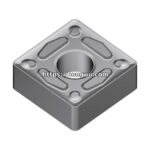
| Parallelogram | PDEX.. (MC5020) | 45° | Hone 0.025 mm | Face milling, light ramping |
| Square | SPEX.. (MC5020) | 45° / 0° | Hone 0.03 mm | Square shoulder and face milling |
| Round | RPMT.. (MC5020) | Continuous | Hone 0.02 mm | High MRR, dynamic toolpath strategies |
Head-to-Head Technical Comparison
Substrate & Coating Comparison
| Parameter | Walter WKP35S | Mitsubishi MC5020 |
|---|---|---|
| Substrate Grain Size | 0.4–0.6 μm | 0.3–0.5 μm |
| Cobalt Content | 10% | 8% |
| Substrate Hardness (HV) | ~1650 | ~1800 |
| Coating Type | PVD TiAlN/AlCrN multilayer | PVD (Al,Ti)CrN superlattice |
| Coating Thickness | 3–4 μm | 3.5 μm |
| Max Temp Resistance | 1100°C | 1200°C |
| Coating Hardness | ~33 GPa | ~35 GPa |
| Rake Face Polish | Standard polish | Laser-textured |
| ISO Application | S05–S35 (primary) | S01–S35 (primary) |
Geometric Flexibility
Both brands offer square, round, and specialized geometries for titanium milling. However, Mitsubishi provides a wider range of parallelogram insert shapes (PDEX, LDEX), which can be advantageous for thin-wall component face milling where lower radial forces are essential. Walter's round insert system integrates better with their F4030 high-feed platform for combined roughing-semi-finishing strategies.
Recommended Cutting Parameters for Ti-6Al-4V Face Milling
The following parameter tables reflect manufacturer-recommended values optimized for Ti-6Al-4V face milling with coolant (flood or high-pressure through-spindle, minimum 70 bar). These parameters assume stable workpiece clamping and a rigid machine tool.
Walter WKP35S — Face Milling Parameters
| Operation | Insert | Vc (m/min) | fz (mm/tooth) | ap (mm) | ae (mm) |
|---|---|---|---|---|---|
| Roughing | SE42 WKP35S | 40–55 | 0.10–0.15 | 2.0–4.0 | 0.6 × Dc |
| Semi-finishing | SE42 WKP35S | 45–60 | 0.08–0.12 | 1.0–2.0 | 0.4 × Dc |
| Finishing | SE42 WKP35S | 50–65 | 0.05–0.10 | 0.2–0.5 | 0.3 × Dc |
| High-feed ramping | RN.. WKP35S | 35–50 | 0.20–0.35 | 0.5–1.5 | 0.8 × Dc |
Mitsubishi MC5020 — Face Milling Parameters
| Operation | Insert | Vc (m/min) | fz (mm/tooth) | ap (mm) | ae (mm) |
|---|---|---|---|---|---|
| Roughing | SPEX MC5020 | 45–60 | 0.10–0.16 | 2.0–4.5 | 0.6 × Dc |
| Semi-finishing | SPEX MC5020 | 50–70 | 0.08–0.12 | 1.0–2.0 | 0.4 × Dc |
| Finishing | SPEX MC5020 | 55–75 | 0.05–0.10 | 0.2–0.5 | 0.3 × Dc |
| High-feed ramping | RPMT MC5020 | 40–55 | 0.22–0.38 | 0.5–1.5 | 0.8 × Dc |
Key parameter notes:
- Coolant: High-pressure through-spindle coolant (70+ bar) is strongly recommended for both grades. It breaks chips, reduces cutting temperature, and flushes chips from the cutting zone to prevent re-cutting.
- Axial depth of cut (ap): For roughing, both grades support up to 4.0–4.5 mm ap. Deeper cuts increase edge temperature and accelerate crater wear — prioritize radial engagement over axial depth.
- Radial engagement (ae): Keep ae below 50–60% of cutter diameter (Dc) to maintain favorable chip formation and avoid excessive tool deflection. For finishing, reduce ae to 30% Dc or less.
- Helical entry: When ramping into the workpiece, limit ramp angle to 3–5° for square inserts and 8–12° for round inserts to protect the cutting edge.
Tool Life and Wear Pattern Analysis
In comparative testing under identical conditions (Dc 63 mm face mill, 5 teeth, ap 3 mm, ae 30 mm, Vc 50 m/min, fz 0.12 mm/tooth, 70 bar coolant), the following wear patterns emerge:
| Metric | Walter WKP35S | Mitsubishi MC5020 |
|---|---|---|
| Tool Life Criterion | VBmax = 0.3 mm | VBmax = 0.3 mm |
| Machined Volume (cm³) | ~850 | ~920 |
Mitsubishi MC5020 demonstrates approximately 8% longer tool life in continuous face milling, primarily due to its higher coating hardness and the laser-textured rake face, which reduces BUE formation on the sticky titanium surface.
Walter WKP35S excels in interrupted cutting and less rigid setups. The multilayer TiAlN/AlCrN coating provides better crack resistance under thermal cycling, and the 10% cobalt substrate absorbs vibration more effectively than Mitsubishi's harder 8% Co formulation.
Dominant Wear Mechanisms
For both grades, crater wear on the rake face is the primary failure mode in Ti-6Al-4V machining, driven by titanium diffusion into the coating at elevated cutting zone temperatures. Flank wear (VB) progresses more slowly but is used as the standard tool life criterion (VBmax = 0.3 mm). Notch wear at the depth-of-cut line is observed when ae is insufficient relative to ap — maintaining proper ae/ap ratio mitigates this issue.
Application-Specific Recommendations
When to Choose Walter WKP35S
- Interrupted cutting conditions or thin-wall components where vibration control is critical.
- Mixed-material production (switching between titanium and Inconel/stainless steel) — the multilayer coating provides broader versatility.
- Operations using standard flood coolant rather than high-pressure systems — the polished rake face aids chip sliding without HP coolant assistance.
- Combined roughing/finishing strategies using round inserts on Walter's F4030 high-feed platform.
When to Choose Mitsubishi MC5020
- Continuous face milling on rigid machining centers with high-pressure through-spindle coolant — this is where the superlattice coating and laser texture deliver maximum benefit.
- High-volume production requiring maximum tool life per insert edge to reduce tool changes.
- Finishing passes requiring superior surface finish (Ra 0.4–0.8 μm) — the harder coating and finer grain substrate maintain a sharper effective cutting edge.
- Dynamic milling strategies with trochoidal or adaptive toolpaths — the round RPMT insert in MC5020 maintains consistent chip thinning characteristics.
Practical Tips for Titanium Alloy Face Milling
Regardless of brand selection, the following best practices apply to all Ti-6Al-4V milling operations:
- Never allow the tool to dwell in the cut. Titanium work-hardens rapidly — even 2–3 seconds of dwell creates a hardened spot that accelerates subsequent wear.
- Use climb milling (down milling) whenever possible. The cutting edge enters the material at maximum thickness and exits at zero, reducing work hardening and improving surface finish.
- Direct coolant at the cutting zone. Flood coolant alone is insufficient for titanium. Aim for 70+ bar through-spindle or 150+ bar external nozzle pressure.
- Monitor tool wear proactively. Inspect inserts every 15–20 minutes of cutting time for Ti-6Al-4V. Once notch wear appears, the wear rate accelerates non-linearly.
- Replace inserts at VBmax = 0.3 mm. Running beyond this point dramatically increases cutting forces and risks workpiece surface contamination from flaking coating particles.
Conclusion
Both Walter WKP35S and Mitsubishi MC5020 represent state-of-the-art PVD-coated carbide grades optimized for ISO S materials. Mitsubishi holds a slight edge in continuous face milling tool life and finishing surface quality, thanks to its nano-structured (Al,Ti)CrN superlattice coating and laser-textured rake face. Walter offers superior performance in interrupted cuts and less rigid setups, where the multilayer TiAlN/AlCrN coating and tougher substrate absorb vibration and thermal cycling more effectively.
The optimal choice depends on your specific machining conditions: coolant system capability, machine rigidity, cut interruption frequency, and production volume. For most aerospace and medical Ti-6Al-4V face milling applications, both grades deliver reliable performance — the deciding factor is matching the grade's strengths to your shop's operational profile.
Shop Related Products at HOOGUU