Introduction
Kyocera is one of the world’s leading manufacturers of cemented carbide cutting tools, and much of that reputation stems from its pioneering work in coating technology. Every year, Kyocera invests heavily in both Chemical Vapor Deposition (CVD) and Physical Vapor Deposition (PVD) processes, producing coatings that dramatically extend tool life, improve surface finish, and allow higher cutting speeds across a wide range of workpiece materials. This article provides a deep technical dive into Kyocera’s coating portfolio, explaining how CVD and PVD differ, where each excels, and what the company’s latest generations such as Gen2000, CA025P, and MP9000 series bring to modern CNC machining.
The Science Behind CVD and PVD Coatings
Before examining specific Kyocera products, it is important to understand the fundamental differences between the two dominant coating deposition methods used in cutting tool manufacturing.
Chemical Vapor Deposition (CVD)
CVD is a thermally driven process carried out at temperatures between 850°C and 1050°C. The substrate (usually a cemented carbide insert) is placed in a vacuum chamber, and reactive precursor gases — such as titanium tetrachloride (TiCl₄), nitrogen (N₂), and methane (CH₄) — are introduced. These gases decompose on the hot carbide surface, forming a dense, crystalline coating through atomic-level nucleation and growth.
Key characteristics of CVD coatings:
- Thicker coatings, typically 5–20 μm, providing superior wear resistance
- Excellent adhesion to carbide substrates due to interdiffusion at high temperatures
- Typically produce compressive residual stresses at the coating surface
- Columnar grain structures that align with the cutting direction for enhanced strength
- Ideal for continuous cutting at high speeds (Vc = 200–400 m/min for steel turning)
The trade-off is that CVD’s high deposition temperature can cause the formation of an eta-phase (a brittle Co-W-C compound) at the coating-substrate interface if process control is not precise. Kyocera addresses this with proprietary interface engineering in its advanced CVD grades.
Physical Vapor Deposition (PVD)
PVD operates at much lower temperatures, typically 300°C to 550°C. The most common industrial variant is cathodic arc ion plating, in which a high-current electric arc evaporates a solid target material (titanium, aluminum, chromium) in a nitrogen or argon atmosphere. The vaporized metal ions condense on the cooler substrate surface, forming a dense, nanocrystalline or multilayer coating.
Key characteristics of PVD coatings:
- Thinner coatings, generally 2–8 μm, preserving the sharp cutting edge
- Lower deposition temperature prevents substrate distortion and eta-phase formation
- Typically exhibit tensile residual stresses, requiring careful edge preparation
- Finer, equiaxed grain structures with higher hardness (HV 2000–3500 vs HV 1500–2500 for conventional CVD TiCN)
- Superior performance in interrupted cutting, milling, and low-speed operations with built-up edge tendency
Modern PVD processes — particularly high-power impulse magnetron sputtering (HiPIMS), which Kyocera has adopted for its latest grades — produce coatings with improved density, reduced droplet formation, and better substrate adhesion compared to traditional arc PVD.
Kyocera’s Coating Portfolio Overview
Kyocera organizes its coatings by intended application and deposition technology. The table below summarizes the major coating families currently in production:
| Coating Series | Deposition Type | Composition | Target Application | Typical Hardness (HV) |
|---|---|---|---|---|
| Gen2000 | CVD (gradient) | TiN / TiCN / Al₂O₃ multi-layer | Steel, stainless steel turning | 2200–2600 |
| CA025P | CVD | TiCN + Al₂O₃ + TiN | P-class steel, high-speed turning | 2400–2800 |
| CA015P | CVD | Optimized Al₂O₃ outer layer | Cast iron turning (K-class) | 2300–2700 |
| MP9000 | PVD | TiAlN / TiSiN nanolayer | Milling, interrupted cutting | 3000–3500 |
| SP600 | PVD | CrN / AlCrN | Stainless steel, titanium alloys | 2800–3200 |
| DL1000 | CVD (diamond) | Polycrystalline diamond | Aluminum, graphite, non-ferrous | 8000–10000 |
| BN250 | PVD (cBN) | Cubic boron nitride composite | Hardened steel, heat-resistant alloys | 4500–5000 |
Deep Dive: Gen2000 CVD Coating Technology
Introduced in 2018 as a replacement for Kyocera’s successful M10/M20 series, Gen2000 represents the company’s latest evolution of gradient CVD technology. Unlike conventional CVD coatings with uniform composition through the thickness, Gen2000 uses a continuously varying gradient in both carbon content and aluminum distribution across its five-layer structure.
Gen2000 Layer Architecture
The Gen2000 coating stack from substrate to surface is:
- TiN adhesion layer (0.5 μm) — promotes bonding between the carbide substrate and subsequent layers
- Gradient TiCN layer (3 μm) — carbon content increases from 20% near the substrate to 45% toward the middle, increasing hardness while maintaining toughness
- Al₂O₃ thermal barrier (2 μm) — columnar alpha-phase alumina with high thermal conductivity resistance
- TiCN wear layer (1.5 μm) — high-carbon TiCN for abrasion resistance
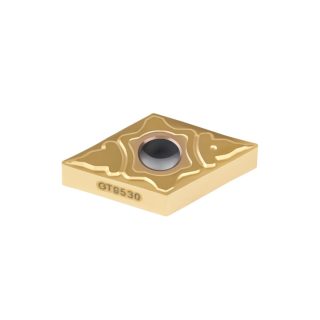
- TiN top layer (0.3 μm) — golden color for wear visualization and improved friction characteristics
This gradient design addresses a classic CVD problem: thick coatings with uniform composition tend to delaminate under thermal cycling because the coating and substrate have different coefficients of thermal expansion. By gradually changing composition, Gen2000 creates a smooth transition in mechanical and thermal properties, reducing interfacial stress by an estimated 35% compared to conventional multi-layer CVD coatings.
Gen2000 in Action: Performance Data
Kyocera publishes extensive field data for Gen2000 inserts. The following table shows typical recommended cutting parameters and tool life improvements compared to standard TiCN-coated inserts:
| Workpiece Material | ISO Class | Vc (m/min) Gen2000 | Vc (m/min) Standard TiCN | fz (mm/tooth) | Tool Life Improvement |
|---|---|---|---|---|---|
| C45 carbon steel | P10 | 320 | 240 | 0.25 | +40–50% |
| 42CrMo4 alloy steel | P20 | 260 | 200 | 0.20 | +35–45% |
| 304 stainless steel | M10 | 220 | 170 | 0.18 | +30–40% |
| GG25 cast iron | K15 | 180 | 140 | 0.22 | +25–35% |
These figures are for continuous turning with a 6 mm depth of cut (ap) and good coolant delivery. In production environments, shops often report even larger gains when Gen2000 replaces older generation coatings, because the improved heat resistance allows feeds and speeds to be pushed beyond traditional limits.
CA025P: Purpose-Built for High-Speed Steel Turning
If Gen2000 is Kyocera’s versatile CVD workhorse, CA025P is its specialized high-speed champion. Launched in 2021, CA025P was engineered specifically for the automotive and aerospace sectors, where high-volume production demands maximum material removal rates without sacrificing surface quality or dimensional accuracy.
What Makes CA025P Different
CA025P uses a modified CVD process that Kyocera calls High-Efficiency CVD (HE-CVD). The key innovation is the elimination of the traditional TiN bottom layer, replacing it with a direct deposition of TiCN on a specially treated carbide substrate. This removes one interface — the weakest point in conventional coatings — and the resulting coating is denser with fewer pinholes.
The outer layer is phase-pure alpha-Al₂O₃, which has better high-temperature stability than the kappa-phase alumina used in many competing coatings. Alpha-Al₂O₃ maintains its hardness and chemical inertness above 1000°C, whereas kappa-phase alumina undergoes a phase transformation at around 900°C that leads to grain coarsening and rapid wear.
CA025P Cutting Parameters
| Parameter | Recommended Value | Range |
|---|---|---|
| Cutting speed (Vc) | 350 m/min | 280–500 m/min |
| Feed per revolution (f) | 0.25 mm/rev | 0.15–0.40 mm/rev |
| Depth of cut (ap) | 2–4 mm | 1–6 mm |
| Coolant pressure | 70 bar (1000 psi) | 40–150 bar |
| Surface roughness Ra | 0.8–1.6 μm achievable | 0.4–3.2 μm |
At 400 m/min with an 0.2 mm/rev feed, CA025P inserts can achieve 80–120 minutes of tool life on C45 steel, depending on workpiece hardness and machine rigidity. That is roughly double the life of competing CVD coatings at the same parameters.
MP9000 Series: PVD for Interrupted Cutting and Milling
The MP9000 family is Kyocera’s flagship PVD coating line, introduced in 2019 and updated with HiPIMS technology in 2022. Where CVD coatings excel at continuous high-speed turning, MP9000 PVD coatings shine in milling, parting-off, thread turning, and any operation involving interrupted contact between the tool and workpiece.
Nanolayer Architecture
MP9000 coatings are composed of hundreds of alternating nanometer-thick layers of TiAlN and TiSiN, each layer 2–10 nm thick. This nanolayered structure provides multiple benefits:
- High hardness (HV 3200–3500) — silicon addition promotes grain refinement and solid solution hardening
- Excellent toughness — crack deflection at layer interfaces prevents catastrophic failure
- Low coefficient of friction (0.35 vs 0.55 for TiCN) — reduces built-up edge formation
- Oxidation resistance to 900°C — thanks to aluminum-rich surface layers that form a self-healing Al₂O₃ film
MP9000 vs Competitive PVD Coatings
| Property | Kyocera MP9000 | Sandvik TiAlN PVD | Iscar TiAlN PVD |
|---|---|---|---|
| Coating thickness | 4–6 μm | 3–5 μm | 3–5 μm |
| Hardness (HV) | 3200–3500 | 2800–3200 | 2900–3300 |
| Oxidation temperature | 900°C | 850°C | 870°C |
| Recommended Vc (steel milling) | 150–250 m/min | 130–220 m/min | 140–230 m/min |
| Tool life relative to standard TiN | 3.5–4x | 2.8–3.2x | 3.0–3.5x |
The higher hardness and oxidation resistance of MP9000 translate into measurable gains in milling operations. In a typical slotting test in 42CrMo4 steel at Vc = 180 m/min and fz = 0.15 mm/tooth, MP9000 inserts achieved 42 parts per edge compared to 31 parts with Sandvik’s comparable PVD grade and 34 parts with Iscar’s.
Specialty Coatings: DL1000 Diamond and BN250 cBN
Beyond CVD and PVD nitride coatings, Kyocera also produces two highly specialized coating families for niche but demanding applications.
DL1000: CVD Diamond for Non-Ferrous Machining
Polycrystalline diamond (PCD) has long been the gold standard for machining aluminum alloys, copper, graphite, and other non-ferrous materials where high cutting speeds and excellent surface finish are required. Kyocera’s DL1000 coating is a CVD-deposited PCD layer 10–25 μm thick, offering hardness of HV 8000–10000 and a coefficient of friction of just 0.1–0.2 against aluminum.
Key DL1000 applications and parameters:
- Aluminum alloy milling: Vc = 2000–4000 m/min, fz = 0.1–0.3 mm/tooth
- High-silicon aluminum (AlSi18): Vc = 800–1500 m/min, reduced flank wear compared to non-coated PCD
- Graphite machining: Vc = 1500–3000 m/min, prevents graphite adhesion to the cutting edge
- Note: PVD diamond coatings exist but are much thinner and less durable; CVD PCD remains superior for high-volume production.
BN250: PVD cBN for Hardened Materials
Cubic boron nitride (cBN) is the second-hardest known material after diamond, and unlike diamond it remains stable at temperatures above 1000°C and does not react with iron-based materials. Kyocera’s BN250 coating uses a PVD process to deposit a composite layer of cBN and TiN, achieving HV 4500–5000 hardness with better toughness than pure cBN compacts.
BN250 typical performance:
| Workpiece | HRC | Vc (m/min) | fz (mm/rev) | ap (mm) | Tool Life |
|---|---|---|---|---|---|
| AISI 52100 bearing steel | 60–62 | 80–120 | 0.08–0.12 | 0.1–0.3 | 60–90 min |
| Inconel 718 | 38–42 | 50–70 | 0.10–0.15 | 0.5–1.0 | 90–120 min |
| D2 tool steel | 58–60 | 60–90 | 0.08–0.10 | 0.2–0.5 | 70–100 min |
How to Choose the Right Kyocera Coating
Selecting the correct coating for a given application requires balancing workpiece material, cutting operation, and production goals. Here is a practical decision framework:
Start with the ISO workpiece material classification:
- P-class (steel, cast steel, alloy steel): CVD coatings dominate. Choose Gen2000 for general-purpose turning, CA025P for high-speed production, and MP9000 for milling or interrupted operations.
- M-class (austenitic stainless steel, heat-resistant alloys): SP600 PVD or MP9000 for lower speeds and interrupted cuts; CA025P CVD if continuous turning at moderate speeds (Vc up to 220 m/min).
- K-class (cast iron): CA015P CVD (optimized alumina outer layer) or Gen2000; avoid PVD coatings for high-speed cast iron turning due to thermal cracking.
- N-class (aluminum, copper, non-ferrous): DL1000 CVD diamond for production; SP600 PVD for lower-volume applications where diamond cost cannot be justified.
- S-class (titanium alloys, high-temperature alloys): SP600 PVD or MP9000; CVD coatings tend to cause excessive workpiece heat generation and accelerated tool wear.
- H-class (hardened steel > HRC 45): BN250 PVD cBN; avoid conventional CVD/PVD coatings as they wear rapidly at cutting temperatures exceeding 800°C.
Factor #2: Operation Type
- Continuous turning (straight cuts, shoulders): CVD is almost always preferred for higher speeds and longer life.
- Interrupted turning (facing, parting-off): PVD provides better edge toughness; MP9000 is the top choice.
- Milling (face, end, slot): PVD exclusively; MP9000 for steel, SP600 for stainless, DL1000 for aluminum.
- Thread turning: PVD for sharp thread profiles, CVD for coarse threads on steel.
Factor #3: Production Volume and Economic Considerations
High-volume production favors CVD coatings because the higher coating cost per insert is offset by longer tool life and higher cutting speeds. Low-volume or job-shop environments may prefer PVD coatings with lower initial cost and acceptable performance at moderate parameters. Specialty coatings like DL1000 and BN250 are justified only when standard coatings fail to meet life or finish requirements.
Recent Innovations and Future Directions
Kyocera’s R&D pipeline includes several emerging coating technologies that should reach the market in the next two to three years:
- HiPIMS-CVD hybrid processes: Combining the best of both deposition methods to produce coatings with PVD-like edge sharpness and CVD-level thickness. Early prototypes show 20% higher tool life than Gen2000 in high-speed steel turning.
- Self-lubricating coatings: Incorporating solid lubricant phases (MoS₂, h-BN) into the coating matrix, reducing built-up edge and allowing dry or minimum-quantity lubrication (MQL) machining with equivalent or better results than flood coolant.
- AI-optimized coating architectures: Machine learning models are being used to design optimal layer sequences and compositions for specific workpiece-tool pairings, potentially moving beyond general-purpose grades to application-specific coatings manufactured on-demand.
- Recyclable coating removal: A process to strip coatings from worn carbide substrates and re-coat them, reducing both material cost and environmental impact. Kyocera estimates this could lower insert lifecycle cost by 30–40%.
Conclusion
Kyocera’s coating technology represents one of the most complete portfolios in the cutting tool industry, spanning from conventional CVD workhorses like Gen2000 and CA025P to advanced PVD nanolayer systems like MP9000, and extending into specialty diamond and cBN coatings for the most demanding applications. The key to their effectiveness lies not just in individual coating properties but in the company’s systems approach — matching deposition method, coating architecture, substrate composition, and edge preparation to specific machining scenarios.
For CNC shops looking to upgrade their tooling, the practical starting point is a controlled test: compare a component coated with Gen2000 against the current production coating for steel turning, or MP9000 against whatever PVD grade is used for milling. In most documented cases, the results speak for themselves — lower cost per part, better dimensional consistency, and less downtime for tool changes.
As coating technology continues to evolve, with hybrid HiPIMS-CVD processes and AI-driven design on the horizon, Kyocera is well positioned to maintain its leadership. Understanding how CVD and PVD coatings differ, and how to select the right Kyocera grade for each application, will remain an essential skill for manufacturing engineers and production managers for years to come.
Shop Related Products at HOOGUU