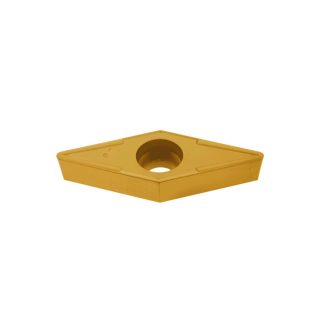


Steel turning is still the largest single application in metal cutting, and the ISO P range is where most of that volume sits. Within it, the P25 position — medium machining of carbon and low-alloy steel — is the grade every manufacturer builds first, because a P25 insert that survives mixed workshops sells in volume. Sumitomo Electric’s answer to that requirement is the AC800P series, a family of CVD-coated carbide grades built around the Absotech Platinum coating platform.
This article breaks down what is inside AC8025P, AC810P, AC820P and AC830P, how their substrates and coating thicknesses differ, what cutting data they tolerate, and how they compare with equivalent grades from Sandvik, Iscar, Seco, Walter and Korloy.
Why the AC800P Series Exists: The P25 Anchor Problem
ISO P covers steels with a wide spread of hardness and toughness. A 180 HB low-carbon steel cuts differently from a 320 HB quenched and tempered alloy steel, and both behave differently again under interrupted cutting. A single grade cannot be optimal everywhere, but a workshop wants the smallest possible inventory that covers the most work.
Sumitomo solves this the same way its competitors do: one anchor grade at the centre of the range, then a ladder of variants that trade wear resistance for toughness. In the AC800P family the anchor is AC8025P; AC810P steps toward higher speed and lower feed, AC820P stays close to balance, and AC830P moves toward roughing and interrupted cuts.
All four share the same architecture: a cobalt-enriched surface layer on a fine-grain carbide substrate, a multilayer CVD coating with a thick alpha-alumina layer, and a TiN top coat for wear indication and reduced friction. What changes is coating thickness, alumina texture and substrate cobalt content.
Absotech Platinum Coating Architecture
The Absotech Platinum platform is an evolution of Sumitomo’s earlier CVD coatings. Its distinguishing feature is a smoother, finer-grained alpha-alumina layer deposited with a controlled texture, which reduces the built-up edge tendency and the friction heat that normally accompanies a rough crystalline Al2O3 surface. On steel, that translates into less crater wear at high cutting speed and a more predictable wear land.
| Layer | Material | Typical thickness (µm) | Primary function |
|---|---|---|---|
| Top coat | TiN | 0.5 – 1.0 | Wear identification, reduced friction, chip flow |
| Thermal barrier | Textured alpha-Al2O3 | 4 – 8 | Crater wear resistance, thermal insulation of substrate |
| Hard layer | MT-TiCN | 3 – 6 | Adhesion to alumina, abrasive wear resistance |
| Bond layer | TiN / TiCN fine | 0.5 – 1.5 | Substrate adhesion, crack deflection |
| Substrate | Fine-grain WC-Co, Co-enriched surface | — | Edge strength, plastic deformation resistance |
Two details matter. Alumina thickness is the main lever between grades: thicker alumina raises wear resistance but also raises the risk of spallation on a sharp edge under impact. The cobalt-enriched zone below the coating is what lets a relatively hard substrate survive interrupted cuts without chipping, and it is controlled through the sintering cycle rather than the coating.
Exact thicknesses are proprietary and vary by insert size and edge preparation, so treat these numbers as engineering estimates.
Grade-by-Grade Breakdown
AC8025P — the P25 Workhorse
AC8025P sits at the centre of the family and is the grade most workshops should stock first. It combines a medium-thickness alumina layer with a substrate in the 9–11 % cobalt range, giving a balance that handles continuous turning of 180–280 HB steel at 180–260 m/min and still tolerates light interruptions such as a keyway or a cross-hole.
Its strength is predictability in mixed production. Its weakness is at the extremes: past 300 m/min in continuous cutting crater wear accelerates, and on a heavy interrupted cut in 300 HB material edge chipping becomes the limiting factor.
AC810P — P05 to P15 Finishing
AC810P increases alumina thickness and reduces substrate cobalt, which raises hot hardness and wear resistance. It is intended for finishing and light medium turning at 220–320 m/min with feeds of 0.12–0.25 mm/rev and depths of cut below 2 mm. The thinner, sharper edge preparation typical of this grade reduces cutting forces, which matters on slender shafts and on machines with limited rigidity.
Do not use AC810P for interrupted cutting or for heavy scale. The same coating thickness that gives it tool life in clean continuous cutting makes it prone to coating chipping when the edge sees impact. If the workpiece has a hard cast skin or a milled slot, step down to AC8025P.
AC820P — P15 to P25 Medium Turning
AC820P overlaps AC8025P but shifts the balance slightly toward toughness. Substrate cobalt is a little higher and the edge preparation is a little stronger, so it tolerates interrupted cuts and slightly higher feeds better than AC8025P while giving up a small amount of wear resistance at the top of the speed range.
In practice, many shops run AC8025P as the default and use AC820P where a batch has more interruptions than usual, or where the machine is older and tends to chatter. The difference between them is subtle; it is a fine adjustment, not a different application.
AC830P — P25 to P40 Roughing
AC830P is the roughing grade. Higher cobalt content, a thicker and more impact-resistant edge, and a coating optimised for adhesion rather than maximum thickness. It is designed for depths of cut of 3–6 mm, feeds of 0.3–0.5 mm/rev and speeds of 140–220 m/min, and it is the correct choice for forgings and castings with scale, for interrupted cuts, and for undermanned setups where the operator cannot watch every pass.
The trade-off is tool life in clean cutting: at 250 m/min on clean bar stock, AC830P wears measurably faster than AC8025P. Use it where edge security matters more than the last few minutes of tool life.
Cutting Data: Carbon and Alloy Steel
The table below gives starting parameters for external longitudinal turning with coolant. Treat them as a baseline to be adjusted by 10–20 % according to rigidity, coolant quality and surface finish requirement.
| Material | Hardness (HB) | Grade | Vc (m/min) | Feed (mm/rev) | ap (mm) |
|---|---|---|---|---|---|
| Low-carbon steel C15 / 1015 | 120 – 160 | AC8025P | 220 – 300 | 0.15 – 0.35 | 0.5 – 3.0 |
| Medium carbon C45 / 1045 | 170 – 220 | AC8025P | 190 – 260 | 0.20 – 0.40 | 1.0 – 4.0 |
| Alloy steel 42CrMo4 / 4140 | 240 – 300 | AC820P | 160 – 220 | 0.20 – 0.35 | 1.0 – 4.0 |
| Alloy steel 42CrMo4, Q&T | 300 – 340 | AC830P | 130 – 180 | 0.25 – 0.45 | 2.0 – 5.0 |
| Tool steel 1.2311 / P20 | 280 – 320 | AC820P | 140 – 200 | 0.15 – 0.30 | 0.5 – 3.0 |
| Free-cutting steel 11SMn30 | 150 – 190 | AC810P | 260 – 350 | 0.10 – 0.30 | 0.5 – 2.0 |
Interrupted Cutting Reduction Factors
For interrupted cuts, reduce cutting speed rather than feed. Feed reduction costs cycle time without solving the impact problem; speed reduction lowers the temperature at the edge and lengthens the time available for the coating to absorb the shock.
| Interruption severity | Description | Vc factor | Grade shift |
|---|---|---|---|
| Light | Single keyway, one cross-hole per part | 0.90 | AC8025P |
| Moderate | Two to four interruptions, milled flats | 0.75 | AC820P |
| Heavy | Scaled forging, cast skin, interrupted rim | 0.60 | AC830P |
| Severe | Multiple deep slots, unbalanced casting | 0.45 | AC830P, reinforced edge |
Adjacent Materials: When to Leave the P Range
The AC800P family is a steel family. Stainless steel and cast iron need different substrates and different coating balances, and Sumitomo’s catalogue separates them accordingly.
- Stainless steel (ISO M): use the AC630M and AC530U grades. These use a tougher substrate and a coating with better adhesion resistance, because stainless steel work-hardens and produces a built-up edge that pulls coating away from the rake face.
- Cast iron (ISO K): use the AC4010K class grades. Grey and ductile iron abrade rather than adhere, so the coating is optimised for abrasive wear resistance and the substrate for thermal shock.
- Hardened steel above 45 HRC: move to CBN or ceramic, not to a tougher coated carbide. Beyond that hardness, carbide wear becomes catastrophic rather than progressive.
Chipbreaker and Geometry Matching
Grade choice without chipbreaker choice is only half a decision. The AC800P series is available with several chipbreaker families, and the pairing determines whether the chip breaks or wraps.
| Chipbreaker family | Application | Feed range (mm/rev) | Depth of cut (mm) | Edge treatment |
|---|---|---|---|---|
| Finishing (sharp) | Finish turning, low force | 0.08 – 0.20 | 0.3 – 1.5 | Sharp, narrow land |
| Medium (universal) | General turning | 0.15 – 0.35 | 0.8 – 3.0 | Light T-land |
| Roughing | Heavy stock removal | 0.30 – 0.60 | 2.0 – 6.0 | Wide T-land, reinforced |
| Wiper finishing | Ra reduction at high feed | 0.20 – 0.45 | 0.5 – 2.0 | Wiper facet |
Insert shape matters as much. CNMG 80° inserts are the default for external turning: four usable corners with a strong included angle. DNMG 55° inserts reach into shoulders but have less edge strength. WNMG trigon inserts give six corners with a stronger edge than CNMG at the same depth of cut.
Wiper inserts flatten the theoretical roughness profile, allowing the same Ra at roughly double the feed. A 0.8 mm wiper radius at 0.4 mm/rev typically holds 0.8–1.2 µm Ra in C45; a conventional 0.8 mm radius at the same feed would give 2.5–3.5 µm.
How AC800P Compares: Sandvik, Iscar, Seco, Walter, Korloy
The table below maps the Sumitomo grades against their closest equivalents. The mapping is functional rather than exact — every manufacturer’s grade numbering is proprietary and the boundaries do not line up perfectly.
| Application position | Sumitomo | Sandvik | Iscar | Seco | Walter | Korloy |
|---|---|---|---|---|---|---|
| Finishing, high speed | AC810P | GC4315 | IC8150 | TP2501 | WPP10S | PC5100 |
| Medium, universal | AC8025P / AC820P | GC4325 | IC8250 | TP3501 | WPP20S | PC5300 |
| Roughing, interrupted | AC830P | GC4335 | IC8350 | TP4501 | WPP30S | PC5400 |
| Coating platform | Absotech Platinum CVD | Inveio CVD | SUMO TEC CVD | Duratomic CVD | Tiger·tec Silver CVD | Advanced CVD |
Several functional differences matter when choosing between brands rather than substituting one for one:
- Sandvik GC4325 emphasises flank wear resistance at high speed through its textured alumina. On clean continuous turning of 200–250 HB steel it is a credible alternative to AC8025P.
- Iscar IC8250 matches AC820P closely, with a slightly stronger edge preparation that suits machines of moderate rigidity. IC8150 covers the AC810P position.
- Seco TP3501 uses a different alumina deposition route that leaves a particularly smooth rake face, which can reduce built-up edge in gummy low-carbon steels.
- Walter WPP20S from the Tiger·tec Silver platform has a low-friction top layer and performs well where chip flow is the constraint rather than wear.
- Korloy PC5300 behaves much like AC8025P and is effectively interchangeable with it in general turning.
Substitution between these brands is reasonable at the P25 position but less reliable at the extremes. If a process runs on AC810P at 300 m/min, verify the finishing grade of the other brand at that speed before switching a whole batch.
Worked Example: 42CrMo4 Shaft, Ø120 mm
Consider a 42CrMo4 (AISI 4140) shaft at 280 HB, Ø120 mm by 600 mm, turned in three passes on a 15 kW CNC lathe with flood coolant. The part has one keyway, so the last 80 mm of each pass is interrupted.
Step 1 — Roughing
Stock allowance 6 mm on diameter, so 3 mm depth per side in one roughing pass. Choose AC830P with a roughing chipbreaker. Cutting speed 170 m/min, feed 0.35 mm/rev.
- n = 1000 × Vc / (π × D) = 1000 × 170 / (π × 120) ≈ 451 rpm
- vf = f × n = 0.35 × 451 ≈ 158 mm/min
- Specific cutting force for 280 HB alloy steel, kc ≈ 2,100 N/mm²
- Pc = ap × f × Vc × kc / 60,000 = 3 × 0.35 × 170 × 2,100 / 60,000 ≈ 6.2 kW
- Required motor power at 85 % efficiency ≈ 7.3 kW — comfortably inside 15 kW
At the keyway the interrupted section reduces effective speed by the moderate factor, but since the interruption is local and the roughing grade already has a reinforced edge, no further reduction is needed.
Step 2 — Semi-finish
0.6 mm depth per side, AC820P, medium chipbreaker, Vc 200 m/min, f 0.25 mm/rev.
- n ≈ 531 rpm, vf ≈ 133 mm/min
- Pc = 0.6 × 0.25 × 200 × 2,100 / 60,000 ≈ 1.05 kW — no power constraint
Step 3 — Finish
0.3 mm depth per side, AC810P with a wiper finishing geometry, Vc 240 m/min, f 0.35 mm/rev. The wiper facet allows the higher feed without sacrificing Ra; expected Ra is 0.8–1.0 µm on a stable machine, which meets a typical Ra 1.6 requirement with margin.
| Pass | Grade | Vc (m/min) | n (rpm) | f (mm/rev) | ap (mm) | Power (kW) |
|---|---|---|---|---|---|---|
| Rough | AC830P | 170 | 451 | 0.35 | 3.0 | 6.2 |
| Semi-finish | AC820P | 200 | 531 | 0.25 | 0.6 | 1.1 |
| Finish | AC810P wiper | 240 | 637 | 0.35 | 0.3 | 0.9 |
This three-grade sequence is the intended use of the family: a matched set rather than competing options. Stocking all three covers most steel turning work in a job shop without reaching for a fourth grade.
Wear Patterns and Grade Correction
Grade selection is not a one-time decision. Read the wear pattern after the first batch and adjust. The table below maps the most common failure modes to a corrective action within the AC800P family.
| Wear pattern | Most likely cause | Corrective action |
|---|---|---|
| Uniform flank wear, VB reaching limit early | Speed too high for grade | Reduce Vc 15 %, or move to AC810P |
| Deep crater behind the chip | High temperature, thin alumina | Move to AC810P, reduce Vc 20 % |
| Edge chipping on entry | Impact, insufficient edge strength | Move to AC830P, reduce Vc 20 %, increase T-land |
| Coating spallation on rake face | Adhesion or thermal cycling | Check coolant delivery, move to tougher grade |
| Notch wear at depth-of-cut line | Work-hardened surface, scale | Change depth of cut, use AC830P, check insert seating |
| Plastic deformation of the edge | Excessive temperature and pressure | Reduce Vc and feed, verify coolant, move to harder grade |
| Built-up edge | Low speed, gummy material, sharp edge | Increase Vc, use a honed edge, verify coating condition |
Change one variable at a time. Reducing speed and feed together makes it impossible to tell which change fixed the problem, and usually costs more cycle time than necessary.
Practical Selection Checklist
- Start at AC8025P unless the application clearly sits at an extreme. It is the correct default for 180–280 HB steel in continuous or lightly interrupted turning.
- Move up to AC810P only when the cut is continuous, the surface is clean and the constraint is wear rather than edge security.
- Move to AC830P as soon as scale, casting skin or more than two interruptions appear. Edge security beats theoretical tool life.
- Match the chipbreaker to the feed, not to the depth of cut. A roughing chipbreaker run at 0.15 mm/rev will rub rather than cut.
- Use a wiper for finishing if the machine can hold rigidity at higher feed. It is the cheapest productivity gain in turning.
- Verify coolant before changing grades. Poor coolant delivery mimics a grade problem and cannot be fixed by insert selection.
Conclusion
The Sumitomo AC800P family is a deliberately narrow, coherent set of CVD grades rather than a long catalogue. AC8025P carries the general work, AC810P handles clean high-speed finishing, AC820P absorbs moderate interruption, and AC830P protects the process where impact dominates. The Absotech Platinum layer structure explains why the same nominal P25 rating does not mean the same performance across brands.
Used as a set with matched chipbreakers and realistic parameters, the family covers most steel turning in a general machine shop. Used as a single grade, it still works — but the value is in the ladder, not in any one rung.
Shop Related Products at HOOGUU