

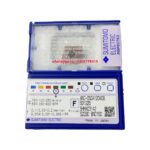
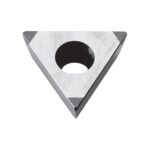
Iscar vs Sumitomo Face Milling Inserts for Cast Iron Compared: Grade Technology, Insert Geometry, and Cutting Performance
Introduction Cast iron remains one of the most challenging workpiece materials in modern manufacturing, demanding tooling solutions that balance wear resistance, toughness, and thermal stability. From gray cast iron (GCI) engine blocks to ductile iron (DI) wind turbine components, face milling operations require carbide inserts specifically engineered to handle the abrasive nature of cast iron …
Iscar vs Sandvik High-Feed Milling Inserts Compared: Chipbreaker Geometry, Coating Technology, and Cutting Parameters
High-Feed Milling: Concept and Productivity Advantages High-feed milling (HFM) has become one of the most impactful productivity strategies in modern CNC machining, particularly in die-mold, aerospace, and energy sector applications. The core principle is deceptively simple: by using a very shallow axial depth of cut (ap ≤ 2 mm) combined with a high feed per …
Walter ISO P/M/K/N/S/H Turning Insert Grades Complete Reference: Coating Systems and Cutting Parameters
Walter Turning Grade Naming Convention Explained Walter AG, headquartered in Tübingen, Germany, employs a systematic naming convention for its turning insert grades that directly encodes coating technology, ISO material group, and application range. Understanding this nomenclature is essential for selecting the correct insert for any workpiece material. The Walter grade code follows a three-letter-plus-number format: …
TaeguTec vs Korloy PCBN and Ceramic Grades for Hard Turning Compared: CBN Content, Binder Systems, and Cutting Performance
Hard turning—machining hardened steel workpieces above 45 HRC, typically in the 50–65 HRC range—has largely replaced cylindrical grinding in many production environments. The key enablers are polycrystalline cubic boron nitride (PCBN) and ceramic cutting tool materials. Among the competitive mid-to-premium tier suppliers, TaeguTec (South Korea) and Korloy (South Korea) both offer comprehensive hard-turning grade portfolios …
Stainless Steel Threading Best Practices: Insert Selection, Cutting Parameters, and Troubleshooting Guide
Why Stainless Steel Threading Is Uniquely Challenging Stainless steel threading is widely regarded as one of the most demanding operations in precision machining. Unlike carbon steels, stainless alloys—particularly austenitic grades like 304 and 316—exhibit high work-hardening rates, poor thermal conductivity, and strong tendencies to form built-up edge (BUE) on cutting edges. These characteristics directly impact …
Aerospace Aluminum Alloy High-Speed Milling Tool Selection Guide: End Mill Geometry, Coatings, and Cutting Parameters
Introduction Aluminum alloys — particularly 7075-T6, 6061-T6, and 2024-T3 — are the backbone of aerospace structural components, accounting for over 60% of the airframe weight in modern commercial aircraft. Their exceptional strength-to-weight ratio comes with a machining challenge: at high spindle speeds, the material’s high ductility and low melting point create a narrow window between …
Kyocera CA Series CVD and PR Series PVD Turning Grades Explained: Coating Architecture, Chipbreaker Technology, and Cutting Parameters
Kyocera’s turning insert portfolio is built on two distinct coating technology platforms: the CA Series for chemical vapor deposition (CVD) applications and the PR Series for physical vapor deposition (PVD) applications. Each series encompasses multiple grades engineered for specific workpiece materials, cutting conditions, and wear resistance requirements. This article provides a detailed technical breakdown of …
Sandvik GC1115 vs Iscar IC810: CVD Coated Carbide Grades for Steel Turning Compared
When it comes to continuous and lightly interrupted turning of steels, two CVD-coated carbide grades consistently appear in tooling recommendations: Sandvik Coromant GC1115 and Iscar IC810. Both grades occupy the premium tier of their respective portfolios, targeting ISO P10-P30 application ranges with emphasis on high cutting speeds, predictable wear patterns, and extended tool life in …
Sandvik GC1115 vs Iscar IC810: CVD Coated Carbide Grades for Steel Turning ComparedRead More
Walter Tiger·tec® Gold PVD Coating Technology Explained: Layer Architecture, Grade Portfolio, and Machining Performance
Introduction: The Gold Standard in PVD Coatings Since its introduction, Walter’s Tiger·tec® Gold coating family has redefined what manufacturers can expect from physical vapor deposition (PVD) coated cutting tools. Unlike conventional TiN or TiAlN coatings that deliver moderate improvements in tool life, Tiger·tec® Gold represents a multi-layer architectural breakthrough — combining a tough AlTiN base …
ISO Workpiece Material Groups and Turning Parameters Complete Reference: P, M, K, N, S, H Explained
The ISO 513 standard defines six primary workpiece material groups for metal cutting applications, designated as P, M, K, N, S, and H. Each group exhibits distinct machining characteristics that demand specific insert grades, geometries, and cutting parameters. This guide delivers comprehensive cutting data and insert recommendations for precision turning operations across all ISO material …